
By Bosphorus News Geopolitics Desk
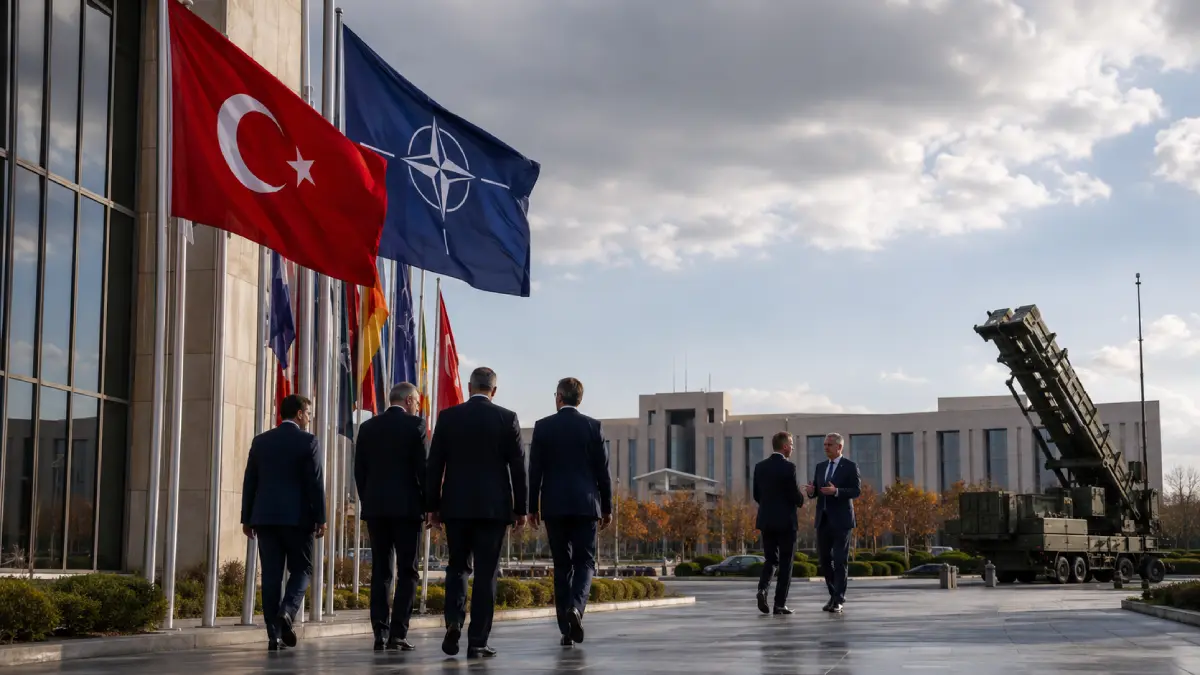
Türkiye will enter this week's NATO foreign ministers' meeting in Helsingborg with a message that links alliance unity to hard capability: the July 7-8 Ankara Summit should reaffirm NATO's "unity and integrity," while removing restrictions on transatlantic defence industry cooperation and recognising Türkiye's role in turning defence spending into operational capacity.
Foreign Minister Hakan Fidan is expected to present that line to allies during the May 21-22 meeting in Sweden, where NATO ministers will prepare the political ground for the Ankara Summit. Reuters, citing a Turkish Foreign Ministry source, reported that Fidan will brief allies on Türkiye's expectations for the summit, Türkiye's NATO contributions and Ankara's view that defence spending should be measured by the military capabilities it produces.
The same source said Fidan would underline the need to develop transatlantic defence industry cooperation within NATO "without any restrictions." That phrase is central to Ankara's message. Türkiye is not treating the summit only as a diplomatic platform. It is placing export controls, procurement barriers, industrial cooperation and operational burden sharing inside the same NATO debate.
Helsingborg Sets the Stage for Ankara
NATO's foreign ministers will meet in Helsingborg on May 21-22, with the official programme including informal events, a NATO-Ukraine Council dinner at Sofiero Castle and ministerial sessions the following day. The meeting is the immediate diplomatic step before leaders gather in Ankara in July.
NATO Secretary General Mark Rutte has framed Helsingborg as part of the preparation for Ankara. The Swedish meeting also carries symbolic weight because it is the first NATO foreign ministers' meeting hosted by Sweden since the country joined the alliance.
The Ankara Summit will be Türkiye's second NATO summit host role after Istanbul in 2004. This time, however, the political setting is more crowded. Ukraine remains central to the alliance agenda. U.S. pressure for higher European defence spending is intensifying. Iran and Middle East escalation are sharpening southern flank concerns. European allies are also being pushed to expand defence production while Washington adjusts parts of its force posture in Europe.
Germany's defence track with Türkiye had already moved the Ankara Summit calendar into a bilateral security frame. Berlin's talks with Ankara ahead of Helsingborg linked NATO preparations, defence industry cooperation and Türkiye's role before the July summit, as Bosphorus News reported.
That is the setting in which Ankara wants the summit to deliver a unity message. The question is how far that message can move beyond summit language and into military capacity, production and restrictions inside the alliance.
Ankara's Capability Case
Türkiye is building its case around concrete NATO files. The most immediate is air defence. Germany will deploy a Patriot air-defence battery and around 150 soldiers to southeastern Türkiye from late June, replacing a U.S. unit as part of NATO's air and missile defence posture. The German Defence Ministry said the Bundeswehr mission will support NATO's integrated air defence on the southeastern flank until September 2026.
German Defence Minister Boris Pistorius described the deployment as part of Berlin's wider alliance responsibility.
"Germany is taking on more responsibility within NATO," Pistorius said, according to German defence authorities.
The deployment gives the Ankara Summit a direct military backdrop. Türkiye will host NATO leaders while allied air-defence systems are operating on its territory, a reminder that the country's geography remains a working security requirement for the alliance.
Fuel logistics is another file. Türkiye has proposed a military fuel pipeline linking Türkiye, Bulgaria and Romania to strengthen NATO's eastern flank, with Anadolu Agency reporting a projected cost of around $1.2 billion. The plan would create an overland fuel route into southeastern Europe at a time when NATO is reassessing the vulnerability of its logistics networks.
Bosphorus News reported that the proposed route would connect Türkiye's logistical position to Bulgaria and Romania, turning energy movement and military mobility into part of the same eastern flank calculation.
The Turkish military's exercise calendar also supports Ankara's argument. EFES 2026 brought together more than 50 countries and over 10,000 personnel, reinforcing Türkiye's ability to host large-scale multinational training on NATO's southern flank. Turkish defence firms, including Baykar, Turkish Aerospace and ASELSAN, add the industrial layer behind that military role.
Rutte's April visit to ASELSAN had already placed Türkiye's defence industry inside NATO's broader production debate. His message in Ankara was clear: allies need more production, more innovation and more joint procurement. Türkiye's answer is that those goals cannot work properly if allied defence industry cooperation remains limited by political restrictions.
Unity Under Pressure
The unity message arrives at a time when NATO cohesion is under pressure from several directions. Washington is pressing allies to spend more. European governments are trying to expand defence output. Ukraine remains dependent on Western military support. Middle East instability is forcing southern flank allies to manage missile, drone, energy and maritime risks at the same time.
Rutte has sought to calm concerns over U.S. force adjustments in Europe, saying recent changes involved rotational forces and did not affect NATO defence plans. But the broader trend is clear. Europe is being asked to carry more of the conventional defence burden, while NATO tries to preserve U.S. commitment and expand industrial capacity.
The same unity test also reaches NATO's southeastern neighbourhood. The Ankara Summit agenda is already pulling the Western Balkans into the wider flank debate, where Montenegro's NATO role, Bosnia's oversight transition and Serbia's China-linked military procurement show how alliance cohesion is being tested beyond Ukraine and the Black Sea, as Bosphorus News reported.
That makes Türkiye's position more valuable and more contested. Ankara has one of NATO's largest militaries, a growing defence industry, access to the Black Sea under the Montreux Convention, operational relevance on the southern flank and diplomatic channels into several crisis theatres. It also carries long-standing complaints about restrictions imposed by allies on Turkish defence procurement and exports.
Türkiye's Communications Director Burhanettin Duran recently framed the issue as part of a longer alliance story.
"In our 74-year journey with NATO, we have faced many challenges and difficulties," Duran said in Washington, according to Türkiye's Directorate of Communications. "Each time, in keeping with the principle of mutual loyalty, we have managed to overcome these tests."
That official language points to the political core of Ankara's message. Türkiye wants loyalty to be measured not only by summit communiques, but by equal treatment in defence industry cooperation and recognition of the capabilities it brings to the alliance.
Ankara's Test
The Ankara Summit is therefore taking shape as more than a host-city event. Türkiye wants it to reaffirm NATO's unity, but it is also using the road to July to press a harder question: what does unity mean if restrictions remain inside allied defence industry cooperation while NATO depends on Turkish geography, Turkish logistics and Turkish military capacity?
Germany's Patriot deployment shows one side of the answer. Allied security still runs through Türkiye's territory. The fuel pipeline proposal shows another. NATO's eastern flank logistics can be strengthened through Turkish routes. EFES 2026 and Türkiye's defence industry add the operational and industrial argument.
The summit will test how much of that argument NATO is ready to accept. Ankara is offering the alliance a unity platform in July. It is also asking allies to prove that unity through capability, production and fewer political barriers around defence cooperation.