
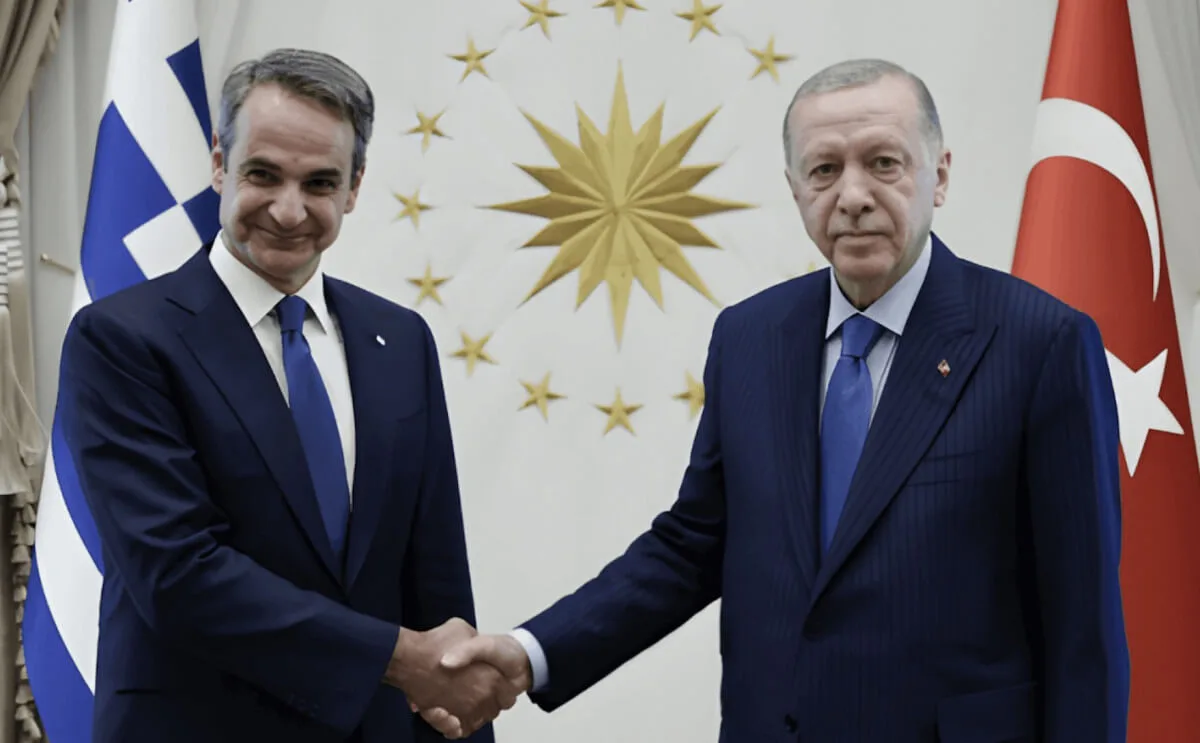
A single statement can be dismissed as an exaggeration. But when the same idea is repeated by different government officials, linked to political stability and accompanied by tougher language on Greek-Turkish relations, it takes on greater significance. That is increasingly the case in Greece, where Turkey is moving from the realm of foreign policy into the domestic political debate, with a clear pre-election dimension now emerging.
The most striking intervention came from Justice Minister Giorgos Floridis, who directly linked the prospect of political instability after the next elections to national security. He argued that, in the event of a political vacuum, "there will be a raid from the other side," clearly referring to Turkey. The wording was unusually blunt for a serving minister and prompted reactions, but the more important point was the political framework it introduced: stable government is no longer presented solely as a prerequisite for economic and institutional continuity, but also as a safeguard against an external threat.
The Prime Minister's Office sought to tone down the rhetoric. Government spokesman Pavlos Marinakis stressed that there was no indication of any immediate danger and that panic should not be encouraged. He did not, however, remove from the discussion the argument that political stability is essential in a period of geopolitical uncertainty. On the contrary, he again highlighted Kyriakos Mitsotakis' experience in crisis management, referring also to the events at Evros. At the same time, other government officials publicly raised the question of who should be leading the country if a new Greek-Turkish crisis were to emerge. Floridis' wording may have been seen as excessive, but the political logic behind it remained intact.
During the same period, Kyriakos Mitsotakis and Foreign Minister Giorgos Gerapetritis have been repeating a parallel message: Greece "threatens no one," but it will not accept threats, dictates or challenges to its sovereign rights. Speaking from Megisti, just a few kilometres from the Turkish coast, the prime minister stressed that Greek restraint should not be mistaken for weakness and that the country is ready to defend its territorial integrity and sovereign rights. Gerapetritis, for his part, says that Athens does not expect a serious incident and that communication channels with Ankara remain open, while insisting that Greece has prepared for every scenario and is ready, if necessary, to respond "in the field."
The official position is not that a confrontation is imminent. It is clear, however, that the possibility of renewed tension is being treated as real and that the government wants to make clear, both to Turkey and to the domestic audience, that it will not be caught unprepared. This rhetoric carries added weight while a number of issues remain unresolved in the Eastern Mediterranean, from maritime zones and energy exploration to subsea cables. These are areas in which even a Greek move of a technical or economic nature can trigger a strong Turkish reaction.
This is where the diplomatic and domestic political dimensions begin to converge. Internationally, Athens wants to present itself as a country that does not seek escalation, acts within the framework of international law and exercises legitimate rights. The message is that, if tensions rise, responsibility will not lie with the Greek side. Domestically, however, the same framework can serve a different political purpose: Greece is in a sensitive geopolitical position, Turkey may seek to exploit a period of weakness, and government stability is therefore becoming increasingly tied to national security.
If that link becomes entrenched, the political consequences are clear. Public debate could shift away from the cost of living, taxation, public services and the government's political wear and corruption controversies, towards a field where the central question becomes who can keep the country safe at a critical moment. In such a contest, the sitting prime minister enjoys an inherent institutional advantage: he is presented not only as a candidate for another term, but as a leader with crisis-management experience and as a guarantor of continuity in an unstable environment.
There is no evidence to support the conclusion that the Greek government is seeking a serious incident with Turkey. Such an assessment would amount to attributing intentions without proof. There are, however, indications of a more limited but politically significant development: that the government is preparing both the diplomatic and domestic political ground for the possibility of heightened tensions, while at the same time shaping the framework through which such a development would be interpreted by Greek public opinion.
Within this framework, Greece is presented as the side that "does not threaten but does not back down," Turkey as the side applying pressure, and political stability as a condition for protecting the country. If this image strengthens as the election period approaches, it could offer New Democracy a clear political advantage. Even without an actual serious incident, the perception of an external threat could reinforce the choice between "stability and uncertainty."
The key question, therefore, is not whether Athens knows that a crisis is coming, nor whether it intends to provoke one. The real test will be whether, over the coming months, the link between Turkey, national security and political stability continues to deepen, and whether Turkish reactions to Greek moves are increasingly incorporated into the domestic debate over who should govern the country.
If that happens, these will no longer be isolated statements. They will amount to a coherent pre-election narrative in which Turkey has acquired a place on the Greek ballot.
Read original here at IBNAEU.