
By Murat Yıldız
Greek defense analyst Kostas Grivas wants Athens to turn the Aegean islands into a network of missile batteries, sensors and expendable unmanned craft. His proposal, published by SLpress under the title "Archipelagic Defense," would reduce Greece's reliance on a small number of expensive warships and spread combat power across numerous connected nodes.
Grivas stops short of calling for the fleet's abolition. Yet the enabling roles of crewed ships receive far less attention than the distributed nodes themselves.
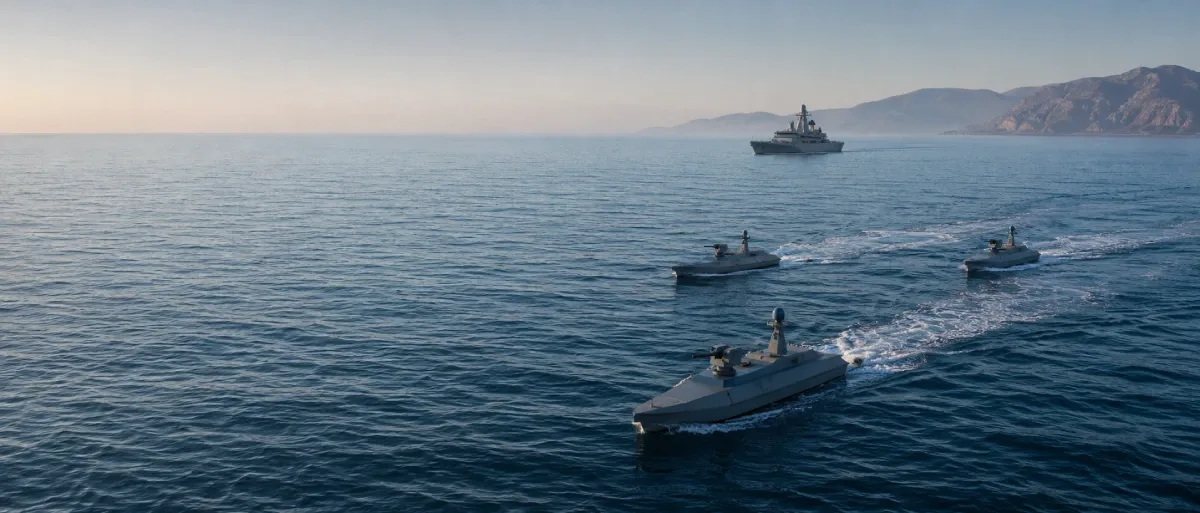
Türkiye receives little attention in the essay, although Turkish programs have already moved into the same field. The MARLIN unmanned surface vessel entered inventory in 2024, SALVO was delivered to the Turkish Navy in 2025 and SANCAR entered service in February 2026. Turkish authorities have also conducted multi-vessel swarm trials and connected unmanned systems with aircraft and naval command networks.
A Greek mosaic would therefore face Turkish platforms designed for the same distributed fight.
The Immune-System Model
Grivas compares archipelagic defense to the human immune system. The body relies on numerous cells that detect threats and coordinate a response. In his naval version, Greek islands become fortified nodes carrying mobile weapons, surveillance equipment and communications systems. Cheap vessels and drones would force an attacker to spend far more valuable missiles and time suppressing them.
A 2021 RAND Corporation study sponsored by the US Defense Advanced Research Projects Agency (DARPA) examined the same comparison. Its authors found that distributing military functions among numerous components could help a force continue operating after individual losses.
The report also warned about duplicated effort, weak control and heavy dependence on communications. A collection of platforms becomes a combat network only when data reaches the right weapon quickly enough to matter. Jamming, deception or the loss of a command link can leave individual nodes active but operationally blind.
Island forces carry their own physical burden. Mobile launchers still need ammunition, fuel and electricity. Their crews depend on ports, airfields, depots and communications sites whose locations are already known or can be found. Moving a missile battery around an island complicates targeting; it does not remove the island's need for resupply.
Turkish Swarm Trials Began in 2022
Türkiye tested a mixed formation of ASELSAN ALBATROS-S unmanned surface vessels and the MİR vessel in 2022. The vessels divided tasks among themselves, used redundant communications and allowed individual units to enter or leave the formation. An eight-vessel ALBATROS-S swarm followed later that year.
The program added an aircraft in 2023. A kamikaze-configured ALBATROS-S struck and sank a target ship during a trial coordinated with a Bayraktar TB2 unmanned aircraft.
Those trials took place under controlled conditions and provide no proof of combat performance. They do show that Turkish engineers have been working on the communications and coordination problems that determine whether a swarm remains a group of boats or becomes a usable weapon.
Three unmanned vessels have since reached the inventory or completed delivery. MARLIN entered the inventory in 2024 with surveillance, reconnaissance, electronic warfare and surface warfare capabilities. Dearsan delivered SALVO after completing acceptance tests in 2025. The Turkish Ministry of National Defense announced on February 24, 2026, that SANCAR had been taken into service.
ASELSAN unveiled another project, the TUFAN kamikaze unmanned surface vessel, at SAHA 2026. Its planned capabilities include coordinated attack formations, automated target engagement and operation under degraded communications or satellite navigation. TUFAN has yet to be confirmed as an operational system and belongs in the development column rather than the current inventory.
Türkiye does not yet have a combat-proven maritime swarm. It has several vessels in service, four years of publicly disclosed swarm work and manufacturers producing successive designs.
ADVENT Connects the Vessels to the Fleet
The Turkish program still assigns large warships a central role.
HAVELSAN developed the Network Supported Data Integrated Combat Management System (ADVENT) to connect sensors, weapons, command elements and tactical data links across naval units. Its integration aboard the amphibious assault ship TCG Anadolu was completed in February 2026.
TCG Anadolu can carry aircraft and unmanned systems while providing command facilities, communications and logistics. Smaller vessels disperse sensors and weapons around the force; the larger ship supplies functions that short-range unmanned craft cannot carry for long periods.
Türkiye's maritime buildup is proceeding on those two tracks. Frigates, submarines and large naval platforms remain in production or service as electronic warfare equipment and unmanned vessels are connected around them.
Greek Defense Minister Nikos Dendias has described a similar division of labor. He said the Aegean should no longer be defended solely by the fleet and proposed mobile missile units on the islands to release warships for other missions. His Agenda 2030 program continues to call for a powerful modern navy.
Dendias's wording leaves the fleet in place and assigns island-based systems a supporting role.
The Opposing Network Is Missing From the Essay
Grivas explains how Greek nodes could detect an attacker and raise the price of moving through the Aegean. His model gives little space to Turkish electronic warfare, submarines, aircraft, unmanned vessels and mainland-based sensors operating across the same sea.
Breaking a distributed force does not require the simultaneous destruction of every launcher or drone. An opponent can attack communications links, force mobile batteries to expose themselves and concentrate fire on the ports or depots keeping a selected sector operational.
Exercises cannot establish which network would continue functioning after ports were hit, data links disrupted and ammunition stocks began to run low.
The Aegean version of Mosaic Warfare would involve two competing systems. Each would be searching for transmitters, testing data links and trying to identify the nodes whose loss would disable the rest.
Island Weapons Cannot Perform Every Naval Mission
Missiles and unmanned craft based around the Greek islands could make narrow passages and approach routes dangerous. They could force Turkish ships to operate cautiously and consume defensive weapons.
Mine clearance, convoy escort, antisubmarine patrols and the protection of resupply routes still require sustained naval and air support, with crewed platforms retaining roles that short-range unmanned craft cannot yet absorb. An island that fires missiles must be resupplied after its ports and communications infrastructure come under attack. Small unmanned vessels with limited endurance cannot maintain control of distant waters by themselves.
Grivas offers Greece a case for distributing weapons and sensors across the archipelago. The Turkish record changes the starting date of that debate.
Turkish swarm trials began in 2022. MARLIN entered inventory in 2024, SALVO was delivered in 2025 and SANCAR entered service in 2026. Any Greek maritime mosaic will be built against that record and under observation from the opposite coast.
Sources: SLpress, RAND Corporation, Hellenic Ministry of National Defence, Turkish Ministry of National Defense, Türkiye's Presidency of Defense Industries, ASELSAN, HAVELSAN, Dearsan, Bosphorus News review and reporting.