

By Murat Yıldız
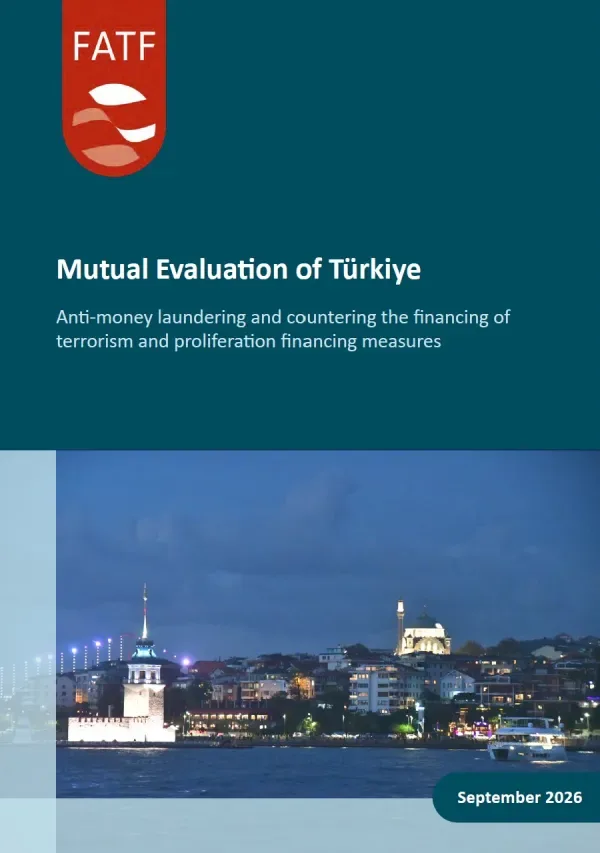
Türkiye has reached compliant or largely compliant status on 38 of the Financial Action Task Force's (FATF) 40 recommendations, while eight of 11 measures of real-world effectiveness remain rated Moderate. In its September 2026 Mutual Evaluation Report, FATF kept Türkiye in enhanced follow-up.
The enhanced follow-up status is separate from the International Co-operation Review Group process, which the report says Türkiye exited in June 2024.
The assessment reflects measures in place during FATF's November 11-28, 2025 onsite visit. In 2019, Türkiye was compliant with 11 recommendations and largely compliant with 17. Ten were partially compliant and two were non-compliant. Today, only two remain partially compliant and none are non-compliant.
The remaining concerns center on enforcement, supervision and outcomes.
MASAK stands out in the 2026 assessment
The Financial Crimes Investigation Board (MASAK), Türkiye's financial intelligence unit, has direct access to more than 300 databases containing financial, tax, property, corporate and criminal information. FATF says this access, upgraded information systems and close cooperation with prosecutors and law enforcement allow MASAK to produce financial intelligence widely used in investigations.
Financial intelligence receives a Substantial effectiveness rating, one of only three Immediate Outcomes at that level. Risk assessment and policy coordination, along with international cooperation, receive the same rating.
Türkiye also makes extensive use of mutual legal assistance (MLA), police cooperation, financial intelligence exchanges, liaison officers and joint investigations. FATF still identifies delays in some complex cases and limited follow-up when assets have moved abroad.
MASAK received about 2.74 million suspicious transaction reports (STRs) between 2020 and the November 2025 onsite visit. Banks submitted 63%, payment and electronic money institutions 26%, and virtual asset service providers (VASPs) 7%.
FATF identifies fraud, illegal betting and gambling, drug trafficking and smuggling as the main predicate crimes generating illicit proceeds in Türkiye. Türkiye's 2025 National Risk Assessment (NRA) also places fraud, illegal betting and gambling and drug trafficking among the main money-laundering risks, alongside theft and plundering.
STRs are concentrated in a narrower group of offences. Illegal betting and gambling account for 32% of reports, tax evasion 24% and fraud 13%. Reporting linked to terrorist financing (TF), drug trafficking, customs smuggling and migrant or human smuggling remains low compared with their assessed risks.
Direct TF-related STRs account for about 1% of submissions, while 76.4% of MASAK's analysis and dissemination work concerns terrorism and TF cases. FATF says many reporting entities still struggle to identify TF indicators from individual transactions.
MASAK's screening and analysis compensate for part of that reporting gap.
Banks perform better than the wider financial system
Banks represented more than 75% of Turkish financial-sector assets in 2024, and FATF says they generally have a good understanding of money-laundering and TF risks.
FATF finds weaker TF-risk awareness among parts of the non-bank financial sector and among VASPs. Exchange offices, money or value transfer services and VASPs continue to record significant numbers of supervisory breaches. Identification and monitoring of politically exposed persons are only partially effective.
The gaps are wider among designated non-financial businesses and professions (DNFBPs). Real estate agents, precious-metals dealers, accountants, lawyers and notaries are covered by the framework, but STR reporting remains very low in several of these sectors.
FATF says supervision of lawyers and notaries is scarce relative to the risks posed by some entities. It also finds weak money-laundering and TF risk awareness across parts of the DNFBP sector.
Türkiye has moved quickly on virtual assets. FATF records stronger controls at some VASPs, including blockchain analytics and compliance with the travel rule. But the regulatory framework was still being implemented during the onsite assessment, so FATF could not fully judge its effectiveness.
The report also records greater use of virtual assets in drug-trafficking typologies. Fraud and illegal betting cases involve bank transfers, VASPs, front accounts, point-of-sale transactions, front companies and asset purchases.
Serious compliance failures do not always draw serious sanctions
Customer due diligence (CDD) and STR violations can trigger fixed administrative fines for each breach. More serious institutional problems, including weak internal controls, poor risk management or the absence of an institution-wide money-laundering and TF risk assessment, may initially lead to written warnings and a period for remediation.
If an institution fixes the problem during that period, the case may never move to a punitive sanction unless separate CDD or STR breaches are also present.
FATF says serious or systemic weaknesses are therefore not always met with sanctions that match their severity. It also says the failure to publish anti-money laundering and counter-terrorist financing sanctions and remedial measures reduces their deterrent effect.
The 2026 roadmap calls for stronger enforcement against serious and systemic breaches.
Ownership records still depend too heavily on self-reporting
Türkiye has expanded the infrastructure used to identify company owners and controllers.
The Trade Registry, the Central Trade Registry System, the beneficial ownership (BO) registry and controls on bearer shares give authorities broad access to ownership information. FATF credits these measures with reducing anonymity.
BO information still relies heavily on self-reporting, and FATF says substantive checks are not systematic enough. The problem is more pronounced for higher-risk companies, foreign-created legal persons and complex cross-border structures.
FATF wants authorities to verify more than the identity of the person entered in the registry. The assessment specifically calls for checks on whether that person is the actual beneficial owner.
Complex money laundering remains difficult to prosecute
Türkiye investigates and prosecutes large numbers of money-laundering cases and has a well-resourced institutional framework.
FATF finds weaker results in cases involving professional money launderers, shell or front companies, lawyers and accountants, layered corporate structures, trade-based money laundering (TBML), cross-border currency movements and technology.
Drug trafficking and smuggling also produce fewer money-laundering prosecutions and convictions than their risk levels would suggest.
The report records 7,248 pending prosecutions. FATF calls for clearer prioritization and greater attention to complex cases involving professional laundering, legal persons and cross-border movements of goods and currency.
Türkiye has strong domestic tools for tracing criminal property and frequently postpones transactions while their legitimacy is examined. Far fewer cases progress to seizure or final confiscation, and FATF considers the amount ultimately confiscated modest relative to Türkiye's risk profile.
Recovering assets abroad is harder still. Between 2021 and 2025, Türkiye made eight requests to seize assets located abroad and opened two formal MLA confiscation processes. FATF describes the limited use of cross-border asset tracing and recovery as a major shortcoming.
Türkiye also has a cash declaration system and advanced technology at land and air border points, but FATF says seizures of undeclared or falsely declared cash and other goods remain low for a country with Türkiye's trade and transit profile.
Trade risks receive closer scrutiny
FATF says Türkiye understands its overall money-laundering and TF risks well, but its assessment of cross-border activity needs more depth.
TBML, sanctions evasion and smuggling are still treated largely as extensions of underlying crimes rather than distinct systemic risks.
FATF wants more detailed analysis of trade finance, shipping, customs activity, logistics, cargo movements and cross-border transfers of cash or value. It also points to foreign-linked laundering, professional facilitators and unlicensed money-transfer activity.
The issue carries added weight because Türkiye is a regional trade, finance and logistics hub.
Terrorist financing capacity is strong, but coverage is uneven
Türkiye requires parallel financial investigations in terrorism cases and has conducted more than 11,000 TF investigations.
FATF credits specialized investigators, integrated databases and close coordination among agencies, particularly in cases involving organizations identified in Türkiye's NRA as TF threats.
The report finds weaker results in trade-based terrorist financing, procurement networks, layered commercial structures and cases involving legal persons.
It also identifies an effectiveness gap involving organizations and networks that are not designated under United Nations Security Council resolutions or Türkiye's domestic sanctions regime but are identified through international cooperation and other international sources as relevant to Türkiye's TF exposure.
Targeted financial sanctions (TFS) present a separate timing problem.
FATF requires United Nations listings to be implemented "without delay." In Türkiye, making those listings legally enforceable takes an average of 2.5 days because they must first be transposed into domestic law.
Proliferation financing also receives a Moderate effectiveness rating. FATF credits institutional coordination but finds weaker understanding of sanctions-evasion methods involving legal persons, particularly foreign entities. Understanding of proliferation-financing sanctions outside the banking sector is generally low.
FATF's 2026 follow-up roadmap focuses on stronger non-bank supervision, more effective enforcement, verified ownership information, complex money-laundering cases, foreign asset recovery, deeper analysis of trade risks and faster implementation of TFS.
Türkiye enters enhanced follow-up with 38 of 40 recommendations rated compliant or largely compliant. The follow-up process will concentrate on whether those rules produce stronger enforcement and better outcomes in the areas FATF still rates Moderate.
Sources: FATF 2026 Mutual Evaluation Report of Türkiye, Bosphorus News review and reporting.