
By Bosphorus News Geopolitics Desk
Türkiye and the Turkish Cypriot side moved to cool expectations around a possible new United Nations Cyprus track after Greek Cypriot media accounts suggested UN envoy Maria Angela Holguin was exploring a looser settlement formula before a possible 5+1 meeting this summer.
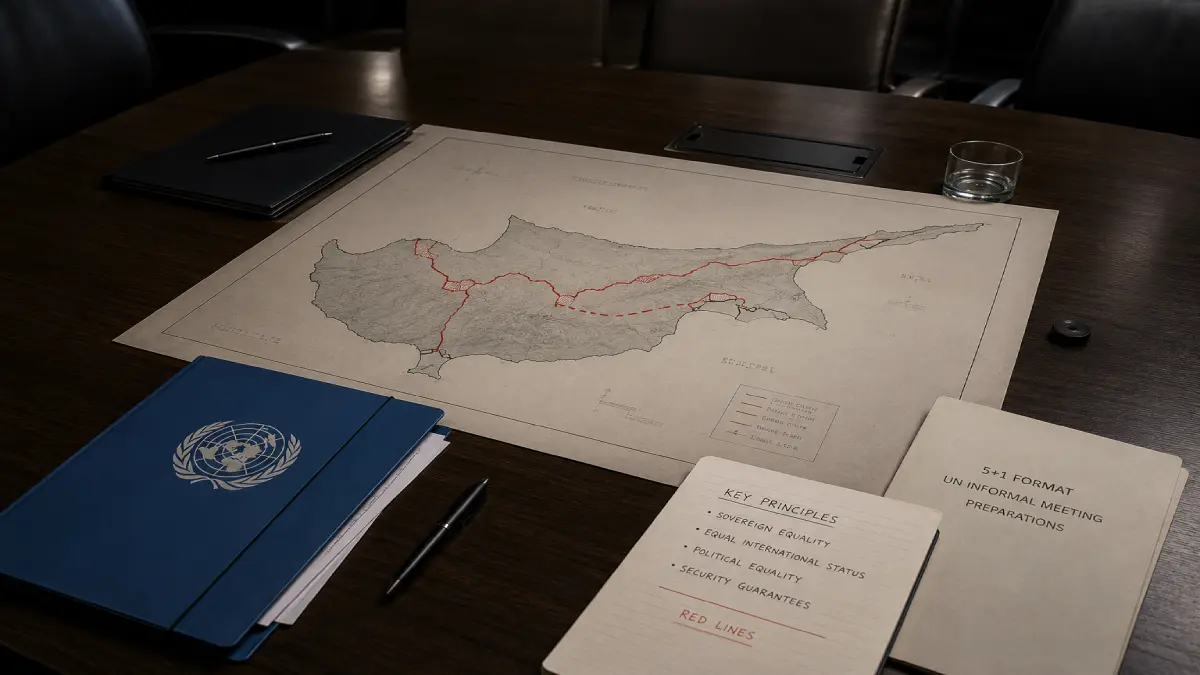
The reaction has turned an unofficial debate over settlement models into a test of the Turkish Cypriot side's baseline position: sovereign equality, equal international status, political equality and Türkiye's security guarantee role remain the conditions through which any new process will be judged.
The discussion comes as Holguin's contacts resume and the UN's July Cyprus cycle approaches, with the Security Council expected to review both the peacekeeping file and the Secretary-General's good offices mission. Bosphorus News previously reported that UN Assistant Secretary-General for Political and Peacebuilding Affairs Miroslav Jenča Diagne briefed the Council as preparations continued for possible follow-up diplomacy in the informal 5+1 format.
The ideas circulating in Greek Cypriot media have not been presented as an official UN plan. That distinction is central. Yet the political effect is already visible: Ankara and Turkish Cypriot actors across different camps are warning against a process built on vague assumptions, one-sided formulas or another open-ended round without agreed parameters.
Turkish Cypriot Prime Minister Ünal Üstel gave the clearest official response, saying the Turkish Cypriot people's state, land, sovereignty and Türkiye's effective guarantee cannot be treated as bargaining items. He rejected any arrangement that would weaken sovereign equality or equal international status, arguing that a durable settlement cannot be reached unless the Turkish Cypriot side's status is accepted from the outset.
Üstel also pushed back against any approach linking a settlement to territorial concessions. Property disputes, he said, should be handled through mechanisms such as exchange, compensation and the rights of current users rather than territorial retreat.
Ankara's line ran in parallel. Türkiye's Ministry of National Defense said the Turkish Cypriot side's security is tied directly to Türkiye's own security and reaffirmed support for a settlement based on two states, sovereign equality and equal international status.
That position builds on an earlier Bosphorus News assessment of Holguin's Ankara track, where the phrase "way forward" was already being filtered through the Turkish side's status demand. In that reading, procedural movement remains possible, but only if it does not dilute the requirement that status be addressed before the substance of talks resumes.
Turkish Cypriot President Tufan Erhürman added institutional weight to the caution, warning against reacting to every claim circulating in the Greek Cypriot press. His focus was methodological: the Turkish Cypriot side should not be pulled into speculative scenarios, but should also avoid a return to talks that lack a defined outcome or expose Turkish Cypriot equality and security to erosion.
Former Turkish Cypriot negotiator Kudret Özersay offered a separate warning. Rather than focusing only on red lines, Özersay questioned whether expectations around a new 5+1 meeting were being inflated before the ground was ready. Premature optimism, he argued, could create another cycle of disappointment if the parties enter a process without realistic prospects or clear political preparation.
The two interventions point to a broader northern Cyprus mood. The government's response is anchored in the two-state line, while Özersay's caution focuses on expectation management and Erhürman's position stresses method, equality and safeguards. Together, they suggest that the Turkish Cypriot debate is not only about the content of any future formula, but also about how a process is framed before it begins.
That line reflects a deeper structural problem Bosphorus News examined earlier this year in the exchanges between Erhürman and Greek Cypriot leader Nikos Christodoulides. Even when both sides speak positively about dialogue, technical measures or confidence-building, the process repeatedly returns to the same core disagreement: whether Cyprus talks can resume before the Turkish Cypriot side's status demand is addressed.
The July UN track gives the debate greater weight. Security Council discussions are expected to place Holguin's shuttle diplomacy inside a wider review of whether there is enough common ground for another informal round.
That does not mean a settlement framework is ready. It does mean the political space around Cyprus is moving again, and that each side is trying to shape the starting assumptions before any new meeting is formally locked in.
The Turkish and Turkish Cypriot response suggests that the next phase will not be judged only by whether the UN can convene the parties. It will also be judged by whether the format recognizes the limits Ankara and the Turkish Cypriot side say have defined every failed round since Crans-Montana: status, security and political equality cannot be postponed to the end of the process.
For now, the loose-model discussion has done less to open a negotiation than to expose the boundaries around one. Before any 5+1 track can gain momentum, the first contest is already over the terms on which the table would be set.
Sources: Turkish Cypriot Prime Ministry, Turkish Ministry of National Defense, Cyprus Mail, Politis, Kıbrıs Postası, OmegaLive, SigmaLive, Phileleftheros, Bosphorus News review and reporting.