
By Murat Yıldız
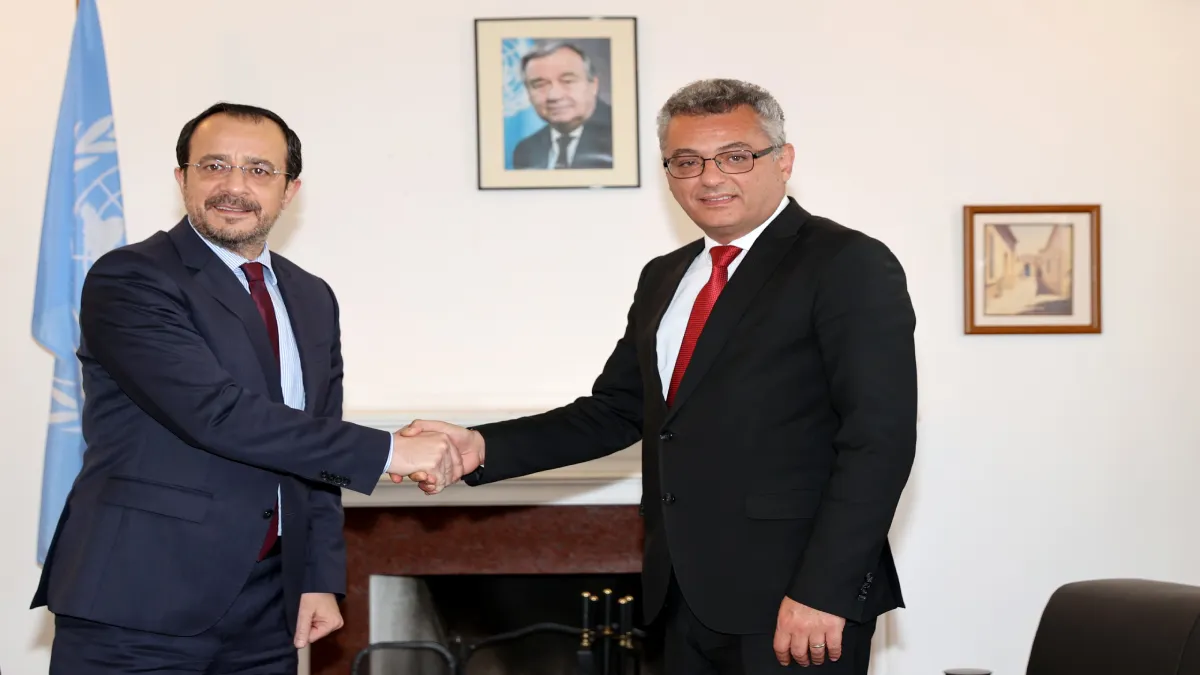
Turkish Cypriot President Tufan Erhürman and Greek Cypriot leader Nikos Christodoulides met for nearly two hours in the UN buffer zone in Nicosia on May 8, reaching four practical understandings on civil society participation, religious access, animal health coordination and halloumi-related trade issues.
The meeting, held at the residence of UN Special Representative Khassim Diagne at the old Nicosia airport, was described by the United Nations as positive and productive. Yet the substance of what followed showed how quickly even a positive meeting is pulled back into the old dispute over method, status and political equality.
The four understandings matter because they touch daily life and technical cooperation across the divide, but they do not reopen the settlement track or settle the argument over what should come next.
Erhürman called the meeting "useful, productive and positive," but his message after the talks focused on the order of the next steps, with the Turkish Cypriot leader making clear that Cyprus cannot be carried straight into another international format before the two sides show that they can produce visible results on the island.
"Our approach is what could be called a step-by-step approach," he said. "First, let us solve the issues we can solve in Nicosia."
The point goes to the heart of the dispute exposed by the meeting, because Christodoulides is looking toward a wider diplomatic format while Erhürman is asking what that format would rest on if the two sides still cannot move on practical issues in Cyprus itself.
Christodoulides placed the meeting inside a wider diplomatic timetable, pointing to the possibility of an expanded conference in the summer and linking the renewed activity to UN Secretary-General António Guterres' increased engagement with the Cyprus file after his contacts with Turkish President Recep Tayyip Erdoğan.
That matters because Christodoulides is trying to move Cyprus diplomacy back toward an expanded format involving the two sides, Türkiye, Greece, the United Kingdom and the United Nations, while keeping the European Union as a wider institutional frame around the process.
The Greek Cypriot leadership has long sought to widen the Cyprus file beyond the island itself through international and European platforms, a tendency that became more pronounced after the Republic of Cyprus joined the European Union in 2004. In the current setting, that approach gives Christodoulides an institutional route that Erhürman does not possess, since the Turkish Cypriot side remains outside the same EU framework even while Turkish Cypriots remain EU citizens in law.
The timing also matters inside the Greek Cypriot political scene. Parliamentary elections in the Republic of Cyprus are scheduled for May 24, 2026, less than three weeks after the leaders' meeting, with Reuters reporting a record 753 candidates competing for 56 seats in a race that could produce a more fragmented parliament and weaken the centrist parties supporting Christodoulides.
The vote comes after months of domestic pressure over corruption and influence-peddling allegations linked to a leaked video that forced the resignation of Christodoulides' chief of staff, Charalambos Charalambous. Christodoulides denies wrongdoing and his government has framed the video as a possible disinformation operation, while opposition parties have used the affair to sharpen their demands for accountability.
That domestic backdrop sits inside a wider debate over institutional credibility in the Republic of Cyprus. The leaked-video scandal, the renewed debate over the "mafia state" report and the Anastasiades-era corruption probe have made governance a more sensitive theme before the vote, a context Bosphorus News examined in its report on Cyprus' deepening governance crisis.
A wider conference may create visibility, bring Türkiye, Greece, Britain and the UN into the same diplomatic frame, and give the appearance of renewed movement, yet it does not by itself answer the harder questions of status, equality and political partnership that have left Cyprus diplomacy trapped in the same dispute for decades.
Erhürman's caution comes from that gap. He has not closed the door to a broader UN initiative and has acknowledged the expectation that Guterres may take a new step in July, while arguing that another diplomatic format should not be launched before confidence has been built on the island itself.
The crossings file is the clearest test of that approach, with Erhürman saying the sides had still not reached the desired point on opening new crossing points and describing the issue as one that had gained "symbolic value," a phrase that matters because movement across the island is tied to recognition, daily contact, trade and the psychology of partition.
Delays on crossings weaken the claim that a broader diplomatic framework can be built on real confidence, because in Cyprus the ability of people to move, trade, worship, visit relatives and cross from one side of the island to the other remains one of the most visible measures of whether statements after leaders' meetings can change daily conditions.
The four understandings announced after the meeting should be judged on implementation, because their real value will come from whether they show that the two sides can still produce limited but real cooperation under UN facilitation.
A civil society advisory mechanism would test whether the process can move beyond leader-level diplomacy and bring organised voices from both communities into the discussion, while a six-month schedule for religious services would try to prevent every visit to a mosque, church or monastery from becoming a fresh political dispute.
Coordination on foot-and-mouth disease belongs to the same category, because it is not a constitutional issue but still tests whether island-wide technical cooperation can work when a practical problem crosses the dividing line and forces the two sides to manage a shared risk rather than retreat into separate administrative reflexes.
The planned subcommittee under the Technical Committee on Economy and Trade carries a sharper political edge, because halloumi is tied to the European Union's Protected Designation of Origin, or PDO, regime, which protects products linked to a specific geography and production method. For Turkish Cypriot producers, the issue is not only commercial; it concerns access to regulated EU markets through the Green Line framework, turning what may look like a technical trade file into a question of economic belonging.
The civil society mechanism also opens another neglected layer of the Cyprus problem, because the island's lived reality has long been more complex than the formal political categories used by diplomats, institutions and negotiating teams.
Erhürman has recently pushed the issue of children born from mixed marriages into the international human rights arena, pointing on May 5 to the May 1 findings of the UN Committee on the Elimination of Racial Discrimination, which raised concern over obstacles faced by Turkish Cypriots born from mixed marriages in acquiring citizenship.
That issue belongs inside the Cyprus talks because it touches citizenship, documentation, freedom of movement, access to services and education, while also showing how the conflict reaches into private life far beyond the language of conferences, leaders' meetings and technical committees.
Mixed families and children caught between legal systems show how citizenship, documentation and movement can become daily extensions of the status dispute. Their position also shows why civil society cannot be kept at the margins if the aim is to bring into the talks those who experience Cyprus as a daily question of identity, mobility and legal belonging.
That personal and legal uncertainty leads into the wider European paradox of Cyprus. Turkish Cypriots are EU citizens by law, while the EU acquis remains suspended in the north under Protocol 10, a suspension presented as temporary but now embedded in the island's administrative reality more than two decades after the Republic of Cyprus entered the European Union.
This is where the phrase Invisible Europeans becomes more than a label: Turkish Cypriots are citizens in law, but structurally absent from the Union's institutional order.
The leaders' format carries the same contradiction. Christodoulides enters the process as president of the internationally recognised Republic of Cyprus, leader of the Greek Cypriot community and, in the first half of 2026, the head of a state holding the European Union's rotating Council presidency. Erhürman approaches the same format as a meeting between two leaders on the island.
This difference cannot be reduced to protocol, because the Greek Cypriot side can turn international recognition into institutional continuity while the Turkish Cypriot side enters the same room with political equality recognised in UN language, but without equivalent international standing.
This is why even technical discussions on crossings, halloumi or religious access cannot remain technical for long, since each item is shadowed by the question of whether Turkish Cypriots are being approached as a constituent political partner or as a community to be administered inside a recognised state framework.
The island's division is sustained not only by territory, but by an institutional design in which one side acts internationally as the state while the other is asked to negotiate equality without comparable standing.
Method becomes central in that context. A broad international conference can raise the diplomatic level of the file without removing the asymmetry beneath it. Erhürman's step-by-step approach has the advantage of testing cooperation where people actually live, but it also needs a political horizon; otherwise, practical progress can be absorbed into the existing order without changing the status problem at the heart of the file.
The regional environment now makes the Cyprus file harder to isolate, as the island is increasingly pulled into a more crowded Eastern Mediterranean security environment shaped by Türkiye, Greece, Israel, France, the United States, the European Union and the United Nations.
Türkiye has already warned that the Greece-Cyprus-Israel defence axis could deepen regional instability while the Greek Cypriot administration has continued to position the island as a more active diplomatic and security node.
That wider setting does not replace the internal Cyprus track, but it raises the cost of leaving it unresolved, because a frozen negotiation file can survive for years in diplomatic language while the island itself is pulled into regional calculations that move faster than the settlement process.
The May 8 meeting leaves one immediate test before the next UN move: whether the two sides can deliver visible progress on crossings, religious access, halloumi, mixed-marriage rights and technical coordination in a way that gives any summer conference more than diplomatic staging.
If that progress does not materialise, any summer conference will enter the room with the same weakness that has followed every failed attempt before it. The island will still lack practical confidence, and the Turkish Cypriot side will still be asked to negotiate equality inside a framework that does not give it equal institutional standing. That is not a procedural flaw. It is the political contradiction Cyprus diplomacy keeps carrying from one format to the next.