
Türkiye is placing Bulgaria at the European end of a transport and energy network that stretches toward China, Iraq, the Gulf and the Caspian region, as Sofia looks to European Union funding for infrastructure needed to handle the additional traffic.
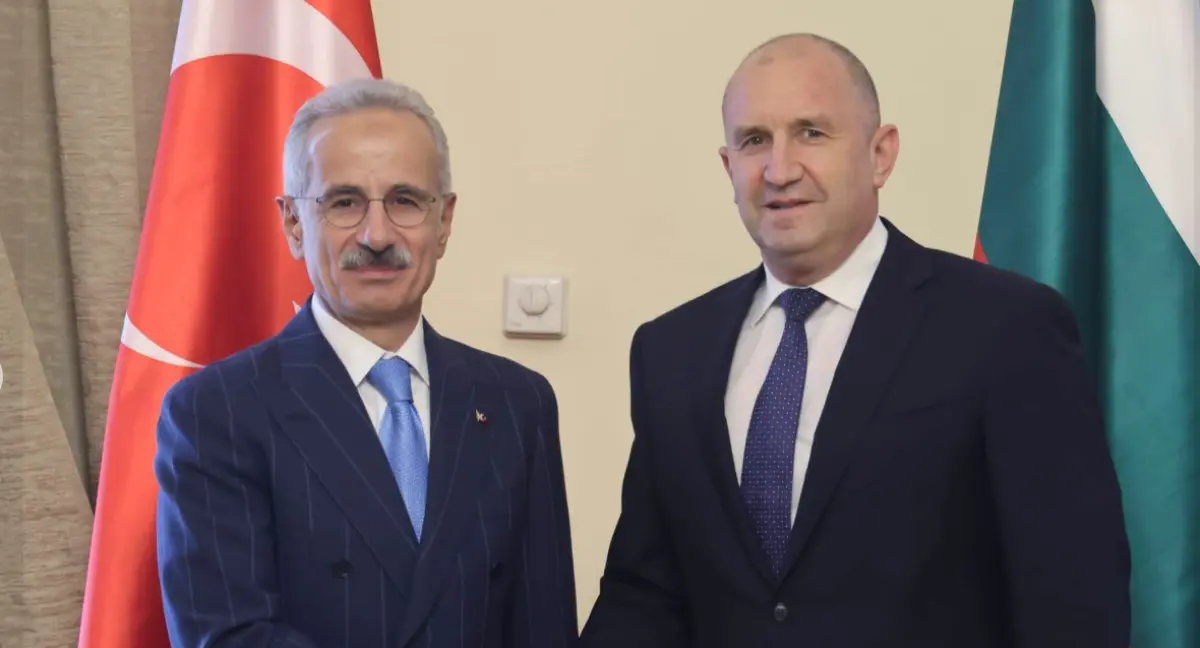
An analysis published on August 21 by EUalive, a media partner of Bosphorus News, examines the surge in Turkish-Bulgarian contacts since Rumen Radev became Bulgaria's prime minister in May. EUalive counted at least 10 meetings and rounds of talks between officials from the two countries between May 22 and August 13, covering railways, roads, border crossings, natural gas, electricity, Black Sea exploration, logistics, migration and security.
The central argument developed by author Emilia Milcheva is an imbalance in what the two sides bring to the relationship. Türkiye has freight and energy routes converging on its territory and wants to move them onward into the European market. Bulgaria offers the nearest EU gateway for several of those routes, but must expand its own infrastructure and find the money to do it.
Three routes Ankara wants to carry into Europe
Turkish Transport and Infrastructure Minister Abdulkadir Uraloğlu has set out an unusually clear view of Bulgaria's place in Ankara's plans.
Türkiye wants freight moving along the Middle Corridor from the Far East, Iraq's Development Road and a future railway connection from Saudi Arabia to continue into Europe instead of stopping at the Turkish border. Uraloğlu identified Bulgaria as Türkiye's most important partner for that European connection.
Making that possible would require a second railway link between Türkiye and Bulgaria and more double-track capacity on the existing Plovdiv-Svilengrad-Turkish border route. The objective is to increase capacity on one of the main land connections between Asia and the European Union.
For Bulgaria, the numbers are substantial.
The Bulgarian Ministry of Transport and Communications told EUalive that two railway projects intended to expand capacity toward Türkiye would cost about €877 million.
A new 71-kilometer railway from Yambol through Elhovo and Lesovo to the Turkish border is estimated at €547.1 million. Doubling the remaining single-track sections of the existing line toward Türkiye would require another €330 million.
Neither project has full financing.
Sofia plans to seek support under the European Union's next Multiannual Financial Framework for 2028-2034. For now, the only concrete application being prepared for European financing is a separate €40 million project covering the Lyubimets-Svilengrad-Greek border section. Bulgaria plans to submit that project jointly with Romania and Greece, with EU co-financing potentially reaching 85 percent.
A second railway crossing remains unfunded
The planned Lesovo connection would restore and modernize the existing 39-kilometer Yambol-Elhovo railway and add 32 kilometers of new track to the Turkish border.
The preferred design is a single-track electrified railway allowing passenger trains to travel at up to 160 kilometers per hour and freight trains at up to 120 kilometers per hour. Three stations and six stops are planned, including a new border station at Lesovo.
On the Bulgarian side, the National Railway Infrastructure Company (NRIC) would build the route to Lesovo. Turkish State Railways (TCDD) would construct the continuation from the border toward Edirne.
The planning is considerably further advanced than the financing. The pre-investment study has been completed and its results were handed to TCDD in September 2025, but there is still no settled financing arrangement for the new cross-border railway.
EUalive also notes a qualification in Bulgaria's own assessment. The project passes the economic justification test, but projected traffic remains low relative to the investment required.
Nor did the August 13 ministerial meeting produce a new agreement. Bulgaria's Transport Ministry told EUalive that no document was signed and no new commitment was made. The Yambol-Elhovo-Lesovo route itself dates back to a memorandum signed in 2023.
The Botaş contract hangs over the relationship
Railways are only one side of the story.
The most difficult element in Turkish-Bulgarian energy relations remains the 13-year agreement signed in 2023 between Bulgaria's Bulgargaz and Türkiye's state-owned Botaş.
The arrangement gives Bulgaria access to Turkish liquefied natural gas terminals and the Turkish transmission network, but requires payment for reserved capacity even when that capacity is not fully used.
According to EUalive, unpaid liabilities associated with the agreement have exceeded $360 million. The contract is being renegotiated, although the terms of those negotiations have not been made clear.
The agreement has acquired new relevance as the two governments discuss expanding their energy cooperation rather than treating the Botaş contract as an isolated dispute.
Journalist and Türkiye analyst Mehmed Yumer told EUalive that Ankara's advantage rests on infrastructure. Türkiye has become an entry point for gas moving toward Balkan markets, while countries seeking alternatives to Russian supplies still need access to Turkish pipelines and liquefied natural gas terminals.
His assessment places energy alongside defense industry ties, investment and diplomacy as instruments of Turkish influence in the Balkans. Control over the infrastructure carrying goods and energy between Asia and Europe gives Ankara leverage that does not depend solely on bilateral political relations.
Caspian electricity could cross Türkiye and Bulgaria
Electricity is moving onto the same map.
Bulgaria, Türkiye, Azerbaijan and Georgia are preparing a roadmap for a Green Energy Corridor intended to transport electricity from the Caspian region through Türkiye and onward to European consumers.
Ankara has compared the proposal to an electricity version of the Trans-Anatolian Natural Gas Pipeline (TANAP), with power entering the Turkish system before continuing toward Europe.
Türkiye and Bulgaria already have two 400-kilovolt electricity interconnections. Two additional lines are planned, although EUalive found no indication that construction has begun and no published cost or financing package for the expansion.
Gas infrastructure remains part of the discussions as well. The two governments want more efficient use of existing capacity at Strandzha-Malkoclar, the main gas connection between their systems.
Türkiye is also entering Bulgaria's offshore energy sector directly. Turkish Petroleum Corporation (TPAO) has acquired a 33 percent interest in exploration rights in Bulgaria's Khan Tervel block in the Black Sea, joining Shell and OMV.
Bulgaria becomes the EU entrance
Milcheva's analysis does not treat the rail, gas, electricity and Black Sea projects as separate files.
The common feature is geography.
Türkiye is trying to carry routes already reaching its territory farther west. Chinese freight can arrive through the Middle Corridor. Iraq's Development Road is designed to connect the Gulf with Türkiye. Ankara is discussing a future Saudi railway connection. Gas can enter through Turkish pipelines and liquefied natural gas terminals. Caspian electricity could follow another Turkish route toward the EU.
Bulgaria sits where several of those plans can cross into the European Union.
The difficulty for Sofia is that being the gateway requires physical capacity. Railways must be restored, doubled or built from scratch. Border facilities need expansion. Electricity links require investment. Several projects are waiting for financing that Bulgaria hopes to obtain from Brussels after 2028.
EUalive's assessment is deliberately sharp: Ankara is defining routes toward Europe while Sofia is being asked to provide much of the European-side infrastructure.
There is an economic opportunity for Bulgaria in increased freight, transit and energy connectivity. But the €877 million rail requirement and the unresolved Botaş liabilities show why the emerging partnership cannot be measured by the number of ministerial meetings alone.
The next stage will depend less on declarations of connectivity than on whether Bulgaria can finance the infrastructure, whether projected rail traffic justifies the cost and whether Sofia can renegotiate the gas arrangements without replacing one form of energy dependence with another.
Full analysis: Read Emilia Milcheva's original analysis on EUalive
Sources: EUalive, Bosphorus News review and reporting.