
By Bosphorus News Defense Desk
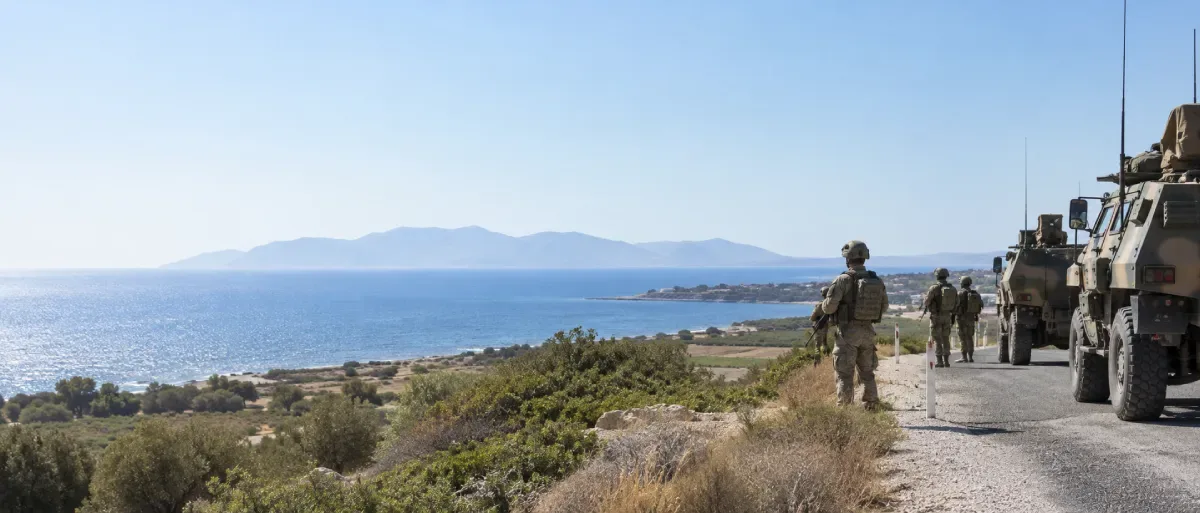
Türkiye approved the relocation of its 51st Commando Brigade from Hozat in eastern Tunceli province to Söke on the Aegean coast in June, nearly three months before Greek Prime Minister Kyriakos Mitsotakis visited Kastellorizo and nearby islets, according to the Turkish Ministry of National Defence.
Parts of the Turkish and Greek media later presented the move as a response to Mitsotakis' September visit. The ministry's timeline does not support that reading.
The ministry addressed the deployment on Sept. 17 after its weekly briefing. It said changes to military organization and basing were made according to the Turkish Armed Forces' "mission and operational needs" and confirmed that the 51st Commando Brigade's change of station had been approved in June.
Mitsotakis arrived in Kastellorizo, known as Meis in Turkish, on Sept. 11. He visited Kastellorizo, Ro and Strongyli on Sept. 12, including military observation posts on the two islets, and attended ceremonies marking Kastellorizo's liberation anniversary on Sept. 13.
By then, the brigade was already in Söke.
An official Hozat district record identified Brig. Gen. Yaşar Karaoğlu as commander of the Hozat-based 51st Commando Brigade on March 18. On Aug. 30, Söke Municipality recorded Karaoğlu taking part in Victory Day ceremonies as Söke garrison commander.
Turkish media reports put the brigade's strength in Söke at around 2,004 professional commandos. The Ministry of National Defence has not published an official personnel figure for the relocated formation.
A chronology that does not hold
Yeni Şafak on Sept. 16 described the move in its headline as a Turkish Armed Forces "response" to Mitsotakis' island visit and said it followed what the newspaper called his provocative trip.
TV100 wrote the next morning that a "noteworthy step" had followed the visit. Halk TV paired the relocation with Mitsotakis' island tour and Greece's defense cooperation with Israel before reporting the ministry's June approval date the following day.
Greek coverage picked up a similar reading.
Ta Nea wrote on Sept. 16 that Türkiye was "raising the bar of tension" by moving the brigade opposite Samos and treated the relocation as more than an internal administrative change. eReportaz described it the next day as a new Turkish military move raising tensions in the Aegean.
CNN Greece was more careful. It reported that analysts in Türkiye were linking the redeployment to Mitsotakis' Kastellorizo visit and Greek-Israeli defense cooperation rather than presenting that link as established fact.
Other Greek outlets challenged the chronology. Paraskhnio noted on Sept. 16 that reports of the brigade's presence in Söke predated Mitsotakis' visit. Proto Thema returned to the issue on Sept. 17 and reported that the decision had been taken months earlier.
The available dates leave no evidence that Mitsotakis' September visit triggered the relocation.
Why Söke?
The June decision leaves the reason for the move unanswered.
The 51st Commando Brigade had been based in Hozat, in a region where Turkish forces conducted operations against the Kurdistan Workers' Party (PKK), which is designated as a terrorist organization by Türkiye, the United States and the European Union. Its new base is in western Türkiye, close to the Aegean coast and opposite Samos.
Retired Col. İbrahim Keleş offered one explanation in an interview with TGRT Haber. He argued that commando formations had been concentrated in eastern Türkiye because of the PKK threat, linked the Söke transfer to a changing threat assessment under the government's "Terror-Free Türkiye" process and pointed to the brigade's new position opposite Samos as relevant to Türkiye's Aegean defense requirements.
The Ministry of National Defence has not publicly connected the relocation to the PKK process. Its explanation stops at "mission and operational needs." Bosphorus News found no public ministry document stating that a change in the PKK threat assessment directly led to the Söke transfer.
PKK figures continue to attach conditions to the disarmament process.
Kurdistan Communities Union (KCK) Executive Council co-chair Cemil Bayık said on Sept. 18 that weapons would not be surrendered and members would not return to Türkiye unless imprisoned PKK founder Abdullah Öcalan was free.
The statement followed earlier demands from Bayık, Murat Karayılan and Evindar Ararat tying further stages of the process to Öcalan's status or physical freedom. Those demands sit alongside a legal mechanism that does not make Öcalan's physical freedom a prerequisite for the next phase of disarmament.
One possibility is that the military began shifting forces west before the political process was settled. Keleş has argued publicly for that interpretation. Ankara has not confirmed it.
Denizkurdu-I
The Söke deployment is drawing attention as Türkiye begins Denizkurdu-I/2026, which runs from Sept. 20 to 25 across the Black Sea, Marmara Sea, Aegean Sea and Eastern Mediterranean.
The Ministry of National Defence said naval units will form the core of the exercise, joined by elements of the land forces, air force and coast guard. Activities include operational readiness training, live-weapons training and a Distinguished Observer Day.
The ministry's Sept. 17 briefing initially listed Sept. 20-24 for the surface warfare exercise and placed the Distinguished Observer Day aboard TCG Anadolu in the Eastern Mediterranean on Sept. 24. A separate ministry notice issued on Sept. 18 set the full Denizkurdu-I/2026 schedule at Sept. 20-25, with the broader exercise program covering 100 ships, 50 aircraft and around 14,000 personnel.
There is no official evidence linking Denizkurdu-I to the June decision on the 51st Commando Brigade. It does, however, put the brigade's new Aegean location into a period of intense Turkish military activity across the surrounding seas.
Ankara approved the relocation in June and Karaoğlu was already serving as Söke garrison commander by Aug. 30, before Mitsotakis reached Kastellorizo in September. The Ministry of National Defence has not disclosed the threat assessment behind the decision to move the formation from Hozat to the Aegean coast.
Sources: Türkiye's Ministry of National Defence, Office of the Greek Prime Minister, Hozat District Governor's Office, Söke Municipality, TGRT Haber, Yeni Şafak, TV100, Halk TV, Ta Nea, CNN Greece, eReportaz, Paraskhnio, Proto Thema, Bosphorus News review and reporting.