
By Bosphorus News Energy Desk
Somali President Hassan Sheikh Mohamud defended Mogadishu's hydrocarbon cooperation with Türkiye, saying Ankara received only three of Somalia's 12 oil and gas blocks while rejecting criticism of Türkiye's role in the country's natural resources sector.
Mohamud made the remarks in an interview with Somalia-based Dawan TV, where he framed Türkiye as one of the few partners ready to support Somalia with investment, security cooperation and operational capacity at a time when the country is trying to turn offshore energy potential into a working development track.
"Who else do we have other than Türkiye?" Mohamud said, arguing that larger international companies had not shown the same readiness to commit capital and operational support to Somalia's energy sector.
Dawan reported that Mohamud said 12 blocks had been allocated during his administrations, with three going to Türkiye and the remaining nine to Western companies. He also said one company that received seven blocks later returned them because it lacked the financial capacity to invest.
The comments give a sharper political frame to a Türkiye-Somalia energy track that has already moved from diplomatic agreements into offshore survey and drilling activity.
Türkiye and Somalia signed an intergovernmental hydrocarbon cooperation agreement in March 2024 covering exploration, evaluation, development and production in Somalia's land and maritime blocks. In July 2024, Turkish Petroleum and Somalia signed production-sharing agreements for three offshore blocks.
Türkiye's Energy and Natural Resources Ministry said the Oruç Reis seismic research vessel completed a seven-month three-dimensional (3D) seismic campaign across the three Somali offshore blocks, collecting about 4,500 square kilometers of data before interpretation and drilling.
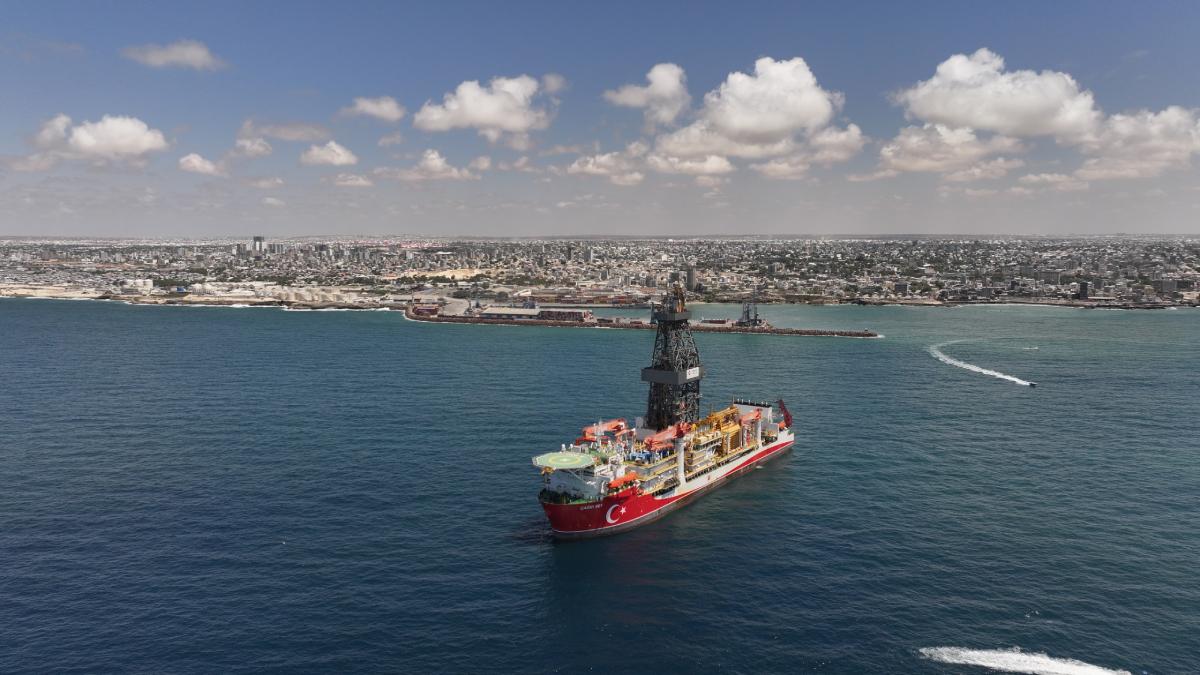
The campaign is now moving toward the Curad-1 deep-sea drilling campaign, where Türkiye's deepwater drilling vessel Çağrı Bey is expected to operate about 370 kilometers off Mogadishu. The ministry said the well is planned at about 3,500 meters of water depth, with a total drilling target of about 7,500 meters.
Energy Minister Alparslan Bayraktar has described the Somalia mission as Türkiye's first deep-sea exploration drilling operation abroad, placing the project inside Ankara's wider effort to expand its energy search beyond the Black Sea and the Eastern Mediterranean.
The energy file also sits alongside a wider Türkiye-Somalia security track. Ankara has built its role around training, naval cooperation and maritime security and offshore energy protection, giving the hydrocarbon program a strategic layer beyond exploration rights alone.
Mohamud's remarks also answer a domestic debate over whether Somalia is handing strategic resources to outside partners before its institutions and regulatory structures are strong enough to manage future production.
The Somali government has defended the Türkiye track as a way to bring exploration capacity, maritime security cooperation and long-term investment into a sector that has remained largely undeveloped despite the country's offshore potential.
Reuters reported in 2024 that two of the three Turkish exploration areas lie about 50 kilometers off Somalia's coast, while the third is about 100 kilometers offshore. The agreements give Turkish Petroleum exploration and production rights should commercially viable resources be found.
Mohamud's remarks do not amount to a new block award. They show that Somalia's presidency is prepared to publicly defend Türkiye's role and keep deeper energy cooperation on the table as the Curad-1 campaign moves into its next phase.
*** Sources: Dawan Africa, Türkiye Energy and Natural Resources Ministry, Somali National News Agency, Reuters.