
By Bosphorus News Energy Desk
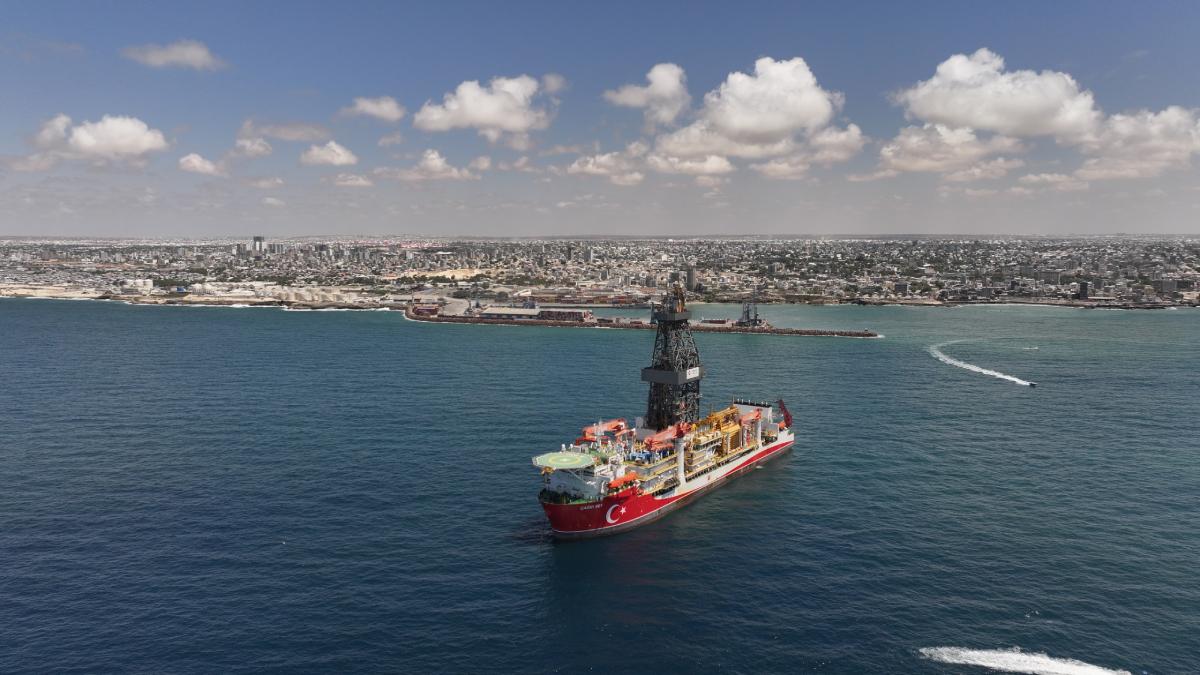
Türkiye's deep-sea drillship Çağrı Bey arrived at Mogadishu Port on April 9 and has since moved to its designated drilling location off the Somali coast, marking the start of Ankara's first overseas deepwater exploration campaign. Energy and Natural Resources Minister Alparslan Bayraktar attended a welcoming ceremony alongside Somali President Hassan Sheikh Mahmoud, describing the mission as a new chapter in the energy history of both countries.
"We are opening a brand-new chapter in the energy history of both Türkiye and Somalia," Bayraktar said at the ceremony. "We say Bismillah for our first overseas deep-sea drilling operation that goes beyond our borders."
The drillship, a seventh-generation vessel and the first of its kind in Türkiye's fleet, is targeting the well designated Curad-1, located 372 kilometres off the Somali coastline. Operations are planned to continue for 288 days at a drilling depth of up to 7,500 metres. Three Turkish naval vessels are providing security escort throughout the mission: TCG Sancaktar, a Bayraktar-class tank landing ship; TCG Gökova, an Oliver Hazard Perry-class frigate; and TCG Bafra, a Burak-class corvette.
The Curad-1 site was selected on the basis of data gathered by the seismic research vessel Oruç Reis, which conducted three-dimensional surveys across three offshore blocks in Somali waters in late 2024. Each block covers approximately 5,000 square kilometres and is licensed to the state-owned Turkish Petroleum Corporation, known as TPAO. Bayraktar confirmed that onshore drilling is also planned, though significant infrastructure work remains before land-based operations can begin.
Çağrı Bey departed Mersin's Taşucu port on February 15 in a ceremony attended by Bayraktar and Somali officials. The vessel took the Atlantic route via the western coast of Africa rather than the Suez Canal, a decision reflecting security calculations in the Red Sea corridor. The 53-day transit ended with the April 9 arrival at Mogadishu.
Somalia is estimated to hold at least 30 billion barrels of oil reserves and approximately six billion cubic metres of natural gas, placing it behind only Libya and Nigeria among African nations by potential reserve size. Decades of conflict and institutional collapse prevented any major exploration before Türkiye's entry. The March 2024 agreement between Ankara and Mogadishu granted TPAO exclusive exploration and production rights, structured so that Türkiye can recover up to 90 percent of operational costs from produced hydrocarbons before profit-sharing begins, a provision that has drawn criticism from energy analysts and Somali civil society groups who question its terms.
Türkiye's engagement in Somalia extends well beyond energy. Ankara has invested more than one billion dollars in humanitarian aid since 2011, operates its largest overseas military base at Camp TURKSOM in Mogadishu, and has trained thousands of Somali soldiers. Turkish firms manage both the city's main airport and seaport. A ten-year maritime security agreement signed in February 2024 established a joint naval patrol framework for Somali waters, providing the legal and operational basis for the current escort mission.
The Curad-1 campaign adds an energy dimension to a relationship that has long combined diplomacy, military cooperation and infrastructure investment. Bosphorus News has previously examined Türkiye's broader energy positioning across the Black Sea, Somalia and Akkuyu and the strategic framework behind the Çağrı Bey deployment.