
By Bosphorus News Geopolitics Desk
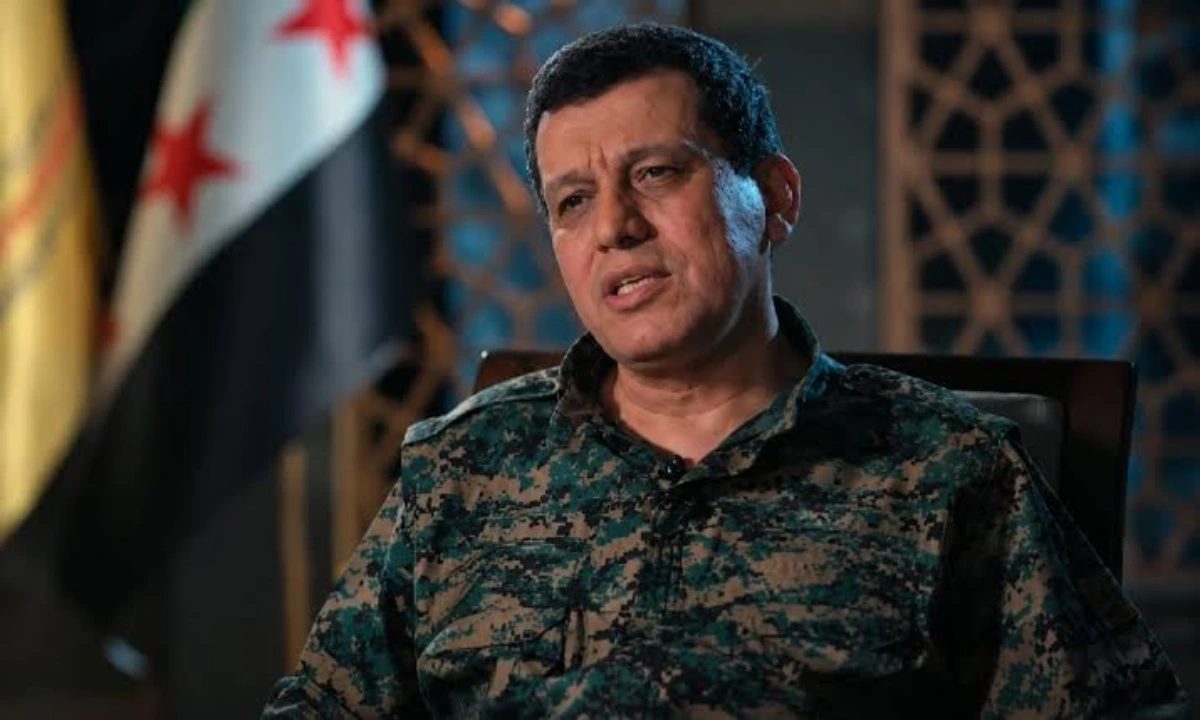
Mazloum Abdi said in Qamishli on August 20 that the integration of the Syrian Democratic Forces' (SDF) military, security and administrative institutions into Syrian state structures was "complete and finished." He said a new phase would now begin, focused on securing Kurdish rights in Syria's constitution.
He did not formally announce the dissolution of the SDF. Nor did he announce the end of the autonomous administration. Four days earlier, both had been presented as only days away.
Four Days Earlier, the Word Was Dissolution
Mahmut Berhudan, whom Türkiye Gazetesi identified as the SDF's official in Kobani, said on August 16 that the YPG and SDF would announce their dissolution "within the next few days" and that the autonomous administration structure would end. He put the integration talks at 99 percent complete and said about 10,000 fighters had already entered the Syrian army.
Nationalist Movement Party (MHP) Deputy Chairman Feti Yıldız picked up the claim on X the same day. He did not name its source. Instead, he placed it directly beside Article 1 of Türkiye's new Law on Strengthening National Solidarity and Social Integration.
The article requires security institutions to determine that the dissolved Kurdistan Workers' Party (PKK), Kurdistan Communities Union (KCK) and every formation linked to them have ended their actual existence and surrendered all weapons and ammunition under their control. That finding must then be confirmed by a National Security Council (MGK) decision published in the Official Gazette.
A declaration of dissolution would therefore matter politically. It would not, by itself, satisfy the test written into the law.
Bosphorus News flagged the dissolution claim on August 18, when no formal announcement from the SDF command had followed.
On August 17, Ahmad al-Hilali, deputy governor of Hasakah and spokesman for the Syrian presidential team overseeing the integration agreement, told Syria TV that an announcement on the SDF's dissolution would come "very soon." He said military, security and civilian integration had reached an advanced stage.
On August 20, Abdi Used a Different Word
Three days later, Abdi announced the completion of integration instead.
He did not explain how the SDF and Kurdish security forces had been absorbed into Syrian state ranks after months of disagreement over command structures and the form the integration would take. AFP also noted that his announcement did not set out that mechanism.
Abdi did address another provision with direct weight in Türkiye. He said Kurdish fighters who had come to northeastern Syria from Türkiye, Iraq and Iran had now left Syrian territory.
The January agreement committed the SDF to removing non-Syrian PKK leaders and members from Syria. It also set out the integration of military and security personnel into Syrian state structures and the transfer of institutions in the northeast to central government authority.
Damascus did not simply repeat Abdi's wording.
Al-Hilali described the August 20 announcement as an acknowledgment of the SDF's dissolution, but added that there was a difference between announcing integration and completing it on the ground. He said administrative, military and security arrangements were still being finalized so that state institutions would become the sole authority.
The talks have not stopped. On Monday, ANHA said Abdi and Ilham Ahmed, co-chair of the Autonomous Administration's Foreign Relations Department, were heading to Damascus for further meetings with Syrian government officials.
What Changed on the Ground
Eight months of implementation have already altered the institutional and military map of northeastern Syria.
Noureddine Ahmed Eissa, a Kurd from Qamishli, was appointed governor of Hasakah in February. Sipan Hamo, a senior Kurdish military figure, was appointed assistant defense minister for the eastern region in March. Syrian government forces entered Hasakah and Qamishli, while Damascus assumed management of Qamishli airport and key oil fields.
The military arrangements provide for three SDF brigades to enter a Syrian army division and for a separate Kobani brigade to be attached to an Aleppo-based division. Those steps preserved units during integration while placing them inside the Syrian military structure.
The United States also transferred more than 5,700 adult male Islamic State detainees from detention facilities in northeastern Syria to Iraqi custody during a 23-day operation completed in February.
The force entering this process was larger than the one now concentrated in Kurdish-majority areas. Abdi has put the SDF's peak strength at about 100,000 Kurdish and Arab fighters. Syria specialist Fabrice Balanche told AFP that large-scale Arab defections after government forces took Raqqa and Deir ez-Zor reduced that figure by roughly half.
Türkiye's Condition Is Written Into Law
Türkiye considers the People's Protection Units (YPG), the principal Kurdish armed component of the SDF, linked to the PKK. The PKK is designated as a terrorist organization by Türkiye, the United States and the European Union.
Foreign Minister Hakan Fidan said on August 6 that the integration process in Syria had to reach its conclusion without interruption and that all armed elements and parallel structures should be brought under a centralized and legitimate national structure.
Türkiye's ambassador to Syria, Nuh Yılmaz, later said the complete removal of SDF and PKK elements across Türkiye, Syria and Iraq was necessary for Syria's territorial integrity and sovereignty. He also described the integration process as moving slowly.
Bosphorus News found no public statement from a named Turkish official accepting Abdi's August 20 declaration as satisfying the legal threshold established by Law No. 7595.
The Board Met in Ankara
The Turkish side of the file moved again on Monday.
Vice President Cevdet Yılmaz chaired the first meeting on August 24 of the Follow-up and Assessment Board established under Law No. 7595, which entered into force on August 18. The board created four subcommittees covering judicial and legal affairs, monitoring and determination, social cohesion and integration, and disarmament and strategic coordination.
The meeting did not certify that Article 1 had been satisfied. The law gives that task to a different sequence: security institutions must determine that the PKK/KCK and linked formations have ended their actual existence and surrendered the weapons and ammunition under their control, after which the MGK must confirm the finding through a decision published in the Official Gazette.
Bosphorus News has set out how that verification mechanism works and why the law can be in force while its deferral provisions remain dormant.
Damascus and the SDF are describing a process that has already transferred personnel, institutions, infrastructure and territory. Türkiye's law applies a separate test: whether the PKK/KCK and every linked formation have actually ceased to exist and surrendered the weapons and ammunition under their control.
Until security institutions make that determination and the MGK confirms it, the law's deferral provisions do not begin.
Sources: AFP, Associated Press, Syrian Arab News Agency, Syria TV, Rudaw, Türkiye Gazetesi, Türkiye's Foreign Ministry, Turkish Grand National Assembly, Anadolu Agency, Feti Yıldız's X account, Bosphorus News review and reporting.