
By Bosphorus News Defense Desk
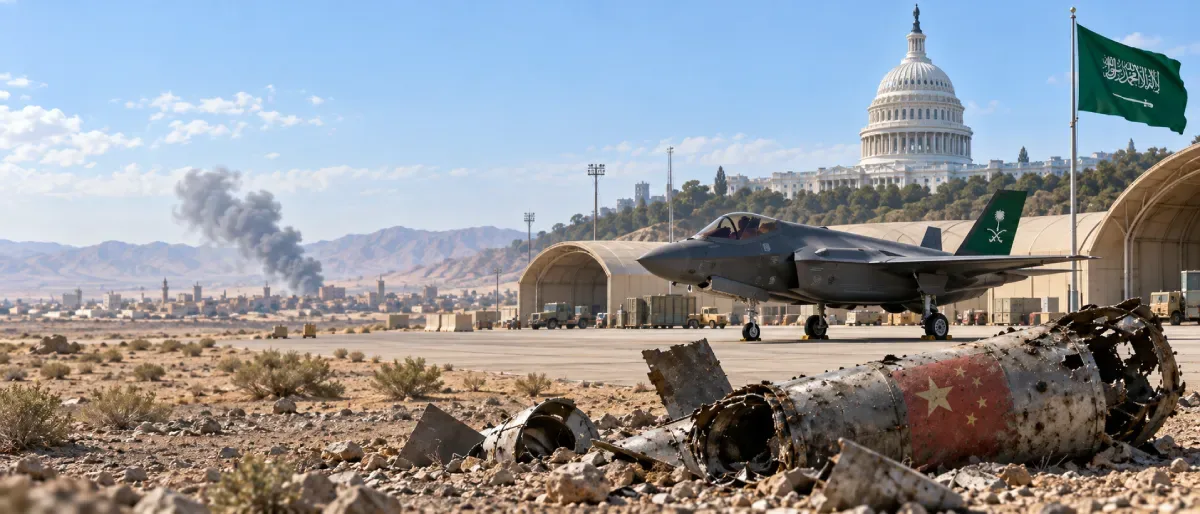
The US State Department on September 17 approved a possible $24.3 billion sale of 48 F-35A fighters to Saudi Arabia, opening formal congressional review of a deal that would make the kingdom the first Arab operator of the stealth jet. The notification came a day after The Wall Street Journal reported that missile debris found in Yemen appeared to show the first Saudi combat use of a Chinese-made DF-15A ballistic missile.
The package covers 48 conventional takeoff F-35As and 49 Pratt & Whitney F135 engines, one of them a spare, along with secure communications, cryptographic and navigation systems, electronic warfare database support, training and spare parts. Lockheed Martin and Pratt & Whitney are named as principal contractors. Congress has 30 days to review the proposed sale, while deliveries would take years even if the transaction proceeds.
The debris
Videos filmed by residents in the Raghwan district of Yemen's Marib governorate began circulating on September 14 after a suspected Saudi strike on Houthi positions the previous night. They show the booster section of a missile with "DF-15A" printed on its side. Analysts cited by the Journal matched the fixed fins and motor to footage previously aired by Chinese state broadcasters.
The DF-15A is a road-mobile, solid-fuel short-range ballistic missile with an estimated range of 600 to 900 kilometers. Only the booster was found. Its warhead separates in flight, so the target cannot be identified from the wreckage. The South China Morning Post reported that the find was the first known appearance of a missile from China's Dongfeng series in Middle Eastern combat.
Neither Riyadh nor Beijing has publicly confirmed the missile's identity or launch. Yemeni authorities have issued no formal confirmation, although a Yemeni government official and a Houthi official told the Journal that Saudi Arabia fired it.
Washington's case
The State Department said the proposed sale would strengthen Saudi homeland defense and improve interoperability with US and allied forces. It described Saudi Arabia, formally designated a major non-NATO ally by President Donald Trump on January 13, 2026, as a force for political stability in the Gulf. The department also said the transaction "will not alter the military balance in the region."
Trump first announced plans to sell F-35s to Riyadh in November 2025, shortly before hosting Crown Prince Mohammed bin Salman at the White House. The State Department sent the package to two congressional committees for informal review in June 2026.
The intelligence warning
A Defense Intelligence Agency (DIA) assessment examined Chinese military access to Saudi bases and the kingdom's use of Chinese telecommunications equipment, The New York Times reported on September 16. It questioned whether F-35 technology could be protected and recommended restricting access to sites holding the aircraft to authorized US and Saudi personnel. The assessment also asked whether Riyadh would remove Huawei and ZTE equipment from telecommunications networks and defense installations.
The Times reported that the document followed an earlier DIA assessment in fall 2025 and circulated among administration agencies and congressional offices as lawmakers sought answers from the administration.
Congress
Congress can seek to block a notified arms sale through a joint resolution of disapproval. Overriding a presidential veto would require two-thirds majorities in both chambers.
Concerns about China were already on Capitol Hill before the September notification. Democratic Representatives Raja Krishnamoorthi, Joe Courtney and Donald Norcross warned the Pentagon and State Department in November 2025 that an F-35 sale could severely jeopardize US national security if sensitive technology or operational know-how reached Beijing. Their letter cited decades of Chinese ballistic missile sales to Riyadh and Chinese telecommunications infrastructure in the kingdom.
Israel
Israel remains the only country in the Middle East operating the F-35. In November 2025, the Israeli Air Force delivered a position paper to political leaders warning that Israel's air superiority depends on exclusive regional access to the jet and that Saudi orders could delay Israeli deliveries.
Two Israeli officials told Axios at the time that Israel had asked Washington to make any sale conditional on Riyadh fully normalizing relations with Israel. No such condition appears in the September 17 notification.
The Jerusalem Post, citing Walla, reported on September 18 that Washington had informed the Prime Minister's Office of the sale and that Israel is expected to seek weapons systems the United States has so far declined to provide. Israeli officials also plan to seek participation in the development and production of classified systems, including interceptors for the Arrow 4 and Arrow 5 programs, bunker-busting munitions, autonomous strike systems and drone swarms, the report said.
One source quoted in the report said the Israeli military would prefer that no other country in the region receive the F-35, while noting that Saudi Arabia would not receive its first aircraft for another five years even if the deal is signed soon. Another defense official argued that the Israeli Air Force's advantage rests mainly with its personnel rather than the aircraft itself.
Riyadh
Saudi Arabia's Ministry of Defense has not commented on the reported DF-15A strike. A Saudi official told the Journal that the Houthis do not possess DF-15 missiles but stopped short of denying a Saudi launch. The kingdom has never publicly acknowledged operating the DF-15 family.
Riyadh has pressed Washington to complete the F-35 process. Defense Minister Prince Khalid bin Salman traveled to Washington about two months ago to lobby senior administration officials, according to Semafor.
Houthi attacks on Saudi territory have intensified. On September 16, the group released footage it said showed a Saudi F-15 shot down over Marib. Saudi authorities have not confirmed the claim.
Beijing
China's Foreign Ministry did not address the reported DF-15A debris at its regular briefings on September 14 and 15. Asked on September 14 about a separate Journal report alleging that Iran obtained satellite imagery of a US base in Jordan from Chinese entities, spokesperson Guo Jiakun said China strictly fulfills its international obligations and opposed what he called attempts to use the conflict to smear Beijing. On Yemen, he called for restraint and de-escalation.
Chinese officials have used similar language when questioned about Saudi missile cooperation. After US media reported in 2021 that China was helping Saudi Arabia build ballistic missiles, the Foreign Ministry did not deny the cooperation. It said the two countries maintain "friendly cooperation in all fields, including in the field of military trade" and argued that it violated no international law or rules governing weapons of mass destruction.
Saudi Arabia acquired Chinese DF-3A intermediate-range ballistic missiles in the late 1980s. Later US reporting and congressional assessments described a DF-21 acquisition and Chinese assistance to Saudi missile infrastructure. The Marib imagery alone cannot establish whether the reported DF-15A was bought directly from China, assembled in Saudi Arabia or produced with Chinese technical assistance.
The Türkiye precedent
Türkiye was removed from the F-35 program after taking delivery of Russia's S-400 system, which US officials argued could expose sensitive information about the aircraft. The November 2025 congressional letter cited that case directly, noting that Washington removed Türkiye despite its NATO membership, a status Saudi Arabia does not hold.
The systems themselves present different risks. The S-400 is designed to detect and track aircraft. The DF-15A is a strike missile. The DIA's concern over Saudi Arabia instead centers on Chinese military access and Chinese-built telecommunications networks that could place sensitive F-35 information within reach.
Ankara also has a direct stake in Saudi defense planning. Türkiye, Saudi Arabia and Pakistan signed the Mecca Joint Defence Agreement, known as the Mecca Pact, on August 7, 2026. The three governments said an armed attack on any one of them would be regarded as an attack on all three.
Congress is reviewing the F-35 package with Riyadh's Chinese defense ties already under scrutiny in Washington. The reported DF-15A use adds another element to that debate, but its identity and Saudi launch remain unconfirmed by Riyadh or Beijing.
Sources: US Department of State, Federal Register, The Wall Street Journal, The New York Times, Semafor, Axios, South China Morning Post, The Jerusalem Post, Walla, Ynet, CNN, Associated Press, Ministry of Foreign Affairs of the People's Republic of China, US House Select Committee on the Chinese Communist Party, Bosphorus News review and reporting.