
By Bosphorus News Energy Desk
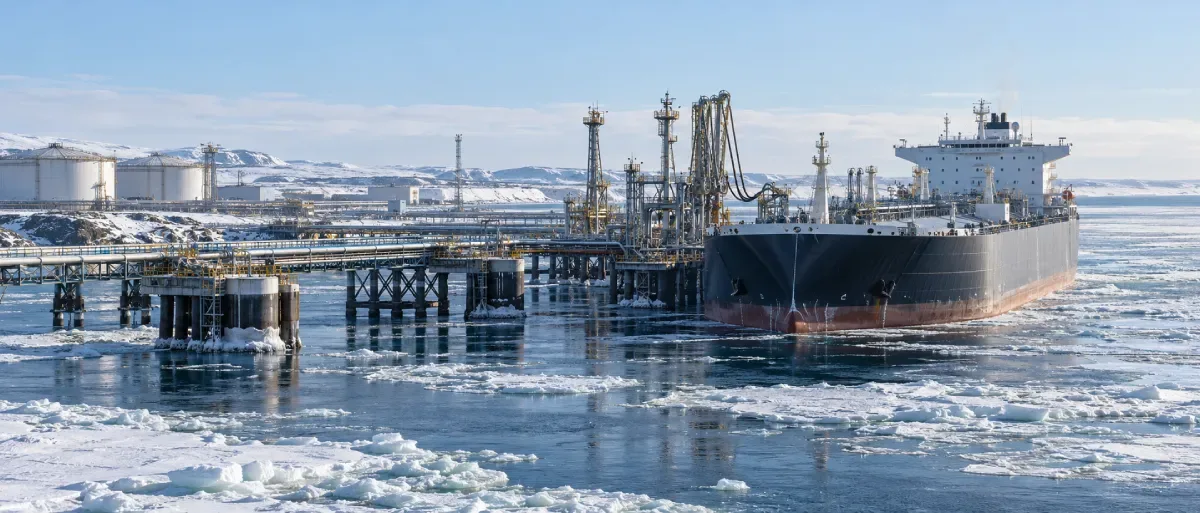
Russia has begun exporting oil from Vostok Oil, Rosneft's giant Arctic project. The first crude was loaded at the Bukhta Sever terminal on September 6 onto Valentin Pikul, a tanker sanctioned by the United States and European Union.
Rosneft said Akademik Gubkin was waiting at anchorage for the next cargo. The vessel is also under U.S. sanctions and linked to Rosnefteflot, Rosneft's shipping subsidiary.
The shipments bring a new stream of Russian crude onto the Northern Sea Route as Moscow works to extend navigation beyond the summer season.
Rosneft built the Vankor-Payakha-Bukhta Sever pipeline with capacity for 100 million tonnes a year. The company now expects Vostok Oil shipments to reach 30 million tonnes as early as the second half of 2027 and up to 50 million tonnes by 2030. A later increase to 100 million tonnes depends on market demand and favourable economic conditions.
The project is running behind Rosneft's earlier timetable. Company material published in 2021 projected Northern Sea Route traffic from Vostok Oil of up to 30 million tonnes in 2024, 50 million tonnes in 2027 and 100 million tonnes in 2030.
The first export loading instead began in September 2026. Rosneft's current 2030 target is 50 million tonnes, half the level projected five years earlier.
Sanctions cover the vessels, Rosnefteflot and Rosneft itself. The U.S. Treasury Department sanctioned Rosnefteflot in January 2025 and identified Valentin Pikul and Akademik Gubkin among vessels owned and operated by the company. Washington sanctioned Rosneft in October 2025 as part of measures targeting Russia's energy sector.
The European Union added Valentin Pikul to its vessel list from April 24, 2026. The EU said the tanker transported Russian-origin crude or petroleum products and engaged in irregular and high-risk shipping practices covered by International Maritime Organization Resolution A.1192(33).
The EU designation applies specifically to Valentin Pikul; it does not establish that every vessel serving Vostok Oil belongs to a shadow fleet. It does, however, put the project's first shipment inside a maritime network already under widening Western sanctions.
The Russian government is expanding the Northern Sea Route for year-round navigation. In March, it called development of the corridor a strategic priority and identified reliable icebreaker escort and ice reconnaissance as requirements for keeping traffic moving in difficult conditions.
Vostok Oil could add tens of millions of tonnes of new cargo to that network within the next several years.
China is adding commercial traffic of its own. The Ministry of Transport said the Ningbo-Zhoushan China-Europe Arctic container service moved to weekly operations during the navigation season in August. Operators plan at least eight voyages in 2026 using seven to eight ice-strengthened vessels, with the main sailing window running from July to October.
South Korea is testing whether the route can support another Asia-Europe service. The 2,758-TEU Panstar Acro left Busan on August 22 for a 45-day round trip through the Northern Sea Route, with calls at Felixstowe, Rotterdam and Gdansk. The voyage gives South Korea a commercial test of its Arctic route for Asia-Europe shipping, with ministry data covering distance, sailing time, fuel consumption, cost and commercial viability.
That expansion still depends on a limited pool of ice-capable ships and Arctic support assets.
A September 23 study by the Center for Strategic and International Studies (CSIS) estimated that Russian seaborne Arctic crude exports generated about $18.8 billion in gross revenue from February 2022 onward. According to the study, 53 percent of those exports passed through two floating storage vessels, Umba and Kola.
CSIS estimated that year-round operations depend on roughly 100 ice-class tankers and eight nuclear icebreakers. Its researchers also identified 110 cases since February 2022 in which sanctioned tankers received Russian nuclear icebreaker escort for more than six hours.
The study places those escorts, floating storage vessels and ship-to-ship transfers inside the wider network supporting Russia's sanctioned Arctic oil trade.
Vostok Oil now enters that network with production targets far above its first cargo. Rosneft says shipments could reach 30 million tonnes as early as the second half of 2027 and 50 million tonnes by 2030 as China increases seasonal container services and South Korea measures whether the route can support regular commercial shipping.
Reaching those volumes will require enough ice-capable tankers, icebreaker capacity and Arctic terminal infrastructure to move the crude through a shipping network already operating under sanctions pressure.
Sources: Rosneft, U.S. Treasury Department and OFAC, Council of the European Union and EUR-Lex, International Maritime Organization, Russian Government, China Ministry of Transport, South Korea Ministry of Oceans and Fisheries, Center for Strategic and International Studies, Bosphorus News review and reporting.