
By Bosphorus News Defense Desk
Turkish manufacturer Repkon supplied machinery for a $533 million U.S. Army artillery project that failed to produce a single compliant 155 mm projectile body. The Repkon name later appeared in two approved U.S. arms packages for Israel, followed by a corporate rebrand, protests in Istanbul and questions in Türkiye's parliament.
General Dynamics Ordnance and Tactical Systems (GD-OTS) was the Army's prime contractor for the Mesquite plant, while Repkon Türkiye supplied and installed production equipment. The American company then called Repkon USA was listed as a principal contractor in the Israel packages. It changed its name to Paligen Technologies in March 2026 and says it is wholly separate from Repkon Türkiye.
ProPublica published its Mesquite investigation on August 12 after interviewing 36 current and former employees and officials and reviewing internal documents, photographs and videos. Its account adds factory-floor evidence to a July report from the Department of Defense Office of Inspector General, which found that the plant had produced no metal bodies meeting the Army's minimum requirements as of March 2026.
The Army accepted an unproven conversion
The Army opened the Universal Artillery Projectile Lines facility in Mesquite, near Dallas, on May 29, 2024. A package of contracts valued at $576 million covered the design and construction of the plant, procurement and installation of its equipment and commissioning of three production lines. Each line was expected to make 10,000 projectile bodies a month.
The dollar figures describe different stages of the project. The inspector general found that the Army spent $469 million to establish the facility between December 2022 and December 2025. The Army later told ProPublica that the cost to taxpayers had reached $533 million.
The machinery offered by General Dynamics and supplied by Repkon had been designed for the older M107 155 mm projectile body. Mesquite was expected to manufacture the newer M795 body, which uses different specifications and steel. Army acquisition officials accepted the conversion as a high-risk opportunity because the equipment was already available and appeared faster to deploy than a purpose-built M795 line.
Army and General Dynamics personnel visited Türkiye to inspect Repkon equipment but did not see a complete production line operating, four former officials told ProPublica. The machinery had not demonstrated that it could produce an M795 body to U.S. specifications before the Army proceeded with three lines.
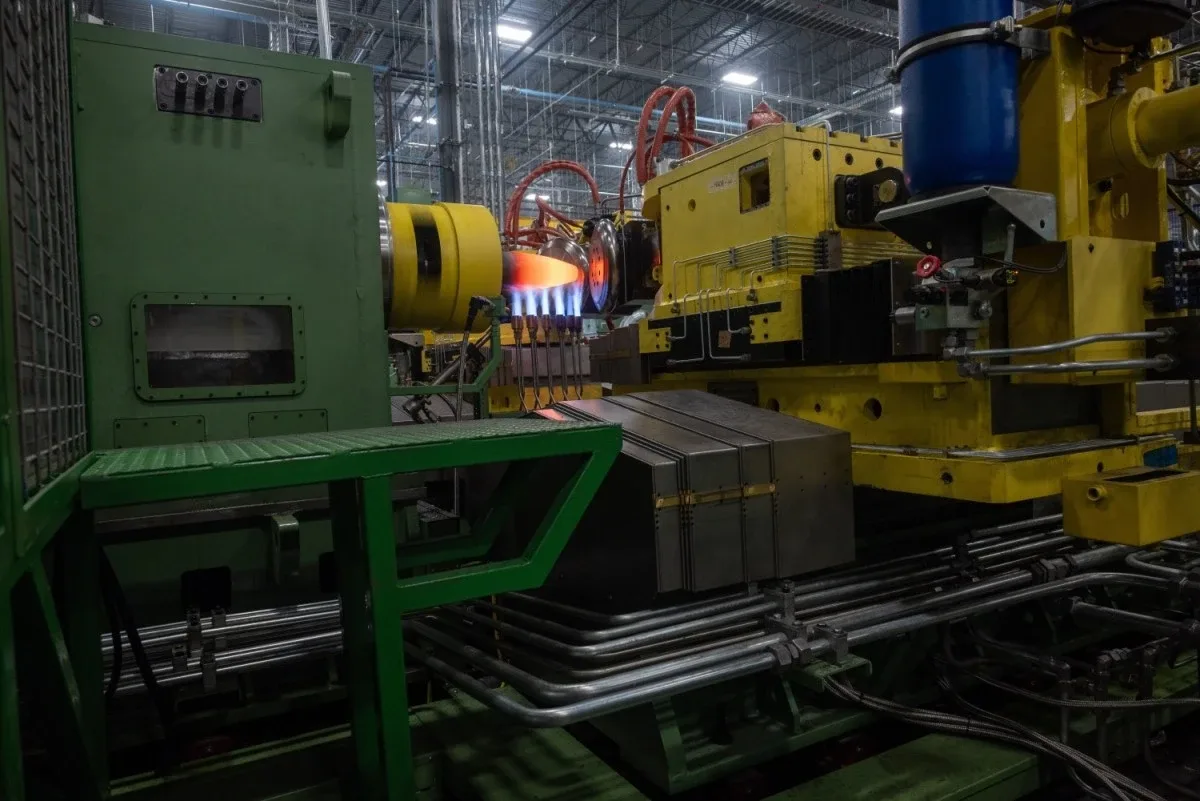
Inside the plant, former workers described robot arms catching fire, colliding with equipment and dropping heated steel. A machine intended to shape smooth projectile noses sometimes left metal resembling soft-serve ice cream. The flow-forming equipment cracked bodies instead of stretching them to specification.
Five former General Dynamics employees told ProPublica that Repkon personnel withheld passwords needed to control equipment. Two said General Dynamics workers removed hardware after machines appeared to be operated remotely from Türkiye. Those accounts fueled suspicions inside the factory, but the Army said it found no evidence of sabotage or espionage.
Repkon Türkiye did not answer ProPublica's requests for comment. General Dynamics spokesperson Jeff Davis said the investigation materially mischaracterized events and unfairly questioned the company's safety record and truthfulness, but did not identify specific errors when ProPublica asked for them. GD-OTS separately told the inspector general that its performance met or exceeded the contract's minimum requirements.
Work stopped, then payments resumed
General Dynamics missed successive completion and qualification dates. The Army halted work on two lines in August 2025 and later extended the stop-work period through April 30, 2026. Under the bilateral agreement used for that extension, the government resumed progress payments and transferred $26.3 million for the second and third lines in December 2025.
The Army did not terminate the task orders. General Dynamics later agreed to invest $200 million of its own money in a recovery plan, replace most of the Repkon machinery with conventional equipment and end the partnership at Mesquite, Bloomberg reported in June.
Since the Army stopped work on two Mesquite lines, GD-OTS has received another $2.5 billion in Army contract awards, ProPublica reported. The Army said those awards covered distinct production lines and other national defense requirements unrelated to Mesquite.
Repkon USA became Paligen after Israel sale notice
The American company carrying the Repkon name had expanded elsewhere in the U.S. munitions industry before the Mesquite failure became public. In November 2024, the Army awarded Repkon USA Defense LLC a $435 million contract to design, build and commission a domestic trinitrotoluene (TNT) plant in Graham, Kentucky. The contract has no reported connection to the production failures in Mesquite.
Repkon USA announced in April 2025 that it had acquired GD-OTS's Garland operation in Texas, a 38-acre facility manufacturing metal parts for defense and aerospace applications. The acquisition gave the company a large U.S. manufacturing site for MK-80 series bomb bodies and other components.
ProPublica described the American business as Repkon's offshoot and reported that Repkon Türkiye's chief executive co-founded it. Paligen told the outlet that the companies are "different and wholly separate." Its March 10 rebranding announcement called Paligen a U.S.-based contractor with more than 400 employees and said the new name was intended to create a distinct American market identity and eliminate confusion about company affiliations.
The rebrand was announced four days after the U.S. Department of State approved an emergency arms package for Israel. Middle East Eye reported the change as following public backlash over the sale. Paligen did not link the new name to Israel, and the chronology alone does not establish the company's motive.
Two approved packages named Repkon USA
The March 6, 2026 notification covered a possible $151.8 million Foreign Military Sale of 12,000 BLU-110A/B general-purpose 1,000-pound bomb bodies and support services to Israel. Secretary of State Marco Rubio waived the usual congressional review requirements after determining that an emergency required the sale. The notice named Repkon USA in Garland as the principal contractor and said part of the requirement would be transferred from existing U.S. stocks.
It was the second such notice. On February 28, 2025, the Defense Security Cooperation Agency approved a possible $675.7 million package containing 201 MK 83 bomb bodies, 4,799 BLU-110A/B bodies and 5,000 Joint Direct Attack Munition (JDAM) guidance kits. Repkon USA and Boeing were named as principal contractors. Deliveries were expected to begin in 2028, and the agency cautioned that the amount represented the highest estimated value rather than a final contract total.
The notices identify the U.S. contractor for government-to-government sales. They do not establish that Repkon Türkiye requested, approved or directly sold the weapons to Israel. Repkon Türkiye said it had made no request, decision or sale connected with the March 2026 package and rejected reports portraying it as the transaction's decision-maker.
Members of Türkiye İşçi Partisi (TİP) protested outside Repkon's factory in Şile on March 13 and chained themselves to its gate. Party officials accused the company of contributing to arms supplied to Israel and criticized the Paligen name change.
Two Turkish-language Anadolu Agency reports praising Repkon's expansion were inaccessible when the Israel sale entered public debate, prompting claims that the state-run agency had removed them. Their English versions remained online and identified Repkon as a Turkish company. No public explanation for the unavailable Turkish pages was found.
İYİ Party lawmaker Buğra Kavuncu submitted a parliamentary question on March 11 asking whether Türkiye's Ministry of National Defence knew of Repkon USA's place in Israel's munitions supply chain, whether the activity conflicted with Türkiye's trade restrictions and how Turkish defense companies operating abroad were monitored.
Minister of National Defence Yaşar Güler replied that companies established abroad are governed by the laws of the countries where they operate. The ministry had no information about Repkon USA's production or supply chain, he said, while Repkon Türkiye remained subject to Turkish defense industry legislation and ministry oversight.
A Bosphorus News review of leading Turkish-language outlets by late morning on August 13 found no coverage of ProPublica's Mesquite investigation, although the Israel packages, the Paligen rebrand, the protest and the parliamentary question had received domestic coverage.
General Dynamics expects the rebuilt Mesquite operation to reach 20,000 compliant projectile bodies a month. The inspector general left the recovery recommendation unresolved until the Army provides a plan showing how the plant will reach that rate and determines how the money already spent was used and whether any of it can be recovered.
Sources: Department of Defense Office of Inspector General, U.S. Army, U.S. Department of State, Defense Security Cooperation Agency, Grand National Assembly of Türkiye, General Dynamics, Paligen Technologies, ProPublica, Middle East Eye, Bloomberg, Anadolu Agency, ANKA News Agency, Bosphorus News review and reporting.