
By Bosphorus News Economy Desk
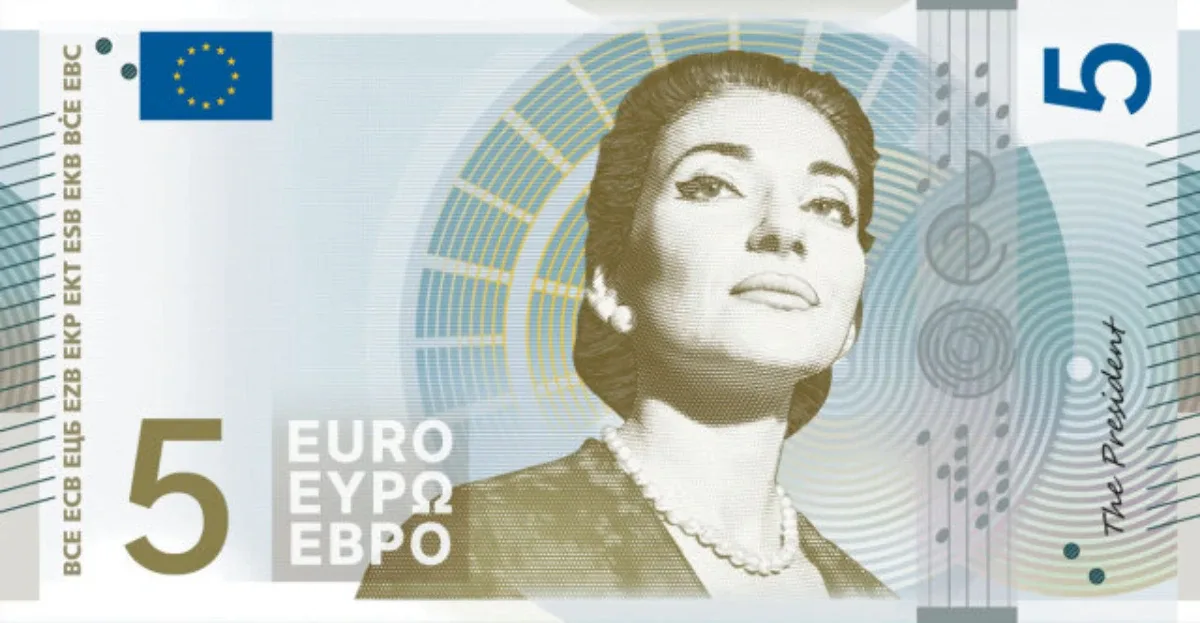
Maria Callas appears on every proposed €5 note in the cultural category of the first full redesign of euro banknotes since their introduction in 2002. A second Greek name is also on the shortlist: painter and engraver Myrsini Vardopoulou, whose six-note series is among the designs now open to public consultation.
The European Central Bank (ECB) unveiled 10 competing series on July 23, divided equally between "European culture" and "Rivers and birds." Europeans can review the designs and participate in the ECB survey until September 21. An independent research company is conducting a parallel survey among a representative sample of euro-area residents.
The ECB Governing Council expects to choose the final design around the end of 2026, taking account of the surveys, the jury's assessment and technical checks. None of the images released so far represents a finished banknote, and the selected series will require several years of development and testing before it reaches circulation.
Callas proposed for €5 note
Each of the five "European culture" proposals places Callas on the front of the €5 note and a performing-arts scene on the reverse.
The series assigns Ludwig van Beethoven to €10, Marie Skłodowska-Curie to €20, Miguel de Cervantes to €50, Leonardo da Vinci to €100 and Bertha von Suttner to €200.
Although the figures and denominations were fixed in advance, the designers approached them differently. Some retained conventional portraits, while others used geometric forms, collages or tightly cropped facial details.
Vardopoulou created Design E. Her proposal surrounds the six figures with circles and symbols intended to direct attention toward their work and cultural contribution.
Vardopoulou studied painting and engraving at the Athens School of Fine Arts. She has designed and supervised the production of stamps for Hellenic Post since 1995, producing more than 250 designs during that period.
Culture competes with rivers and birds
The other five shortlisted series replace historical figures with rivers, landscapes and birdlife. Wallcreepers, kingfishers, bee-eaters, white storks, avocets and northern gannets appear across the six denominations as the setting moves from mountain springs toward the sea. Buildings belonging to European Union institutions are used on the reverse.
The competition attracted 1,241 applications from designers across the European Union. Twenty-five applicants reached the design stage and submitted 39 proposals: 16 under "European culture" and 23 under "Rivers and birds."
An independent jury of 21 experts assessed the entries without knowing the designers' identities and selected five series from each theme.
The chosen design will replace the anonymous architectural imagery used on current euro notes. Existing banknotes will retain their value and remain in circulation after the next series is introduced.
Sources: European Central Bank press release, European Central Bank Design Contest Jury report, European Central Bank future banknote design gallery, Bosphorus News review and reporting.