
By Bosphorus News Geopolitics Desk
Israel's Defense Ministry Director General Amir Baram used the Herzliya Conference on July 1 to lay out the most explicit official framing yet of a strategic axis running from India through the United Arab Emirates to Greece and Cyprus. Speaking at Reichman University, the retired major general said the recent war had shown every regional actor the cost of Iran's military buildup and had created a shared interest in forging a broader alliance across that line.
Baram argued that Israel's technological and operational strengths, combined with the financial power of the Gulf states, could form the basis of what he called a new "security-economic front." He framed the expansion of partnerships not as a substitute for the alliance with Washington but as a way to widen Israel's room to maneuver and diversify its strategic footing.
The threat assessment behind the proposal was equally direct. Baram warned that agreements now taking shape around the world could channel hundreds of billions of dollars into Iran and dramatically accelerate its rearmament, a pointed reference to the indirect US-Iran talks in Doha over frozen assets and the Strait of Hormuz framework. His prescription was a tailored Israeli force buildup and a new regional architecture built first with the United States and then with others.
The most quoted line of the speech addressed the gap between Israeli and American priorities. "We think Tehran, they think Taiwan," Baram said, describing Iran as existential for Israel but a chronic regional challenge for a Washington focused on China and the Indo-Pacific. He tied the argument to the next US-Israel security memorandum of understanding, now under negotiation to govern the relationship for a decade after 2028, saying it must rest on hard interests rather than shared values alone. Baram also disclosed that he had invoked emergency powers over the past year to accelerate production of Arrow, David's Sling and Iron Dome interceptors.
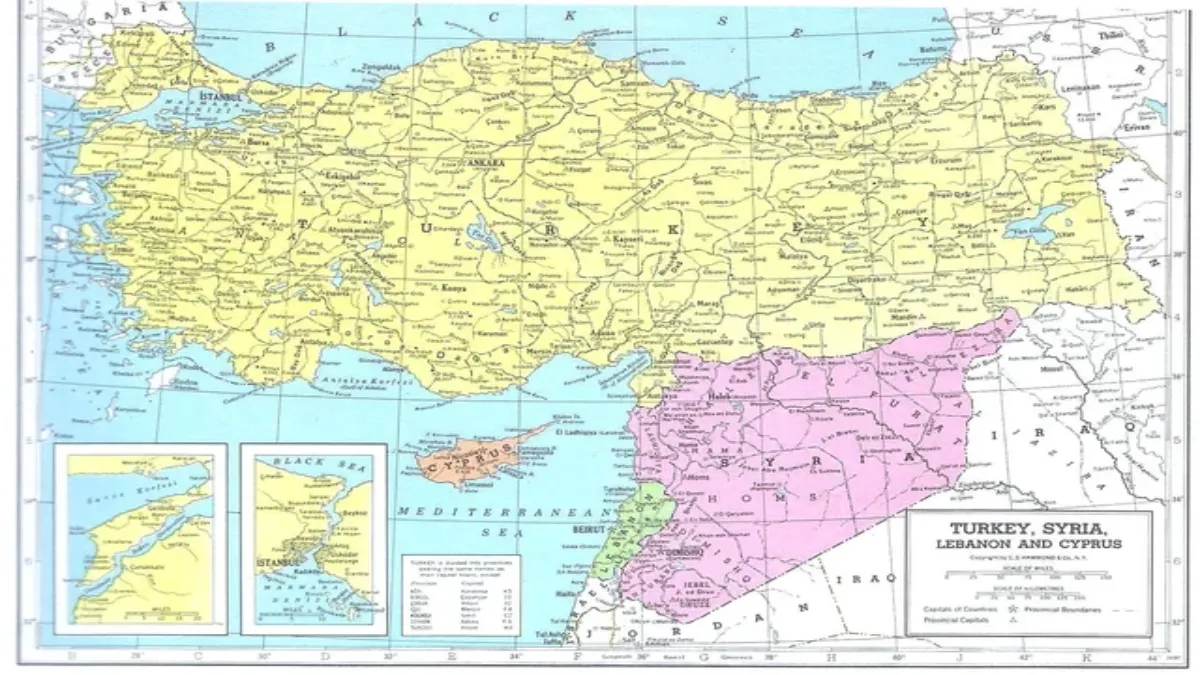
For Ankara, the significance lies in the geography. The line Baram drew runs parallel to the India-Middle East-Europe Economic Corridor (IMEC) and overlaps with Athens' push to bring India into the Greece-Cyprus-Israel framework as an expanded format, a construct increasingly described as a Mediterranean Quad. It follows the Houston declaration establishing the Eastern Mediterranean Energy Center with the United States, and the 2026 trilateral military work plan signed by Israel, Greece and Cyprus. Each step institutionalizes an Eastern Mediterranean architecture designed without Türkiye, and Baram's speech extends that architecture from an energy and trade concept into an explicit security proposition.
The vision has visible limits. Israeli analysts note that the Gulf states and India have shown no appetite for a military alliance, and that Gulf trade corridors could just as easily run through Jordan, Syria and Türkiye if regional conflict persists. The proposal also lands days before the NATO Ankara Summit, where Türkiye hosts the alliance whose two members, Greece and Türkiye itself, sit on opposite sides of the line Baram drew.
Sources: Israel Ministry of Defense statement, July 1, 2026. Cyprus Mail, July 1, 2026. The Jerusalem Post, July 1, 2026. JNS, July 1, 2026. Bosphorus News review and reporting.