
By Bosphorus News Defense Desk
Iran says it proposed a security alliance among Muslim countries during a telephone call with Turkish Defense Minister Yaşar Güler, but Ankara's official account made no reference to the initiative and disclosed no details beyond a general discussion of bilateral and regional security.
The difference between the two statements leaves Tehran as the sole public source for the proposed membership, the political rationale behind the initiative and a series of remarks attributed to Güler.
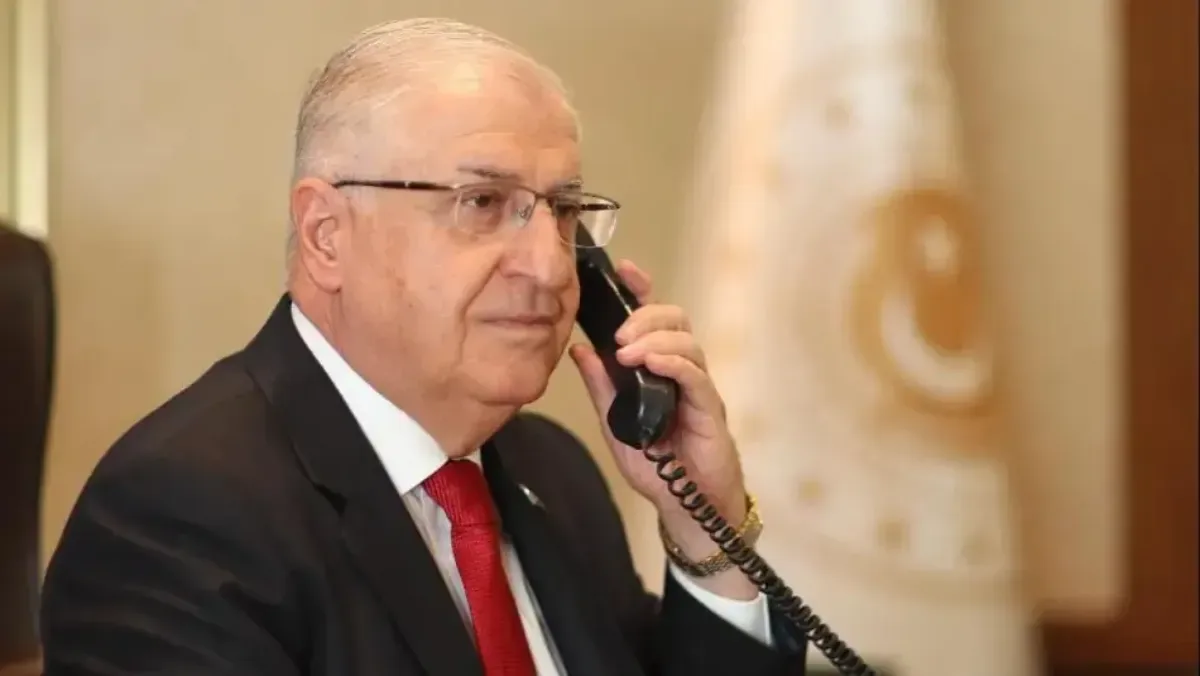
Türkiye's Ministry of National Defense said Güler and Iran's caretaker defense minister, Brigadier General Majid Ebn al-Reza, discussed recent developments and exchanged views on bilateral and regional defense and security matters.
The Turkish readout contained no quotations, did not mention a Muslim security alliance and gave no indication that Ankara had endorsed or agreed to examine the proposal.
Tehran promotes regional security without foreign powers
Tasnim News Agency reported that Ebn al-Reza proposed an alliance involving Iran, Türkiye, Pakistan, Saudi Arabia, Egypt and other Muslim countries.
According to the Iranian account, he argued that the recent war had demonstrated that regional security should be provided by countries in the region rather than foreign military powers, whose presence he said had increased mistrust and instability.
Tasnim also quoted Ebn al-Reza as calling for broader defense, military and security consultations with Ankara, while presenting the proposed grouping as part of a sustainable regional arrangement independent of outside powers.
Mehr News Agency published a substantially similar account. Both reports appear to draw on the Iranian side's description of the call and do not constitute independent confirmation of the proposal.
Statements attributed to Güler absent from Turkish readout
Tasnim attributed several remarks to Güler that were not included in the Turkish ministry's statement.
The agency reported that Güler offered condolences over the death of Iran's late supreme leader, Ayatollah Ali Khamenei, as well as military commanders, civilians and children killed in Minab. It also said he supported full implementation of the ceasefire, continued diplomacy and the territorial integrity of neighboring countries.
According to the same account, Güler expressed readiness to expand cooperation with Iran on counterterrorism, border security and regional affairs, while arguing that lasting security required dialogue among regional states.
Ankara has not publicly confirmed those quotations or the alliance proposal. The difference does not establish that the Iranian account is inaccurate, but it requires each substantive claim to remain explicitly attributed to Tehran.
Source note: Details of the proposed alliance, its prospective membership and the remarks attributed to Yaşar Güler were published by Iranian media. Türkiye's Ministry of National Defense confirmed the call but did not include those elements in its own account.
Public accounts follow a recurring pattern
The gap between the two sides' statements is not unique to this call.
Güler and Ebn al-Reza also spoke on March 28, when the Turkish ministry issued another short notice saying the ministers had discussed recent developments and bilateral and regional defense and security matters, without publishing quotations or detailed proposals.
Iranian accounts of defense contacts with Türkiye have repeatedly provided a broader political narrative, including calls for regional states to assume greater responsibility for their own security and reduce dependence on foreign powers.
The repeated contrast suggests that Tehran is using bilateral contacts to promote its preferred regional security concept, while Ankara acknowledges the exchanges without publicly adopting Iran's framing. This is an editorial assessment based on the two sides' statements, not evidence that Türkiye rejected the proposal in private.
No public record shows that Ankara has agreed to join the suggested grouping, that formal negotiations have begun or that the parties have established a working mechanism.
Proposed grouping faces conflicting strategic alignments
The countries named by Iran operate within markedly different security systems.
Türkiye is a NATO member, Saudi Arabia and Egypt maintain extensive defense relationships with the United States, and Pakistan balances strategic ties with China, the Gulf states and Western partners. Iran, by contrast, presents the proposal as an alternative to security arrangements dependent on extra-regional powers.
Those differences would make the creation of an operational alliance difficult without substantial changes in national threat perceptions, defense commitments and relations with existing partners.
The proposal is nevertheless politically significant because it sets out Tehran's preferred regional model: a security structure led by Muslim and neighboring states, with a reduced role for the United States and other outside powers.
Ankara's narrow public account allows bilateral dialogue with Iran to continue without associating Türkiye with that broader project. It confirms the contact while withholding any public endorsement of Tehran's interpretation.
Sources: Republic of Türkiye Ministry of National Defense, Tasnim News Agency, Mehr News Agency, Bosphorus News review and reporting.