
By Bosphorus News Energy Desk
The U.S. military disabled two Iranian-flagged tankers in the Gulf of Oman on May 8, pushing its blockade enforcement into a more forceful phase as the Hormuz crisis increased the strategic weight of Türkiye-linked energy, trade and defence access corridors.
U.S. Central Command said American forces disabled the M/T Sea Star III and M/T Sevda before the vessels could enter an Iranian port on the Gulf of Oman. CENTCOM said both ships were stopped for violating the ongoing U.S. blockade. Anadolu Agency, citing the U.S. military, reported that both tankers were empty at the time of the incident.
The operation followed a separate clash on May 7, when CENTCOM said Iranian forces launched missiles, drones and small boats as the USS Truxtun, USS Rafael Peralta and USS Mason transited the Strait of Hormuz toward the Gulf of Oman. CENTCOM said no U.S. assets were struck and that American forces responded with self-defense strikes against Iranian military targets.
The crisis is now moving through two competing realities. Washington says the ceasefire remains in effect while the blockade continues. Tehran says U.S. action around Hormuz has violated the truce. That gap is shaping the military, diplomatic, legal and energy layers of the confrontation.
Ceasefire Language, Blockade Reality
CENTCOM's May 8 statement shows the operational logic behind Washington's position. The U.S. is treating the ceasefire and the blockade as separate files: escalation can be limited, in Washington's view, while interdictions continue against vessels entering or leaving Iranian ports.
That distinction is unlikely to satisfy Tehran. Iranian officials have framed U.S. action around Hormuz as a ceasefire violation and a pressure tactic designed to force concessions while negotiations remain open. Iranian Foreign Minister Abbas Araghchi accused Washington of choosing a "reckless military adventure" whenever a diplomatic solution appeared to be on the table.
The same contradiction runs through President Donald Trump's public language. Trump said the ceasefire was still in effect, while also referring to recent U.S. strikes as a "love tap," a phrase Iranian officials rejected as an attempt to soften the scale of the attacks.
The ceasefire has not disappeared from official language, but the blockade is now being enforced with disabling strikes against Iranian-linked maritime traffic.
Shipping Pressure Moves Beyond Oil Prices
The maritime picture is deteriorating faster than the diplomatic one. CENTCOM-linked reporting says U.S. forces have redirected dozens of commercial vessels and disabled several ships since the blockade began. Anadolu Agency reported that U.S. forces had already disabled another Iranian-flagged vessel before the May 8 action.
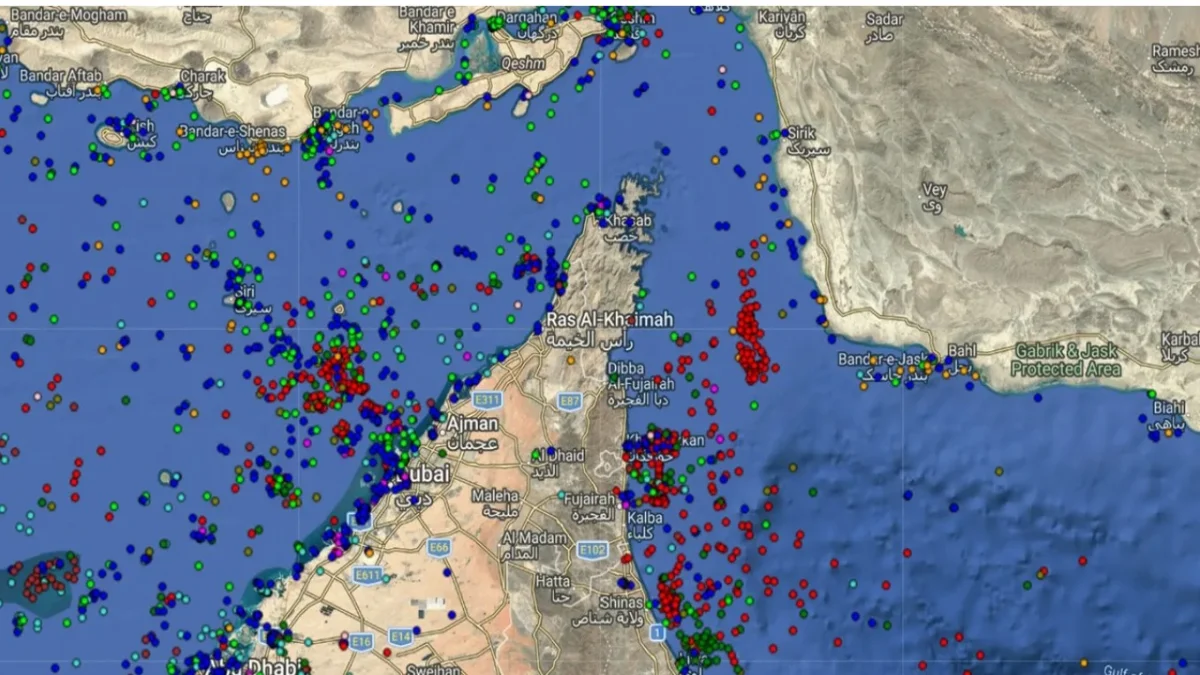
Shipping data has also shown severe disruption through the Strait of Hormuz. Anadolu Agency reported earlier this week that only four commercial vessels transited the strait in a 24-hour period, while live tracking cited by major outlets pointed to a near-freeze in registered commercial traffic during the latest phase of the crisis.
That makes the crisis more than a price shock. Hormuz is moving into a physical shipping disruption, with commercial operators facing military risk, insurance exposure, sanctions pressure and unclear rules around passage.
Iran's reported effort to impose transit fees would add another legal layer to the crisis. A toll demand around Hormuz would place shippers between Iranian pressure, U.S. sanctions warnings and the principle of free navigation through an international sea passage. The practical effect would be the same: fewer vessels, higher risk premiums and more pressure on alternative corridors.
Kharg Island Spill Adds Energy Risk
A suspected oil spill near Iran's Kharg Island has added another layer of uncertainty. Reuters reported that satellite imagery from May 6 to May 8 showed a suspected slick covering about 45 square kilometers near Iran's main oil export hub. The source and cause of the slick remain unknown.
Kharg matters because it handles the overwhelming share of Iran's crude exports, much of them bound for China. Reuters reported that the island is essential to roughly 90 percent of Iran's oil exports, giving the suspected spill significance beyond environmental damage.
The safest reading is narrow but important. Satellite imagery shows a large suspected slick near the heart of Iran's export system at a moment when maritime traffic, tanker movement and blockade enforcement are already under extreme strain.
Sanctions Add a Procurement Front
The U.S. also widened the pressure track through sanctions. The Treasury Department said on May 8 that its Office of Foreign Assets Control targeted 10 individuals and companies accused of helping Iran's military secure weapons, raw materials, Shahed-series UAV components and inputs linked to the ballistic missile program.
The State Department announced related action against entities tied to Iran's overseas military procurement networks.
The timing matters. Washington is not relying only on naval pressure. It is pairing the blockade with procurement sanctions, trying to constrain both Iran's maritime economy and the supply chains behind its missile and drone programs.
Mediation Channel Stays Open
Regional diplomacy has not stopped. Qatar has kept the mediation channel active, with Prime Minister and Foreign Minister Sheikh Mohammed bin Abdulrahman Al Thani calling for all parties to engage with efforts addressing the roots of the crisis through dialogue and peaceful means. Pakistan also said it hoped for an agreement sooner rather than later.
Europe is being pulled deeper into the file. Secretary of State Marco Rubio, during talks in Italy, questioned why countries would not support U.S. efforts and suggested that opposition required more than strongly worded statements.
That puts pressure on European governments. They have an interest in keeping Hormuz open, but they also face political and legal risk if the blockade becomes a long-term military enforcement regime rather than a short-term crisis instrument.
Türkiye Corridor Stakes Rise
Hormuz disruptions are making Türkiye-linked overland energy, trade and defence access corridors more visible, from the Caspian and Iraq to the Black Sea and Europe. The latest tanker strikes reinforce an earlier Bosphorus News assessment that the Hormuz crisis is reshaping Europe's security dependence on Türkiye's regional access.
The strategic logic is direct. If Gulf maritime traffic remains constrained, energy importers and exporters will look harder at routes that reduce exposure to the Strait of Hormuz. That shift has already brought renewed attention to the Iraq-Türkiye-Ceyhan route, which Bosphorus News examined as Iraq's oil export debate returned to the Ceyhan corridor during the Hormuz crisis.
The same logic applies to gas and Black Sea-linked infrastructure. Bosphorus News previously detailed how TurkStream became Russia's last direct pipeline route to Europe as flows rose , a reminder that Türkiye's corridor role is not limited to oil or Iraq.
This does not mean Türkiye replaces Hormuz. The strait is too central to global energy flows for any single corridor to substitute for it. But every day of disruption increases the political value of routes that can move energy, goods or strategic cargo outside the most exposed maritime chokepoints.
A prolonged Hormuz disruption would also sharpen Europe's search for resilient overland and pipeline-linked routes across Türkiye, the South Caucasus, the Black Sea and the Balkans. That search is no longer theoretical. It is being shaped by disabled tankers, collapsing shipping confidence, suspected damage near Iran's main export hub and a ceasefire that still exists on paper while military enforcement expands at sea.
***Sources: U.S. Central Command, U.S. Treasury Department, U.S. State Department, Anadolu Agency, Reuters, The Guardian, Associated Press, Qatar Ministry of Foreign Affairs, Pakistan Ministry of Foreign Affairs, Bosphorus News reporting.