
Bosphorus News Defense Desk
Greece and Cyprus have moved a European-funded unmanned maritime surveillance project into public view, adding a new industrial and operational layer to the Eastern Mediterranean's expanding sensor and monitoring race.
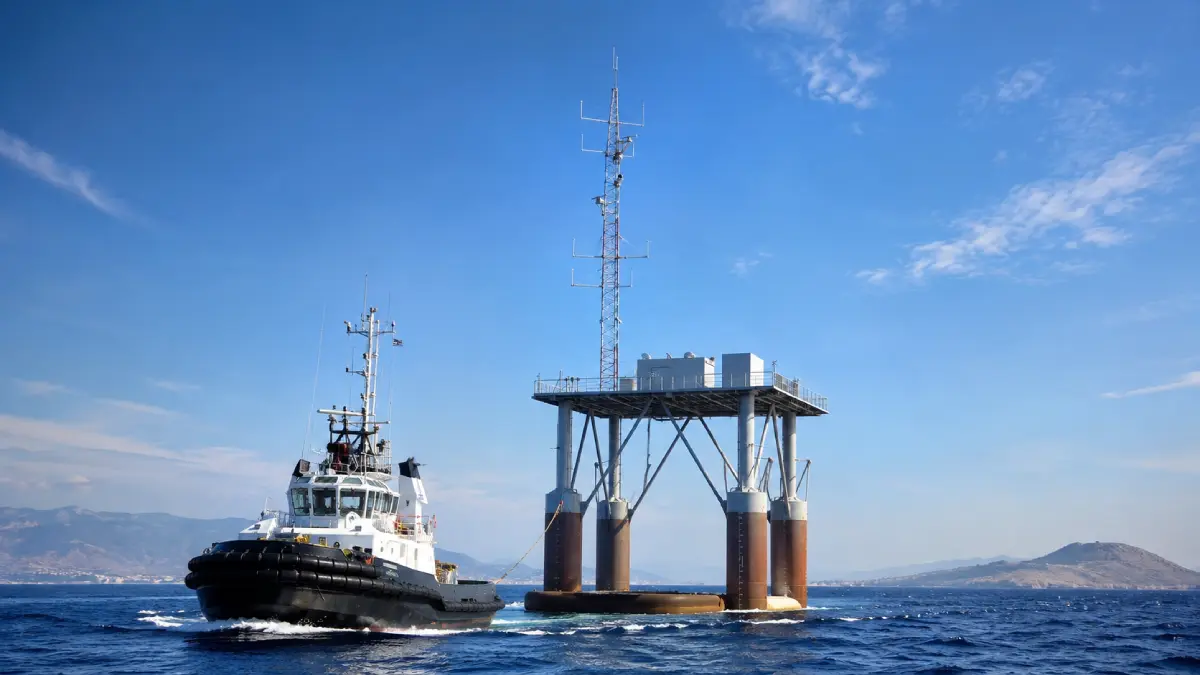
The platform, named PANOPTIS, was shown during a naming ceremony at Salamis Shipyards on May 7, 2026. ETME, the Greek engineering company leading the project, describes it as an unmanned semi-fixed sea platform designed for maritime surveillance and continuous operational monitoring. The platform is part of the wider USSPS, Unmanned Semi-fixed Sea Platforms for Maritime Surveillance, project.
PANOPTIS is not a conventional patrol vessel or a standard buoy-mounted radar system. The project is designed around a semi-fixed unmanned structure at sea, drawing on technology associated with offshore platforms, unmanned systems, artificial intelligence and network-centric surveillance. ETME says the platform incorporates its patent in regional maritime surveillance and introduces a new category of unmanned naval platform.
The defence significance lies in the platform's mission profile. USSPS is intended to improve maritime surveillance by integrating air, surface and underwater sensors into an advanced C5ISTAR federated system of systems. ETME says the architecture aims to connect legacy assets with newer sensors, reduce the use of high-value platforms and provide persistent maritime situational awareness.
The European Union's project factsheet describes USSPS as a system designed to exploit unmanned semi-fixed platforms at sea for maritime surveillance. The project's reported total cost is about €19.47 million, with a maximum EU contribution of about €12.8 million under the European Defence Industrial Development Programme.
The Greek-Cypriot link is central to the project's political value. ETME says USSPS is implemented with the support of the Greek Ministry of National Defence and the Republic of Cyprus. The European project consortium also includes Cypriot participants, including the Cyprus Research and Innovation Center and SignalGeneriX, alongside companies and research bodies from Greece, France, Spain, the Netherlands, Bulgaria and Ireland.
That makes PANOPTIS more than a technology story. It shows how Greece and Cyprus are trying to move from defence procurement toward niche defence-industrial production, especially in maritime surveillance, sensor integration and unmanned systems. The Eastern Mediterranean is already crowded with naval patrols, air defence upgrades, energy infrastructure, undersea cables and contested security narratives. A semi-fixed platform designed to watch the air, surface and underwater domains fits directly into that environment.
The project has also drawn in major European defence industry names. Naval Group said in 2023 that USSPS was launched in 2021 under the European Defence Industrial Development Programme, led by ETME, with Naval Group and Navantia among the main industrial partners. Naval Group described the project as part of an effort to develop a European capability for unmanned semi-fixed maritime surveillance platforms.
The platform's development has been moving through visible milestones. ETME announced in March 2026 that the floating maritime surveillance platform had been successfully launched at Salamis Shipyards and that the programme had entered its final phase of implementation. Maritime Research Institute Netherlands, one of the project participants, describes USSPS as a highly autonomous, energy-efficient and miniaturised oil-rig technology-based platform capable of carrying air, surface and underwater sensors.
The timing matters for Cyprus. Nicosia has been expanding its defence diplomacy beyond its traditional European and Greek channels. Bosphorus News reported this week that India and Cyprus signed a five-year defence roadmap and elevated their ties to a strategic partnership, placing defence cooperation, maritime security and technology more visibly inside the bilateral relationship.
PANOPTIS belongs to the same broader shift, but from the industrial side. Cyprus is not only receiving new security attention from external partners. It is also appearing inside European defence supply chains linked to surveillance, sensors and maritime awareness.
That shift is relevant to Türkiye because the island's security role is no longer limited to the formal Cyprus negotiation track. As Bosphorus News outlined in its analysis of Türkiye, the guarantor powers and the Israel-Greece axis, Ankara increasingly reads Cyprus through a wider map shaped by Gaza, British bases, Israeli regional posture, Greek Cypriot defence alignments and the militarisation of the island's external partnerships.
PANOPTIS does not alter the military balance by itself. Its significance is subtler and more durable. It points to an Eastern Mediterranean in which surveillance infrastructure, unmanned systems and data fusion are becoming part of the regional contest. Greece and Cyprus are using European defence funding to place themselves inside that architecture, while Türkiye will read the development through the larger pattern of maritime monitoring, island security and allied defence-industrial positioning.
The platform is therefore best understood as a small but telling addition to the region's security map. The Eastern Mediterranean is not only being patrolled by ships and aircraft. It is being wired, watched and digitised, one sensor node at a time.