
Bosphorus News Geopolitics Desk
Turkish Defense Minister Yaşar Güler warned on 23 May that Türkiye would invoke its guarantor powers over Cyprus if Turkish Cypriots came under threat, tying the message to Ankara's deepening concern over military cooperation between Israel, Greece and the Greek Cypriot Administration.
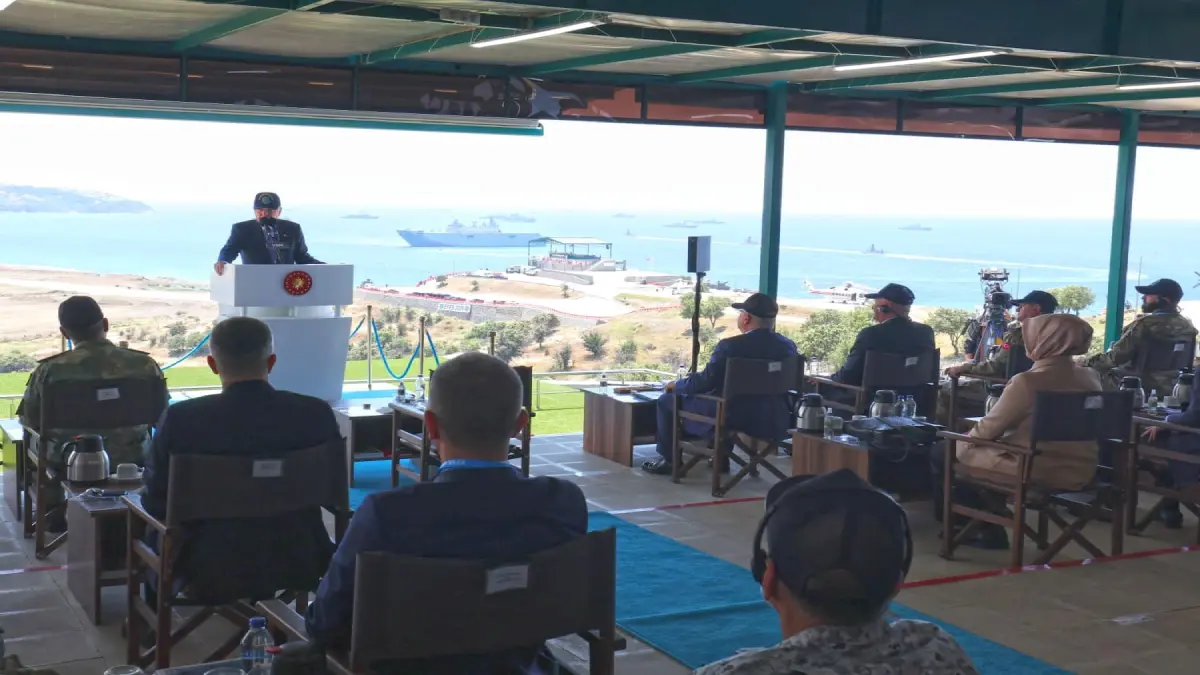
Güler made the remarks to journalist Yahya Bostan on the sidelines of the EFES-2026 exercise in İzmir. Türkiye Today carried a full English-language account of the interview.
"As Türkiye, we will not hesitate to use the authorities given to us by the Guarantorship against hostile attitudes threatening the security of the Turkish Cypriots," Güler said.
The 1960 Treaty of Guarantee designated Türkiye, Greece and the United Kingdom as guarantor powers of Cyprus. Ankara last acted on that status in 1974, and the language has not been invoked this directly in recent years.
Güler was careful with his framing, stopping short of describing the Israel-Greece-Greek Cypriot military relationship as a threat to Türkiye itself. His warning was directed at what he called the future security consequences of that alignment for Cyprus.
"We closely follow the activities and military cooperation initiatives of Israel, Greece and the GCA. The initiative in question does not pose a military threat to Türkiye. But this situation may in the future become a security problem for the people of the GCA," he said, adding: "I want to once again remind that any military alliance being formed in our region against Türkiye has no chance of success."
Ankara's public position on the Israel-Greece-GCA axis has consistently avoided framing it as a direct military challenge while keeping the guarantor card visible, and Güler's remarks follow that line while stating it more explicitly than before. The remarks also came days after Cypriot parliamentary elections on 25 May returned the far-right ELAM party as the third-largest force in parliament, with roughly 11 percent of the vote and eight seats, leaving President Nikos Christodoulides with a more nationalist legislature as he manages Nicosia's defence posture, migration pressures and the spillover from the Israel-Lebanon front.
The security environment around Cyprus has also shifted since March 2026, when an Iran-origin drone struck RAF Akrotiri, the British air base on the island's southern coast, causing light damage to the runway. The attack drew the British destroyer HMS Dragon to waters off Cyprus and put the island's logistics role in Eastern Mediterranean security operations under direct scrutiny. Güler's warning arrives in that changed environment, where Cyprus is no longer a peripheral footnote in regional security planning but a pressure point with active exposure to the conflicts to its east.
Turkish Cypriot President Tufan Erhürman has made a related argument on the civilian side, framing energy, maritime zones, trade routes and security as shared authority areas that cannot be exercised unilaterally by the Greek Cypriot side. In an earlier Bosphorus News interview, Erhürman warned that negotiations without clear rules were eroding trust and that the Turkish Cypriot side would not accept arrangements that bypassed its political equality. In a separate interview with Bosphorus News, he laid out the full scope of that position.
"Hydrocarbons, energy, maritime zones, trade routes, security, and European Union citizenship are shared authority areas. These powers were taken away from us. I do not intend to act alone in these areas. They must be exercised jointly, on the basis of political equality," Erhürman said.
Güler's guarantor warning sits within that same argument, extending it from the civilian and diplomatic register into explicit defence language. The dispute over Cyprus, as Ankara reads it, covers not only territory and settlement terms but also decision-making authority over security, energy and maritime questions around the island. Bosphorus News has previously reported how Türkiye and the TRNC have rejected EU-backed Cyprus language as distorted and exclusionary, a diplomatic line that now carries a sharper defence edge in Güler's remarks.
On the Aegean, Güler described Greece's Patriot deployments on demilitarized islands as "meaningless" and said reports suggested Athens had decided to pull them back. "Most recently they attempted the meaningless move of placing Patriots on demilitarized islands. There are reports they have decided to withdraw them. We are closely monitoring the situation," he said. Türkiye has long contested Greek military installations on islands it says are covered by demilitarization provisions under the 1923 Treaty of Lausanne and the 1947 Paris Peace Treaty.
On Hürmüz, Güler kept the door open for Türkiye's participation in multinational mine-clearing without committing to any side. "In the event of agreement between the parties, we could participate in humanitarian mine-clearing activities," he said, framing any such role as support for freedom of navigation under international law. He also confirmed that Qatar and Oman would temporarily supply aircraft to fill gaps in Türkiye's fleet before new Eurofighters arrive from the United Kingdom, and said the Iran war had not disrupted those arrangements.
One detail from EFES-2026 stood apart from the rest. Forces from both western and eastern Libya joined the exercise under a single Libyan flag at Ankara's encouragement, the first time the two sides had participated together in a military exercise abroad, reflecting Türkiye's continuing effort to use military diplomacy as a bridge across Libya's divided security landscape.
Güler put the guarantor language back on the table, connected it to a shifting military picture around Cyprus, and delivered it from the stage of Türkiye's largest multinational exercise of the year.