
By Bosphorus News Geopolitics Desk
Greece has transferred remains identified as those of medieval ruler Tsar Samuel to Bulgaria under a reciprocal agreement in which Bulgaria returned 48 Greek religious and historical objects.
The protocol was signed on October 3 at the Museum of Byzantine Culture in Thessaloniki by Greek Culture Minister Lina Mendoni and Bulgarian Culture Minister Evtim Miloshev, with Greek Prime Minister Kyriakos Mitsotakis and Bulgarian Prime Minister Rumen Radev attending.
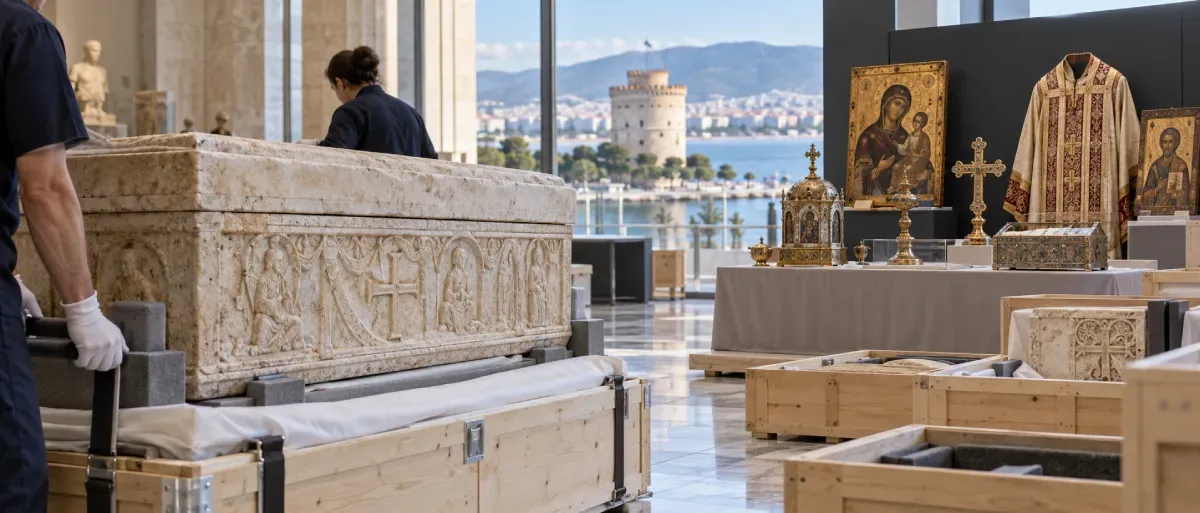
The Greek objects include icons, crosses, vestments, reliquaries and an episcopal throne removed in 1917 during World War I from religious institutions in northern Greece. They will remain on display at the Thessaloniki museum until November 5 before returning to the Monastery of Timios Prodromos in Serres, the Monastery of Panagia Eikosifoinissa and the Holy Metropolis of Serres and Nigrita.
Greece handed over remains attributed to Samuel together with other anthropological material recovered from four sarcophagi at the Basilica of St. Achillios on an island in Small Prespa Lake.
The remains were flown from Thessaloniki to Sofia aboard a Bulgarian military transport aircraft. MiG-29 and F-16 fighters escorted the plane after it entered Bulgarian airspace. A state ceremony followed in Sofia, where the remains were placed in a marble sarcophagus at the Basilica of St. Sophia.
Samuel and the Prespa connection
Samuel ruled the First Bulgarian Empire from 997 until his death in 1014 and spent much of his reign fighting the Byzantine Empire under Basil II.
His army suffered a decisive defeat at Kleidion in 1014. Byzantine chroniclers later wrote that thousands of Bulgarian prisoners were blinded on Basil II's orders and sent back to Samuel, who died soon afterward. Historians continue to dispute the number of prisoners and the direct connection between the episode and Samuel's death.
Prespa was among the political and religious centers of Samuel's state. The remains later attributed to him were uncovered during excavations led by Greek archaeologist Nikolaos Moutsopoulos at the Basilica of St. Achillios in the 1960s.
Accounts differ on the exact excavation year, citing 1964, 1965 and 1969. The identification rests on archaeological and anthropological evidence linked to the sarcophagus and its historical setting.
In Bulgaria, Samuel occupies a central place in the country's medieval historical narrative, and Sofia had sought the return of the remains for decades.
Mitsotakis said discussions dated back to the 1970s and talks between then Greek leader Konstantinos Karamanlis and Bulgarian leader Todor Zhivkov. The October agreement settles a cultural-property question that had remained open for roughly half a century.
Athens links the exchange to the Parthenon
Mitsotakis used the Thessaloniki ceremony to connect the agreement with Greece's campaign for the reunification of the Parthenon sculptures.
He said the return of the 48 objects and the transfer of Samuel's remains showed how cultural disputes could be resolved through negotiation. Greece and Bulgaria also agreed to identify other objects that could be covered by a future arrangement.
Mitsotakis then drew a direct line to the Parthenon sculptures, arguing that cultural objects cannot always be separated from the monuments and places to which they belong.
Athens has long argued that the Parthenon case concerns parts of a single monument rather than unrelated museum holdings. The Thessaloniki agreement gave the Greek government a new example to cite in that case.
Samuel remains part of a Bulgaria-North Macedonia dispute
Samuel's return also revived a long-running dispute over historical identity between Bulgaria and North Macedonia.
Bulgaria regards Samuel as a Bulgarian ruler and his state as part of the First Bulgarian Empire. His legacy also holds an important place in North Macedonia's national historical narrative, where medieval and revolutionary figures have repeatedly become points of contention with Sofia.
North Macedonian coverage quickly returned to the work of the Bulgarian-North Macedonian joint historical commission, which has dealt with Samuel as part of the two countries' effort to address disputes over shared historical figures and events.
North Macedonian Prime Minister Hristijan Mickoski responded by invoking another episode involving historical remains, the 1947 Bled Agreement and the later transfer of revolutionary figure Goce Delchev's remains to Skopje.
The agreement also extends beyond Samuel. Athens and Sofia will continue discussions over other cultural objects that could be returned under future arrangements, turning a decades-long negotiation over one medieval ruler into an ongoing restitution channel.
Sources: Office of the Greek Prime Minister, Greek Ministry of Culture, Bulgarian Council of Ministers, Bulgarian News Agency (BTA), Xinhua, Associated Press, Bosphorus News review and reporting.