
By Bosphorus News Energy Desk
Germany wants to increase gas imports from Azerbaijan, but President Ilham Aliyev says larger volumes will depend on new production, additional pipeline capacity and financing for those projects.
German Chancellor Friedrich Merz and Aliyev signed a Joint Declaration on a Strategic Agenda for Bilateral Partnership in Berlin on July 21. Its energy provisions cover natural gas, renewable power, low-carbon hydrogen, energy efficiency and infrastructure.
Merz said Germany wanted to diversify its energy supply through closer cooperation with Azerbaijan. He also pointed to existing and expandable infrastructure capable of carrying Caspian gas towards industrial consumers in southern Germany.
Azerbaijan began supplying gas to Germany under a 10-year contract signed in June 2025 between SOCAR and SEFE, the energy company owned by the German federal government. The agreement provides for deliveries of up to 15 terawatt hours, equivalent to approximately 1.5 billion cubic metres a year.
No new purchase agreement, price or delivery target was announced during Aliyev's visit.
Aliyev said Azerbaijani gas was reaching 10 European Union member states and that exports could increase if European buyers offered long-term commitments.
Additional supplies would require investment in new production and in the pipelines carrying Azerbaijani gas through Türkiye, Greece, Albania and Italy.
The Trans Adriatic Pipeline, the European section of the Southern Gas Corridor, brought its first expansion phase into operation at the start of 2026, adding 1.2 billion cubic metres of annual long-term capacity. Further growth would require new compressor stations and binding commitments from buyers.
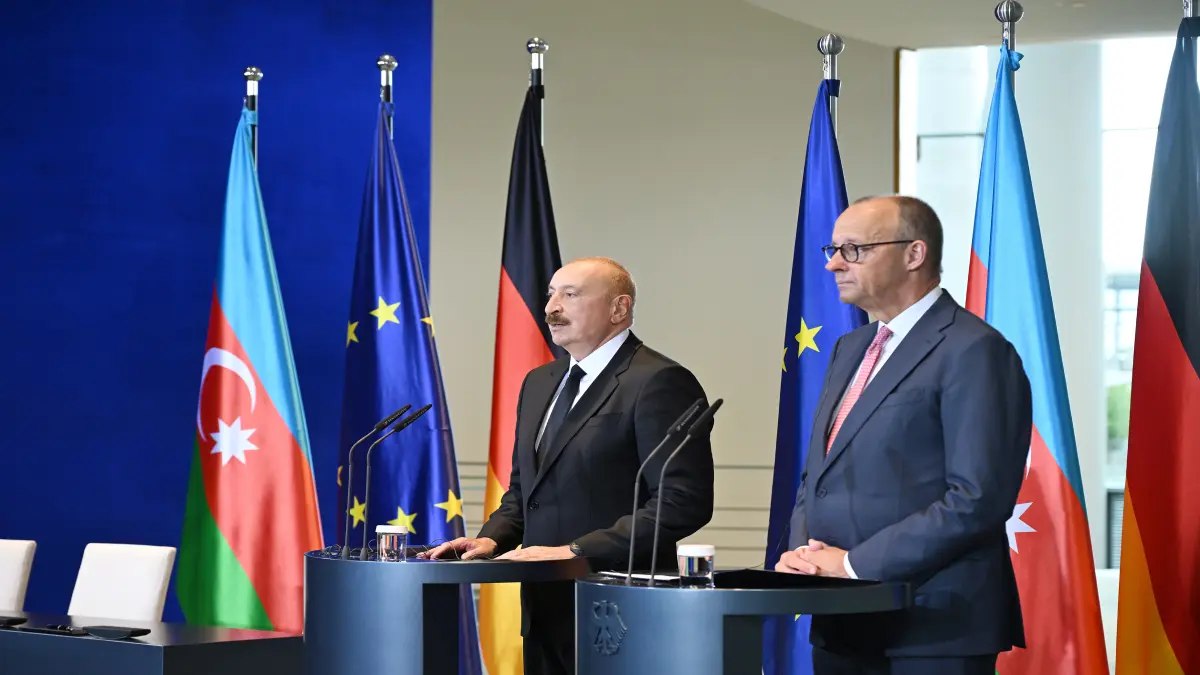
Aliyev criticised European restrictions on financing conventional energy projects. He said European governments were asking Azerbaijan for more gas while institutions such as the European Investment Bank had withdrawn support from oil and gas infrastructure.
The European Investment Bank decided in 2019 to stop financing unabated fossil fuel energy projects, including conventional gas infrastructure. Its current lending policy prioritises renewable energy, electricity networks, efficiency and infrastructure intended for low-carbon gases.
The bank had previously financed sections of the Southern Gas Corridor, including the Trans Adriatic Pipeline and the Trans-Anatolian Natural Gas Pipeline. Private financing remains possible, but one of the public channels used during the corridor's construction is no longer available.
The existing SEFE-SOCAR contract gives Germany another land-based source alongside Norwegian gas, European production and liquefied natural gas imports. Its annual volume remains small compared with German consumption and cannot replace the quantities previously supplied by Russia.
The declaration also calls for cooperation on green and low-carbon hydrogen, renewable electricity and energy efficiency.
Sources: German Federal Government, Office of the President of Azerbaijan, SEFE, Trans Adriatic Pipeline, European Investment Bank, Brussels Signal, Bosphorus News review and reporting.