
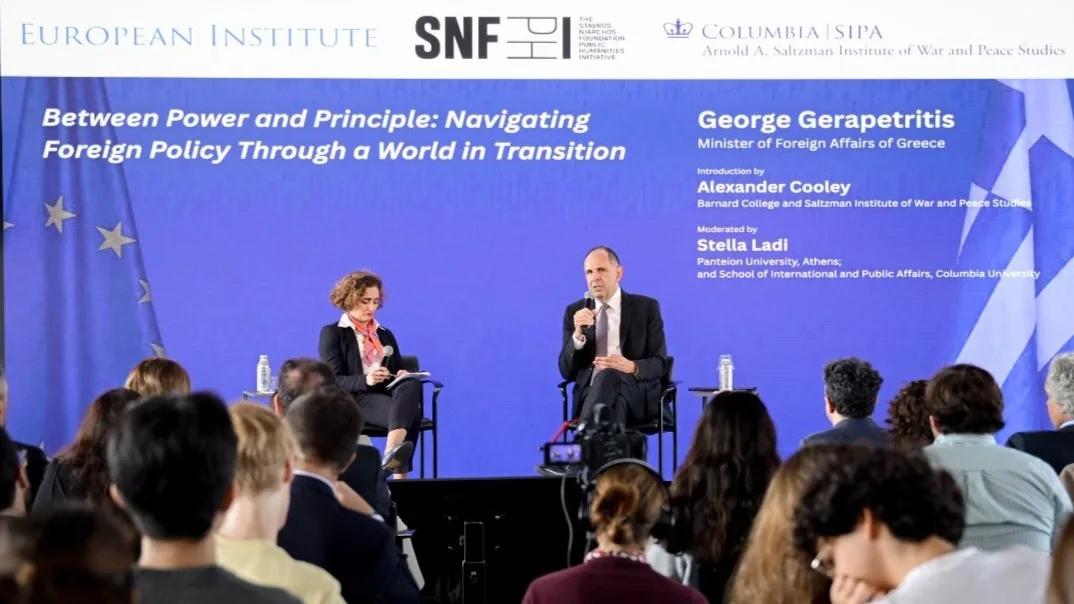
By Bosphorus News Geopolitics Desk
Greek Foreign Minister George Gerapetritis warned that international politics is moving back toward unilateralism and transactionalism as conflicts and global challenges increasingly cross national and regional boundaries.
Speaking at Columbia University in New York on September 23, Gerapetritis called this the "power paradox": power politics is returning just when cooperation and multilateralism are needed more than ever.
"Power politics have two basic features, the first is unilateralism, and the second is transactionalism," he said.
He said international law and multilateralism were retreating in the face of unilateral action, while relations between states were becoming increasingly transactional.
The question, he said, was how political realism could be combined with a principled international order.
Thucydides and the limits of power
Gerapetritis turned to Thucydides and the relationship between strong and weak states, focusing on the Melian Dialogue and Athens' destruction of Melos.
He rejected the idea that Thucydides simply offered a case for domination by stronger states. The lesson of Melos, he said, was also one of "self-deception": Athens destroyed Melos but only a few years later suffered major losses in Sicily.
"The question should be how we combine those two," Gerapetritis said of political realism and a rules-based order.
"Political realism should be combined with a principled international order because this is clearly the best idea," he said.
Gerapetritis then separated leadership from hegemonism.
"We need to place emphasis when it comes to political realism to political leadership and not hegemonism," he said.
"True leadership is essentially a matter of persuasion and not a matter of coercion."
He also contrasted deliberation with transactionalism, saying that what international politics lacked "above all" was "the deliberative spirit to reach rational decisions."
Two different uses of the veto
Gerapetritis contrasted the veto systems of the United Nations Security Council and the European Union.
At the UN, he said, the veto protects the strongest states. Pointing to Russia's war against Ukraine, Gerapetritis said the Security Council had failed to adopt a single resolution on the conflict because of Russia's veto.
The EU's unanimity requirement in foreign and security policy works differently, he said.
"Every single member out of the 27 member states of the European Union does possess a veto," Gerapetritis said.
That system was designed to protect the national interests and identities of individual member states, including smaller countries.
"In the case of the United Nations, the protection of the strongest member states, whereas in the European Union, the protection of the minor states," he said.
'The West to stay together'
Gerapetritis also pointed to Greece's maritime weight, saying the country represents more than 20% of the world's maritime fleet.
"I think the important thing is for the West to stay together," he said. "And this is not only an abstract and conceptual statement. This is, I think, an imperative for us."
He described alliances as multipliers and said international law and multilateralism remained necessary to address global challenges.
"We need to adhere to International Law. We need to adhere to multilateralism, not because we have no alternative. We need to adhere to multilateralism because this is the best model to actually address global challenges," Gerapetritis said.
He closed by saying a "critical mass" of people, including leaders of significant states, now believe multilateralism is dead. For small and medium-sized states, he said, that prospect was both concerning and "very scary."
"A civil society, an international community without rules and principles, is only a jungle," Gerapetritis said.
"So, when we speak of multilateralism, please do not use nostalgic terms. It is still there and we need to work for this."
Sources: Hellenic Ministry of Foreign Affairs, Bosphorus News review and reporting