
By Bosphorus News Geopolitics Desk
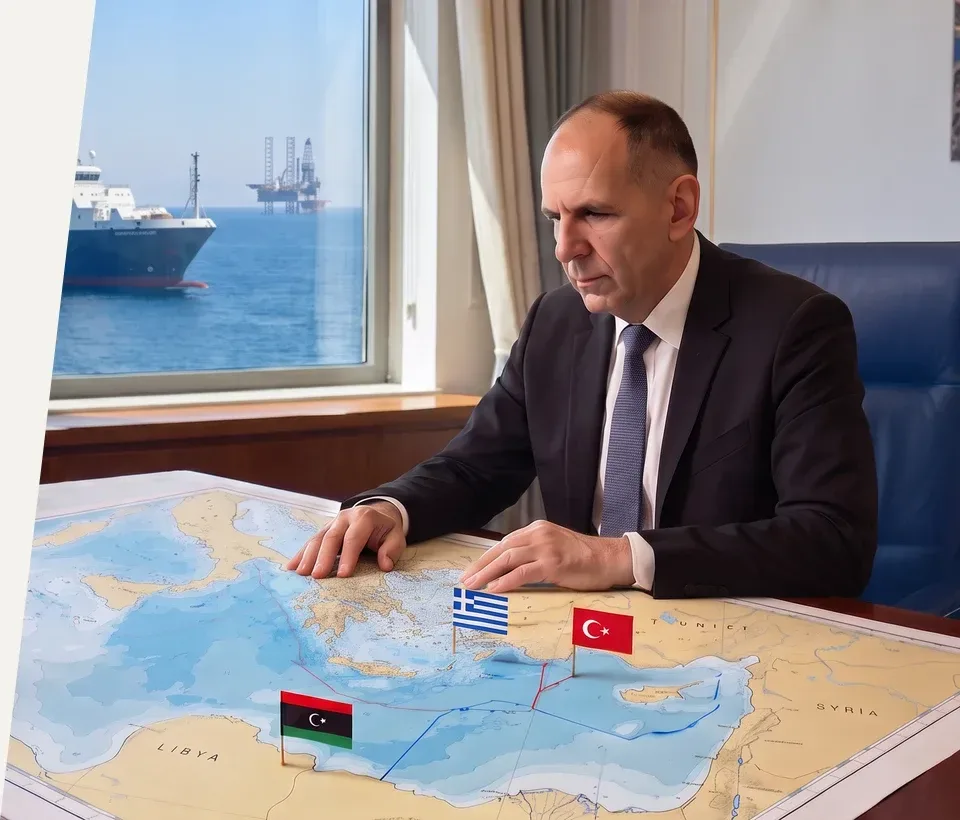
Greek Foreign Minister Giorgos Gerapetritis said he does not rule out an attempt by Türkiye or Libya to obstruct Chevron's planned seismic surveys south of Crete. "I do not rule anything out, however unlikely it may seem," he told Ta Nea in an interview published on 21 November.
The question put to him was whether Türkiye or Libya could invoke the 2019 Türkiye-Libya maritime memorandum to obstruct the surveys. Gerapetritis said uncertainty in international relations makes reliable prediction impossible and requires Greece to prepare for every scenario. He said the blocks granted to Chevron by both the Greek and the Libyan side respect the median line, in line with Greece's position under the law of the sea, and described this as an early positive sign. He added that a company of Chevron's size would have carried out a full legal review of the claims before signing contracts with the Greek and Libyan states.
Oikonomikos Tachydromos reported on 19 November that a Hellenic Coast Guard application covers Chevron surveys in Block A2 and the South of Peloponnese area through 31 January 2027. The report said the two South Crete blocks are expected to follow in 2027. In February, the Turkish Defence Ministry said Greek activities with Chevron south of Crete infringe the 2019 memorandum and that the blocks overlap with Libya's declared continental shelf. Libya has also protested formally against Greek exploration in the area, according to Cyprus Mail.
Gerapetritis repeated Greece's position that the memorandum is invalid and produces no legal effect because it contradicts the law of the sea, a position Greek diplomatic sources said he also put to Turkish Foreign Minister Hakan Fidan in Brussels on 16 November. He said ratification by Libya's House of Representatives does not change that. He said the 27 EU member states, the United States, Israel, the United Arab Emirates, Bahrain and Egypt share this position, and that Egypt sent a letter on the matter to the United Nations. He said technical talks with Libya on their maritime zones are due to start in the coming period. A country that tries to produce unlawful effects against another through unilateral action should expect consequences, he said, and Greece has informed its partners and allies.
Asked about a possible Turkish bill on "Blue Homeland", Türkiye's own doctrine on its maritime jurisdiction areas, Gerapetritis described the concept as an unfounded maximalist theory with no basis in the law of the sea. He said Greece is monitoring the legislative initiative, has informed its partners and allies, and will assess the content once an official text exists. He said Greece seeks dialogue based on international law but considers unilateral actions that harm its interests unacceptable.
On dialogue, Gerapetritis said Greece is working toward the next round of political dialogue and positive agenda talks in Türkiye on 7 and 8 December. Contacts on confidence-building measures continue, and the two delegations last met in Athens on 9 October. He said structured dialogue has run since 2023, that fundamental differences remain, and that working channels help prevent crises.
On territorial waters, he said Greece's right to extend them to 12 nautical miles is unilateral and would be exercised at a time and in a manner Greece chooses. He cited earlier extensions in the Ionian Sea and as far as Cape Tainaron.
On the United Nations, he confirmed that Greece does not support the candidacy of Feridun Sinirlioğlu for secretary-general. He said the post requires guarantees of independence and impartiality, and cited Türkiye's non-implementation of UN resolutions on Cyprus and its non-ratification of the 1982 UN Convention on the Law of the Sea.
On the Greece-Cyprus electricity link, he said he expects work to continue without disruption. He said Greece issued the necessary permit and NAVTEX for work on its continental shelf. His remarks follow a radio exchange between Turkish and Greek frigates near the French survey vessel Abeille Marengo south of Karpathos on 12 November. He rejected claims that a French diplomatic note delivered to Türkiye gives Ankara evidence for maritime rights, saying no communication creates sovereign rights or a legal precedent.
Sources: Ta Nea, Oikonomikos Tachydromos, Greek Reporter, Cyprus Mail, Bosphorus News review and reporting.