
By Prof. Dr. Mehmet Hasgüler | Guest Commentary
Prof. Dr. Mehmet Hasgüler is a Turkish Cypriot scholar of international relations and Cyprus studies. He previously served as deputy chair of YÖDAK and ran as an independent candidate in the 2025 Turkish Cypriot presidential election. He has written extensively on the Cyprus conflict.
The views expressed are those of the author and do not necessarily reflect the editorial position of Bosphorus News.
The European Parliament adopted a resolution on July 8 addressing sexual violence against Cypriot women and girls during the events of 1974. It passed with 575 votes in favour, 33 against and 43 abstentions, calling for recognition, accountability and support for survivors.
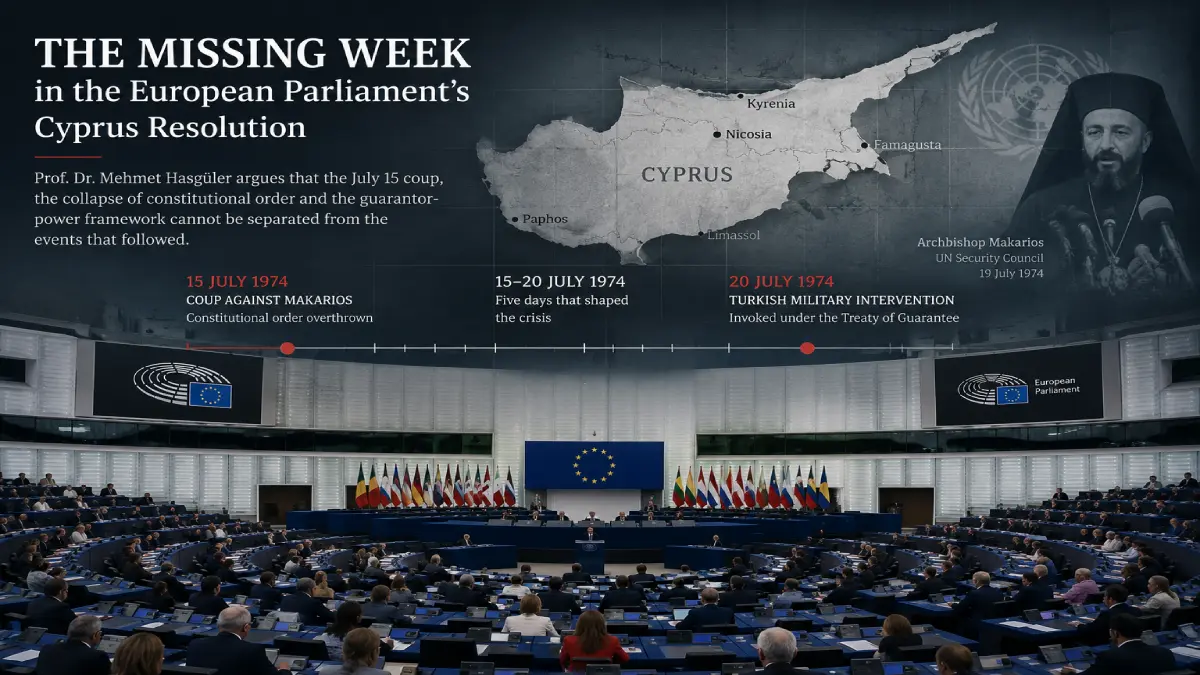
Allegations of sexual violence must be investigated, and survivors have the right to be heard. Historical accountability weakens, however, when chronology is broken. The Parliament's account begins with Türkiye's military intervention on July 20 and leaves the five days that preceded it largely outside the record.
On July 15, 1974, the military junta ruling Greece backed a coup against Archbishop Makarios, the elected president of the Republic of Cyprus. The operation was carried out through the National Guard and forces associated with EOKA B. Makarios escaped and addressed the United Nations Security Council on July 19.
During that debate, Makarios and several speakers described the role of Greek officers, the overthrow of the constitutional order and the responsibility of the government in Athens. The crisis was also discussed within the framework of the Treaty of Guarantee and the obligations held by Türkiye, Greece and the United Kingdom.
Any account of what followed must begin there.
The Conflict Did Not Begin on July 20
The European Parliament is entitled to investigate sexual violence attributed to Turkish forces. It should also examine what happened during the coup and the armed conflict that began five days earlier.
Supporters of Makarios, members of the Progressive Party of Working People and others targeted by the coup forces faced detention, violence and killing. Turkish Cypriot women also suffered abuse during the wider conflict. During the parliamentary debate, AKEL Member of the European Parliament Giorgos Georgiou acknowledged atrocities committed against Turkish Cypriot women by Greek Cypriot paramilitary groups.
A credible inquiry should cover every community and every armed actor. Expanding the record would not diminish the suffering of Greek Cypriot women. It would include victims excluded by the political boundaries of the resolution.
The events after July 20 cannot be separated from the coup that destroyed the constitutional order on July 15.
The Guarantor Framework
The Republic of Cyprus was established in 1960 under a constitutional system backed by Türkiye, Greece and the United Kingdom as guarantor powers. The coup overturned that system and installed a leadership tied to the Greek junta's enosis project.
Türkiye consulted the United Kingdom, the other available guarantor power, before acting alone. It subsequently invoked its rights and obligations under the Treaty of Guarantee.
The legality, scale and consequences of Türkiye's intervention remain contested. Greek Cypriot institutions and the European Parliament describe it as an invasion followed by occupation. Türkiye argues that the first military operation was conducted under the guarantor framework after the Greek-backed coup.
Those legal positions cannot be assessed by removing one side of the chronology. The coup, the collapse of constitutional government and the guarantor system formed the immediate setting in which Türkiye acted.
The NATO Question
The resolution was not prepared overnight in response to the NATO summit in Ankara. The rapporteur was appointed in September 2025, and the European Parliament's Committee on Women's Rights and Gender Equality approved the draft in June 2026.
Its adoption immediately after the summit still invites political interpretation. European governments are seeking deeper defence cooperation with Türkiye, while the Parliament has presented one of the most disputed episodes in Türkiye's modern history through a narrowly selected chronology.
The timing is open to political reading. It is not evidence that the resolution was commissioned as retaliation for Türkiye's role at the summit.
The Turkish Side's Documentation Failure
The European Parliament's selective account is only part of the problem.
Successive governments in Türkiye and Turkish Cypriot institutions have failed to build an internationally accessible record of the violence of 1963-64, the crisis of 1967 and the July 15 coup. They have not produced a sustained body of work grounded in archival evidence, international law, verified testimony and human-rights standards.
Anniversary speeches and official declarations are no substitute for documented case files.
A serious record requires named victims, corroborated testimony, archival material, legal analysis and independent scrutiny. It must withstand examination by scholars, courts and international institutions, including readers who do not already accept the Turkish position.
Without that work, other institutions decide where the history begins, which documents enter the record and whose suffering receives international recognition.
Türkiye and Turkish Cypriot institutions have repeatedly objected to decisions taken in European and international forums. They have invested far less in the research, archival access and diplomatic preparation required to influence those decisions before they are made.
A Shared History Cannot Be Built From Selected Victims
The European Union says it supports reconciliation and a comprehensive settlement between Greek Cypriots and Turkish Cypriots. A historical initiative that recognises the suffering of one community while leaving the other at the edge of the record cannot build trust between them.
The testimony of Greek Cypriot women should be heard, investigated and preserved. The same standard should apply to Turkish Cypriot women, victims of the coup period and those harmed by every armed formation involved in the conflict.
A comprehensive European inquiry would examine sexual violence across both communities, the coup between July 15 and July 20, the fighting that followed and the institutional failures that kept survivors silent for decades.
Europe cannot build a shared memory of Cyprus by documenting only one part of its history. Türkiye cannot expect others to fill the gaps left by its own archives.
Sources: European Parliament, United Nations Security Council records, Prof. Dr. Mehmet Hasgüler's original exclusive Bosphorus News commentary, Bosphorus News review and editing.