
By Bosphorus News Geopolitics Desk
The SOFA Trigger
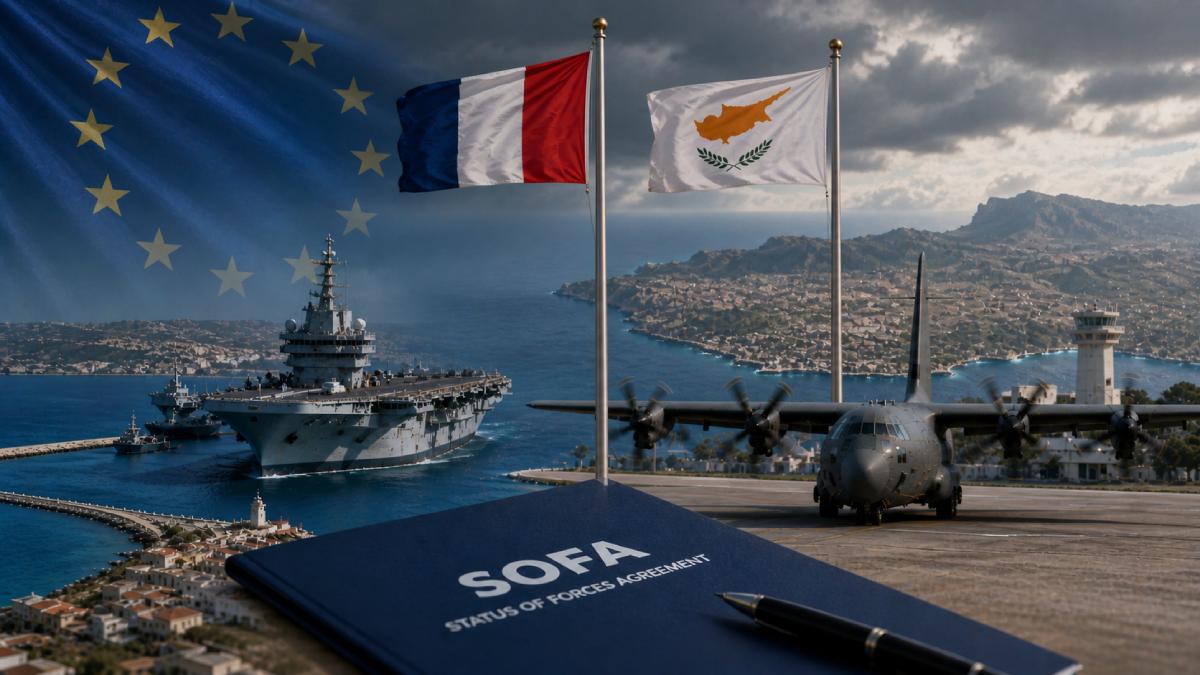
Cypriot President Nikos Christodoulides confirmed on April 26 that a Status of Forces Agreement with France would be signed at ministerial level in June. A SOFA is a legal framework governing the conditions under which foreign military personnel may operate on another country's territory. The announcement drew immediate reactions from Ankara and the Turkish Cypriot administration. It was framed as a bilateral defence step. The framing was accurate but incomplete.
The SOFA builds on a strategic partnership agreement signed in Paris in December 2025, which established structured cooperation across defence, energy, security, innovation and education through 2030. France has since conducted joint amphibious exercises with Cyprus, deployed naval assets to the Eastern Mediterranean following the early March drone strike on RAF Akrotiri, and entered advanced procurement talks covering Griffon armoured personnel carriers, Serval light tactical vehicles and upgrades to existing VAB armoured personnel carrier units. French-linked technical discussions over naval infrastructure at the Mari naval base have also been reported.
Government spokesman Konstantinos Letymbiotis described the SOFA as the next step in deepening Franco-Cypriot cooperation. "Relations with France are at their closest level," he said on April 27. "The agreement will strengthen humanitarian military cooperation and joint action at a regional level." Christodoulides was more direct about the scope. "What we sign are not just texts to take a picture," he said. "They are substantive texts, proven in practice to have an effect." He pointed to France's deployment of naval assets to the region after the Akrotiri strike as evidence of what the relationship already produces before the SOFA is signed.
The Real Shift Is Broader Than France
France is one strand in a pattern that has been building for over a year. As Bosphorus News reported in April, Cyprus has been deepening defence coordination across multiple tracks simultaneously: a trilateral framework with Greece and Israel covering joint planning, exercises and coordinated defence activity; an expanding procurement relationship with European and US suppliers; and a growing network of bilateral SOFA-type arrangements that embed foreign military access into the island's legal and operational framework.
The physical layer is also changing. Infrastructure at key Cypriot facilities has been upgraded to handle heavier aircraft, sustain higher operational tempo and support rotary-wing operations. New heliport capacity and heavy-lift handling point to planning that anticipates prolonged contingency use rather than episodic missions. As Bosphorus News tracked, the island is being built into a wider European crisis-response platform where civil and military assets can be sequenced from a single location, including evacuations under the Estia plan, Cyprus's evacuation framework for foreign nationals in regional conflict zones, firefighting coordination and humanitarian access to the Levant.
After the early March Akrotiri strike, Macron said: "When Cyprus was attacked, it was all of Europe which was attacked." The formulation was political. The infrastructure being built around it is operational.
The Playbook Nobody Has Written Yet
The most significant development of the week did not involve France. It happened at the informal EU summit held in Nicosia and Ayia Napa on April 23 and 24, where European leaders agreed for the first time to develop an operational blueprint for Article 42.7 of the Treaty on European Union, the bloc's mutual defence clause requiring member states to aid an attacked fellow member "by all means in their power."
Article 42.7 has been invoked once in the EU's history. France triggered it after the November 2015 Paris attacks. The response was limited to intelligence sharing. No military mechanism existed. No operational procedure was in place. The clause sat in the treaty without a practical activation framework for over a decade.
Christodoulides used Cyprus's rotating EU Council presidency to change that. "We have Article 42.7 and we don't know what is going to happen if a member state triggers this article," he told AP ahead of the summit. After two days of talks, the answer began to take shape. "We agreed last night that the European Commission will prepare a blueprint on how we respond in case a member state triggers Article 42.7," he said. European Council President António Costa confirmed the mandate. The Commission is now tasked with producing the first operational procedure for a clause that has existed since the Lisbon Treaty without one.
Macron pressed the point in Athens the day before the summit. "On Article 42, paragraph 7, it's not just words," he said. "For us, it is clear, and there is no room for interpretation or ambiguity." EU defence ministers will meet in Cyprus in May to carry the process forward. The island that prompted the discussion is also hosting the meetings where the framework is being written.
Ankara's Reading
Türkiye's National Defense Ministry named France and Greece directly in its April 30 statement, warning that scenario-based remarks by both NATO allies risk increasing tensions. "In any situation involving security and stability, those who position themselves against Türkiye will not prevail, while those who act alongside Türkiye will," it said. On Cyprus specifically, the ministry recalled Türkiye's status as a guarantor power under the 1960 Treaty of Guarantee and questioned the security rationale for a French deployment. "Such steps could disturb the island's sensitive balance and raise tensions," it warned.
Turkish Republic of Northern Cyprus (TRNC) Prime Minister Ünal Üstel set the tone three days earlier. "What is expected of Macron and the EU is that they abandon their colonial mentality in approaching the Cyprus issue and adopt a fair stance," he said in a formal statement on April 27. TRNC National Assembly Speaker Ziya Öztürkler addressed Macron directly on April 28: "Let Macron know: it is not French soldiers but the presence of the Motherland Türkiye that determines the balance on this island. Do not try to set up new games under the shadow of your colonial past."
Ankara's objection rests on a legal and political claim that the EU process does not address. Cyprus's political division remains unresolved. Türkiye is a guarantor power under the 1960 Treaty of Guarantee. The blueprint now being developed by the European Commission makes no reference to that treaty or Türkiye's role under it.
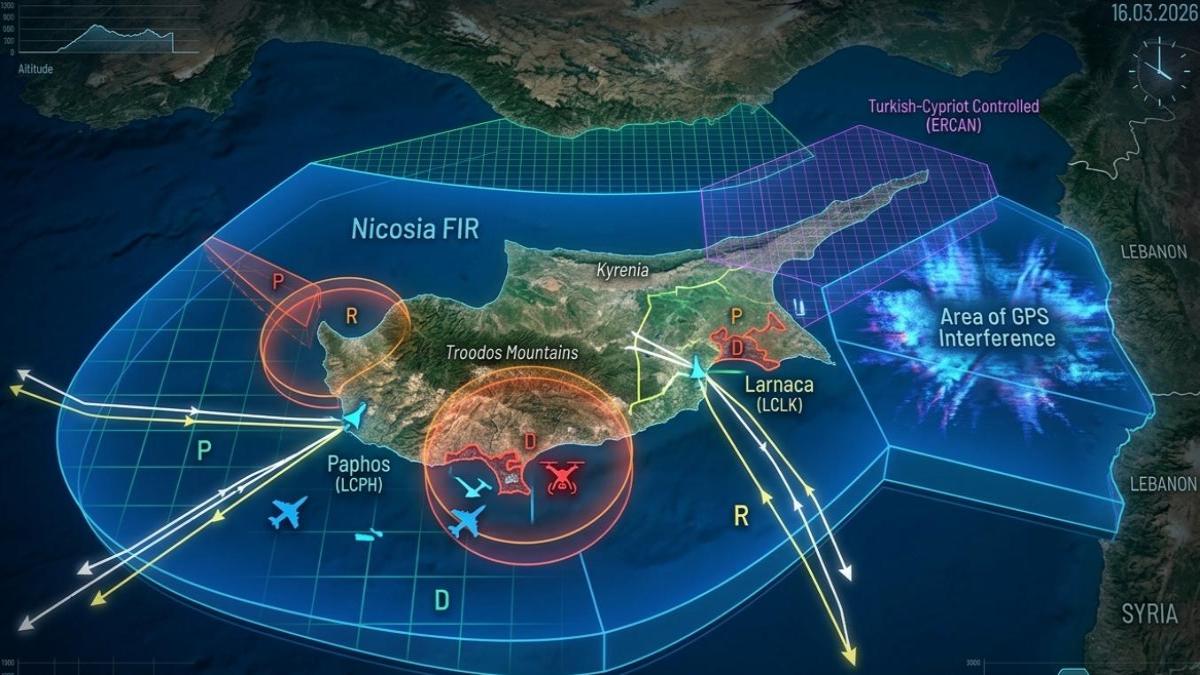
No mechanism exists to reconcile EU collective defence procedures with the Treaty of Guarantee's framework on a divided island. That gap is the core of Ankara's position. As Bosphorus News reported, strategic friction in this environment emerges less from explicit confrontation than from the consolidation of interoperable security ecosystems around Türkiye's maritime and airspace neighbourhood.
Türkiye carries NATO obligations in the same theatre, but the EU defence layer now being written around Cyprus is outside Ankara's institutional reach. As Bosphorus News analysed, Cyprus is being repositioned from a passive fault line into an operational node within a European defence layer that sits adjacent to NATO rather than fully inside it.
What the SOFA Does Not Resolve
France's spokesman Pascal Confavreux walked back part of Macron's Athens remarks on May 1, saying Türkiye had not been specifically targeted and that Paris remains committed to developing bilateral relations with Ankara. The clarification did not alter the SOFA timeline, the Article 42.7 blueprint mandate, the defence ministers' meeting in Nicosia in May or the infrastructure upgrades already under way on the island.
The Cyprus problem has not been solved. The next meeting between Christodoulides and TRNC leader Tufan Erhürman is scheduled for May 8 at the UN Special Representative's residence in the buffer zone. Four informal meetings have produced no concrete output. Erhürman has been explicit about what the process cannot deliver in its current form. "Does anyone really think there can be a solution on this island by ignoring Turkish Cypriots?" he said ahead of the May 8 meeting.
The unresolved Cyprus problem is no longer an obstacle. It has become irrelevant to the process.
For the first time, the European Commission is writing operational procedures for a mutual defence clause that existed on paper for over a decade. For the first time, EU defence ministers are convening in Nicosia. For the first time, France is acquiring a legal right to station forces on a divided island where Türkiye holds guarantor status under international treaty. Not one of these steps required Ankara's consent. Not one acknowledged the Treaty of Guarantee. The blueprint being drafted in Brussels does not mention it. The SOFA being signed in June does not reference it.
Türkiye is a guarantor power on paper and an observer in practice. The island it has legal standing over is being written into Europe's security architecture without it, around it, and faster than the political process that was supposed to come first.
If a guarantee is never invoked, never consulted and never referenced in the documents reshaping the territory it covers, does it still exist as anything other than a legal formality waiting for a crisis to test it?
***Sources: Cyprus Mail, Euronews, Al Jazeera, Associated Press, EU Council official conclusions April 23-24 2026, TRNC Prime Ministry official statement April 27 2026, Türkiye National Defense Ministry briefing April 30 2026, CyBC To Trito radio, Philenews, Bosphorus News reporting.