
By Bosphorus News Geopolitics Desk
Türkiye has placed Cyprus, the Black Sea and southern Syria inside the same security assessment as attacks on commercial shipping widen across the region. A Samsun-bound vessel has been struck near Novorossiysk, while Washington and Tehran are giving conflicting accounts of diplomacy over the Strait of Hormuz.
Türkiye Updates Cyprus Readiness, Points to Greek Cypriot-Israeli Ties
Defense Minister Yaşar Güler said Türkiye had updated its military readiness concerning Cyprus and the Turkish Republic of Northern Cyprus (TRNC), citing expanding military and strategic cooperation between the Greek Cypriot government and Israel.
Güler made the statement in a written response to a parliamentary question from Republican People's Party (CHP) Gaziantep deputy Hasan Öztürkmen, who asked how Türkiye intended to respond to closer security cooperation among the United States, Israel, Greece and the Republic of Cyprus in the Eastern Mediterranean.
The minister said Türkiye was examining developments on the island and across the region, including Israeli activities involving the Greek Cypriot side, and continued to take military and political measures to protect Türkiye and the TRNC and preserve the balances on Cyprus.
The response disclosed no unit movements, deployment figures or timetable for the revised readiness level. It did, however, identify Greek Cypriot-Israeli cooperation as a factor in Türkiye's military planning rather than referring only to a general deterioration in regional security.
Güler placed Cyprus alongside two other operational fronts. He said Türkiye was working with NATO allies Bulgaria and Romania to maintain security in the Black Sea under the principle of regional ownership, while supporting a negotiated end to the war in Ukraine.
On Syria, he said Israeli actions in the south, including measures Türkiye considers violations of the 1974 disengagement agreement, were increasing tension. Türkiye, he added, remained in coordination with the Syrian government over the country's territorial integrity and security.
Samsun-Bound Vessel Hit Near Novorossiysk
The Ro-Ro cargo vessel Nadezhda was struck by a drone while sailing from Novorossiysk to Samsun, adding a direct Türkiye-linked incident to the mounting pressure on Black Sea commercial shipping.
The vessel was hit around 20 nautical miles from Novorossiysk. Three crew members were seriously injured, all 22 people aboard were evacuated and a fire broke out in the forward section. No party had claimed responsibility, and the attacker had not been independently established.
The strike came as tighter security measures were already disrupting Russia's Black Sea export network. Three major grain terminals at Novorossiysk and Taman recently restricted truck deliveries after attacks and navigation controls redirected cargo from the Sea of Azov.
Those restrictions had shifted pressure onto roads, railways, storage sites and terminal access. The attack on Nadezhda returned the risk to the sea and placed another vessel serving Türkiye inside the Black Sea war zone.
Israel and Lebanon Open New Round of Rome Talks
Technical delegations from Israel and Lebanon began a new round of US-brokered talks in Rome on August 4. The meetings are scheduled to continue through August 6 and focus on implementing the framework reached during the previous round.
The agenda includes expanding pilot zones in southern Lebanon, resolving outstanding border issues and advancing negotiations toward a broader security agreement. The framework calls for Hezbollah's disarmament, a phased Israeli withdrawal and the deployment of Lebanese Armed Forces units in areas previously held by the group.
Pilot-zone operations began in July in Froun, Srifa and Zawtar al-Gharbiya. Lebanon has accused Israel of obstructing the army's full deployment, while Israeli officials have resisted committing to further withdrawals and insist on retaining the ability to act against perceived threats.
The dispute has moved from the framework itself to its implementation. Beirut wants Israeli forces and operations removed from areas transferred to state control, while Israel is seeking to preserve military freedom of action after withdrawal.
Washington and Tehran Disagree Over Hormuz Diplomacy
US President Donald Trump said he had called off a planned large-scale strike on Iran after regional governments urged restraint and claimed that negotiations had resumed over the Strait of Hormuz.
Iran rejected the assertion that direct talks with the United States were underway. Foreign Ministry spokesman Esmaeil Baghaei said Tehran was discussing a temporary maritime arrangement with Oman, but no US-Iran negotiating process was taking place.
Washington is presenting the contact as diplomacy that could reopen the strait. Tehran describes it as an Omani channel focused on temporary navigation arrangements that would not settle the wider conflict or surrender Iranian claims over the waterway.
Türkiye, Pakistan, Qatar and Oman have passed messages between the parties during earlier phases of the crisis. Ankara has a direct interest in preventing a prolonged closure or further military escalation because higher Gulf freight, insurance and energy costs would feed into Turkish trade and import prices.
Commercial shipping remains under pressure. Tankers have continued to divert around Africa to avoid threats in the Red Sea and uncertainty around Hormuz, adding time and cost to voyages between the Gulf, Europe and the Mediterranean.
Drone Strike at Damietta Extends War Risk to Egypt
A drone struck the US-owned Energos Winter, a Marshall Islands-flagged floating storage and regasification vessel at Egypt's Damietta port on July 29. The resulting fire spread to the nearby GasLog Salem before emergency crews brought it under control.
Egypt's cabinet said a preliminary investigation had determined that a drone caused the incident. No deaths or injuries were reported, and no state or armed group had credibly claimed responsibility.
The incident was the first confirmed drone attack on Egyptian territory since the current Iran-US war began in February. It extended a conflict previously concentrated around Gulf shipping, the Strait of Hormuz, the Red Sea and military positions elsewhere in the region.
Damietta is part of Egypt's gas import, processing and liquefied natural gas infrastructure. A sustained threat to the port would affect Egyptian energy security and plans to use Egypt as a processing and export route for offshore gas produced around Cyprus.
MOL Buys Shell's Aphrodite Stake
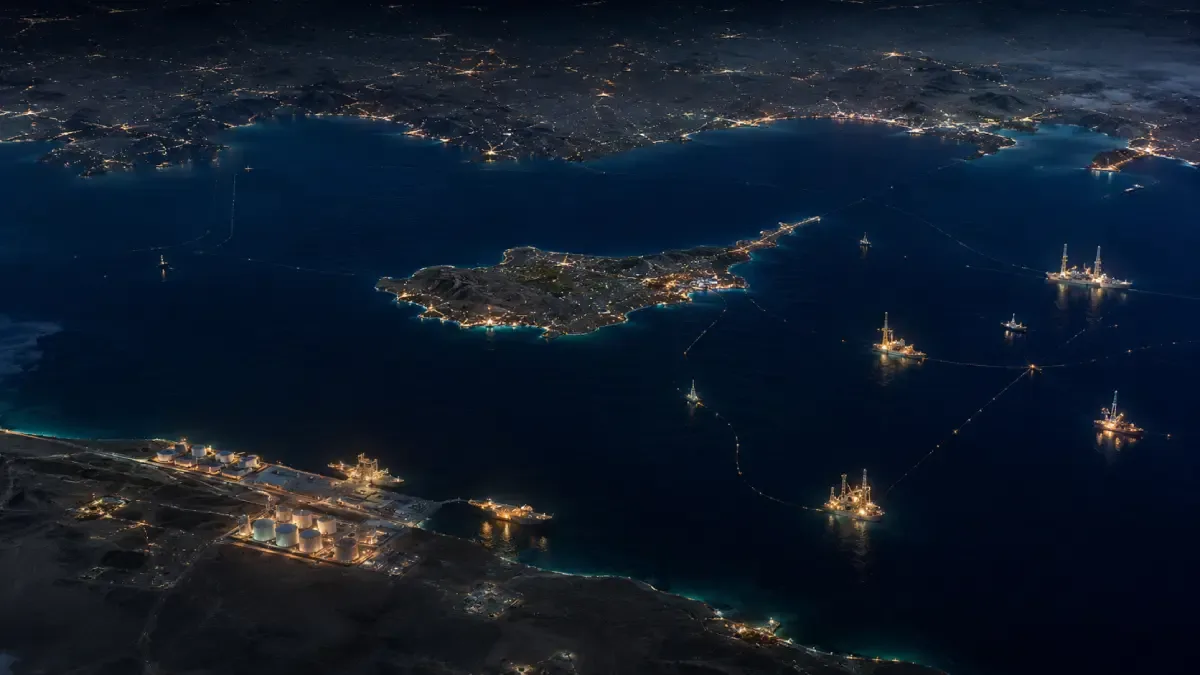
Hungarian energy group MOL has agreed to buy Shell's 35 percent interest in the Aphrodite gas field offshore Cyprus for up to $720 million, securing its first direct position in the Eastern Mediterranean gas sector.
MOL will acquire BG Cyprus, the Shell subsidiary holding the stake in Block 12 of the Republic of Cyprus' exclusive economic zone. Chevron will remain operator with 35 percent, while Israel's NewMed Energy will retain 30 percent.
The Aphrodite transaction changes the shareholder structure but does not resolve the field's development timetable. The current concept envisages offshore production connected by subsea pipeline to Egyptian processing and LNG infrastructure, with a final investment decision expected later in the decade.
The acquisition follows progress at the separate Cronos field and adds weight to plans for Egypt to process and export Cypriot offshore gas. The Damietta strike introduces an immediate security risk into a model already dependent on cross-border infrastructure, regulatory approval and coordination among the Republic of Cyprus, Egypt and Israel.
Azerbaijan Keeps Council of Europe Exit Under Consideration
President Ilham Aliyev said Azerbaijan had seriously considered leaving the Council of Europe and had not abandoned the option as its dispute with the Parliamentary Assembly of the Council of Europe (PACE) enters a third year.
Azerbaijan remains a member of the 46-state organization and has not filed a formal withdrawal notice. Its parliamentary delegation has been absent from PACE since the assembly refused to ratify its credentials in January 2024.
Aliyev said a complete departure had been postponed after Council of Europe Secretary General Alain Berset sought to preserve dialogue, but added that no progress had followed. Baku says its delegation's rights must be restored before it returns. PACE maintains that Azerbaijan must address concerns over democratic standards, human rights and cooperation with monitoring bodies.
The Council of Europe dispute runs alongside Azerbaijan's expanding political and transport ties with Central Asia. Baku is strengthening its eastward connections while leaving open a rupture with an institution linked to the European Convention on Human Rights and the European Court of Human Rights.
Strategic Takeout
Türkiye's Cyprus response is unusually specific in naming Greek Cypriot-Israeli cooperation as a factor in military readiness. The Defense Ministry also placed Cyprus, the Black Sea and Syria in a single official security assessment.
The Nadezhda strike adds a maritime attack to the pressure already affecting Russian terminals, truck deliveries and grain logistics. A vessel sailing to Türkiye has now been hit directly, with three crew members seriously injured.
The Rome talks and the Hormuz channel face different disputes over implementation. Israel and Lebanon disagree over withdrawal and military access in transferred areas. Washington and Tehran do not even agree publicly that negotiations are taking place.
Damietta and Aphrodite connect the day's security and energy files. Egypt is being positioned as the processing and export outlet for Cypriot offshore gas, but the drone strike shows that the infrastructure supporting that route is exposed to the same conflict spreading through the Red Sea and the Gulf.
Sources: Türkiye's Ministry of National Defense, Turkish Grand National Assembly records, US Department of State, Egyptian Cabinet, Reuters, AP, MOL Group, Shell, Presidency of Azerbaijan, Parliamentary Assembly of the Council of Europe, Bosphorus News review and reporting.
Read Yesterday's brief: Eastern Mediterranean Brief August 3, 2026.