
By Bosphorus News Geopolitics Desk
The European Commission's 2026 Country Report on Cyprus credits the Greek Cypriot administration with solid growth and stronger public finances, but the same document points to energy, defense and regional security pressures that reach directly into Türkiye's Eastern Mediterranean file.
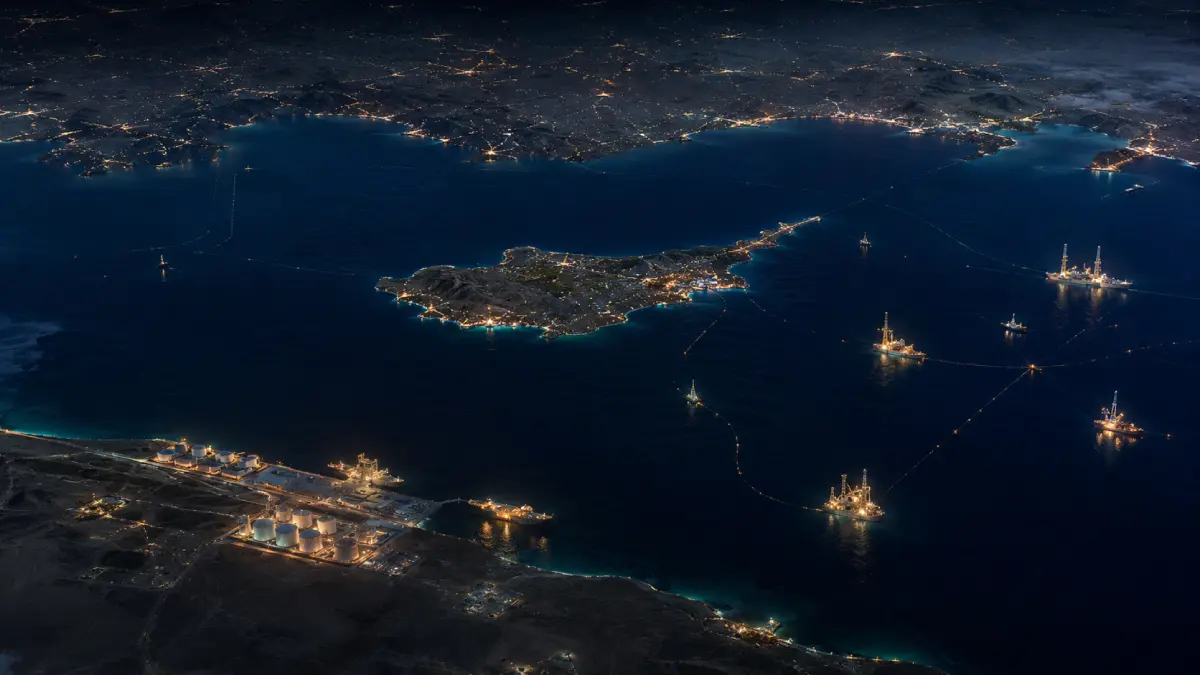
The strongest signal is energy. The report says the Greece-Cyprus-Israel electricity interconnection has faced significant delays, leaving Cyprus exposed as an isolated island energy market. The project, now widely discussed as the Great Sea Interconnector and formerly known as the EuroAsia Interconnector, is designed to link Cyprus with Greece and Israel through a subsea power cable.
The cable belongs to the same Eastern Mediterranean map where Türkiye's maritime claims, Greek Cypriot energy needs, Greece's grid ambitions and Israel's regional energy role intersect. The Commission's warning over significant delays now gives fresh weight to the earlier Bosphorus News reading of the Türkiye-Greece-Cyprus-Israel cable and EastMed funding risk.
Cyprus remains the only EU member state not connected to the European electricity grid. The interconnector was meant to reduce that isolation by giving the island a physical power link to Greece and, later, Israel. Delays leave Nicosia more dependent on imported energy, higher electricity costs and regional shocks.
The report also points to delays in Cyprus's LNG import terminal. That second delay reinforces the same problem. Nicosia is trying to reduce its energy isolation, but the island's main infrastructure projects remain behind schedule.
Ankara is building the opposite energy picture. Türkiye is promoting gas, electricity and logistics corridors linking Anatolia, the Turkish Republic of Northern Cyprus, the Caspian, the Black Sea and the Mediterranean, with the planned Türkiye-TRNC gas pipeline now part of a wider debate over alternative routes into Europe.
The energy gap is not only technical. It touches the political core of the Cyprus file. Nicosia is seeking EU-backed energy connectivity through Greece and Israel, while Ankara is building its own route logic through Türkiye, the TRNC and wider corridor projects. The Commission report shows how those two maps now run in parallel.
Defense financing is the second major Türkiye-related detail. Cyprus has received approval for 1.2 billion euros under the EU's SAFE, Security Action for Europe, instrument, an amount equal to 3.1 percent of its GDP. The figure is politically sensitive because it gives a non-NATO EU member on a divided island access to large-scale European defense financing.
The funding is likely to be viewed in Ankara through the wider militarisation and security architecture around the island. Nicosia has already deepened coordination with Greece, Israel and other partners, while Türkiye continues to treat the Cyprus file as a core security question, not only a diplomatic dispute.
The Middle East adds another layer to the report's relevance. Israel was Cyprus's second-largest tourism market in 2025, showing how deeply the island's economy is tied to the same regional security environment shaping its defense diplomacy. Gaza, Lebanon and the wider Levant are not distant crises for Nicosia. They affect tourism, aviation, investment sentiment and the island's image as a safe European gateway close to the conflict zone.
Cyprus's growth model depends heavily on external demand, services, tourism, finance, real estate and foreign capital. Those sectors perform well in calm periods, but they are sensitive to war risk, energy prices and shifts in regional confidence. The Commission's report does not present Cyprus as a weak economy, but it does show how narrow parts of the model remain.
The fiscal picture gives Nicosia room to move. Growth is solid, public finances have improved and debt dynamics are more comfortable than in Greece. The island's problem is different. Cyprus is small, dependent on external flows and physically placed inside the security geography linking Israel, Lebanon, Gaza, the British bases, Greece and Türkiye.
Housing pressure and foreign demand add a secondary vulnerability. The economy has benefited from investment, tourism and international services, but the same model has fed affordability concerns and social strain. In Cyprus, property is never only an economic issue. It sits close to questions of demography, territorial control and the island's unresolved political order.
The report's Türkiye relevance lies less in Cyprus's headline growth than in the dependencies behind it: delayed energy links, EU-funded defense capacity, economic ties with Israel and an island economy still searching for physical connectivity. These are not side issues for Ankara. They sit near the center of the Cyprus and Eastern Mediterranean files.
Nicosia has fiscal space and growth momentum. The Commission's own findings show why that confidence still rests on vulnerable foundations: unfinished energy infrastructure, dependence on external demand, a widening defense file and a security environment shaped by the same Eastern Mediterranean tensions Türkiye tracks closely.
***Full reports: European Commission country reports on Cyprus