
By Bosphorus News Defense Desk
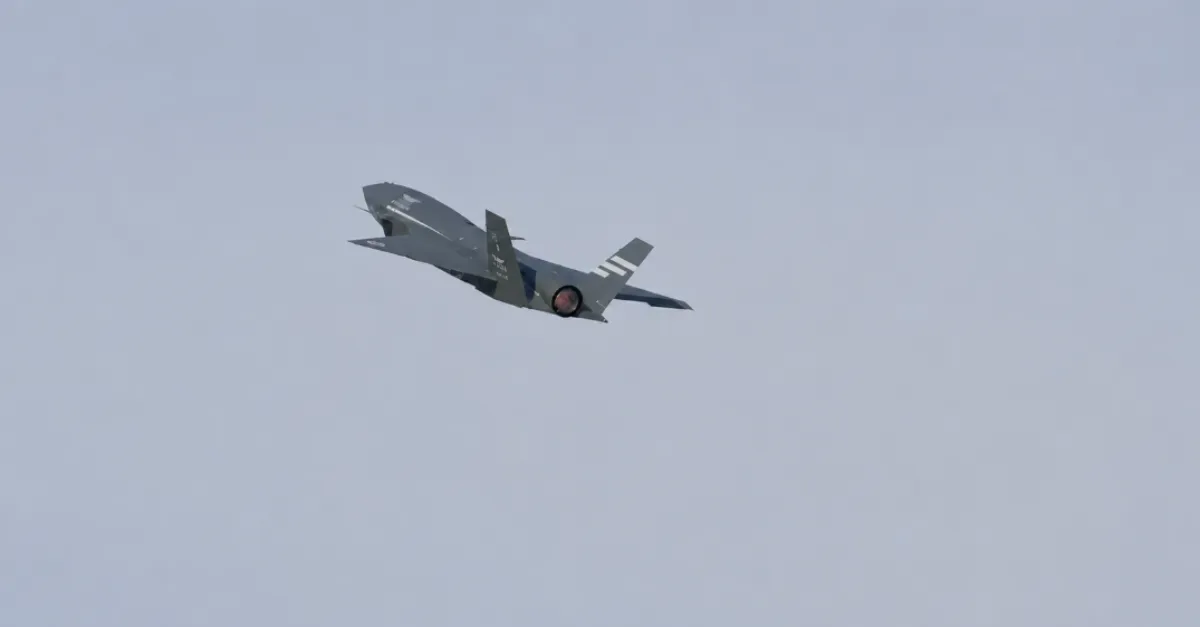
Baykar's Bayraktar KIZILELMA unmanned combat aircraft has completed its first firing tests with weapons carried inside the fuselage, advancing a test campaign that is moving from basic flight development toward integrated combat missions.
The trials were conducted at Baykar's Flight Training and Test Center in Çorlu using the S2 serial-production configuration. According to the company, KIZILELMA released a ROKETSAN-produced TEBER-82 on July 25 and an ASELSAN-produced TOLUN munition on July 28, with both weapons striking their designated targets.
Internal bay tests advance strike configuration
Internal carriage is central to KIZILELMA's planned combat role because it avoids the aerodynamic drag associated with externally mounted weapons and may help reduce the aircraft's radar cross-section.
The latest trials tested the complete release sequence rather than the munitions alone. KIZILELMA had to open its weapons bay, separate each weapon safely and maintain stability after release without relying on external pylons.
Baykar says the configuration is intended to preserve speed and aerodynamic efficiency while allowing precision attacks in areas protected by air defense systems. The company has not published independently verified radar-signature measurements or detailed figures covering release altitude, range and accuracy.
TEBER-82 and TOLUN expand domestic integration
The first trial involved ROKETSAN's TEBER-82, a guidance kit developed for the MK-82 general-purpose bomb. The system combines inertial and satellite navigation, with semi-active laser guidance available in relevant configurations.
The second test used ASELSAN's TOLUN, a compact 250-pound-class guided munition designed for precision strikes against soft and hardened targets. Its smaller dimensions make it particularly suited to internal carriage, where available space and release geometry impose tighter constraints than external stations.
The firings brought Baykar, ROKETSAN and ASELSAN into the same weapons architecture, pairing a Turkish-developed combat aircraft with domestically produced precision munitions and mission systems.
KIZILELMA campaign expands across mission sets
KIZILELMA's weapons campaign has broadened over the past year, progressing from externally carried strike weapons to air-to-air engagement and internal-bay releases.
Bosphorus News previously reported that KIZILELMA completed a beyond-visual-range air-to-air missile test using ASELSAN's MURAD AESA radar and TÜBİTAK SAGE's GÖKDOĞAN missile. The missile struck a jet-powered aerial target during a demonstration Baykar described as a world first for an uncrewed combat aircraft.
The latest tests shift the focus back to precision attack, showing that Turkish munitions can be released from the aircraft's internal configuration rather than only from external stations.
Baykar says KIZILELMA has also conducted trials involving TOLUN, TEBER-82, LGK-82 and the JET-230 supersonic air-to-surface missile. Two prototypes completed an autonomous close-formation flight in December 2025 using fleet algorithms developed by the company.
The program is now testing how its radar, weapons, flight-control software and autonomous functions perform across both air-to-air and air-to-surface missions, rather than treating each component as a separate demonstration.
Operational service has not been announced
Baykar identifies S2 as the serial-production configuration, but neither the company nor Turkish authorities have announced that KIZILELMA has entered operational service with the Turkish Armed Forces.
The aircraft remains in an active development and integration campaign covering propulsion, sensors, weapons, autonomous flight functions and low-observable design features.
Releasing two different munitions from the internal bay clears an important technical stage, although validation will require further trials at different speeds, altitudes and weapon loads, as well as under a wider range of mission conditions.
The industrial significance extends beyond the aircraft itself. KIZILELMA is being developed around a domestic network of radar, targeting, guidance and precision-strike systems, reducing dependence on foreign approval for weapons and mission-system integration.
Sources: Baykar, ASELSAN, ROKETSAN, Bosphorus News review and reporting.