
By Bosphorus News Geopolitics Desk
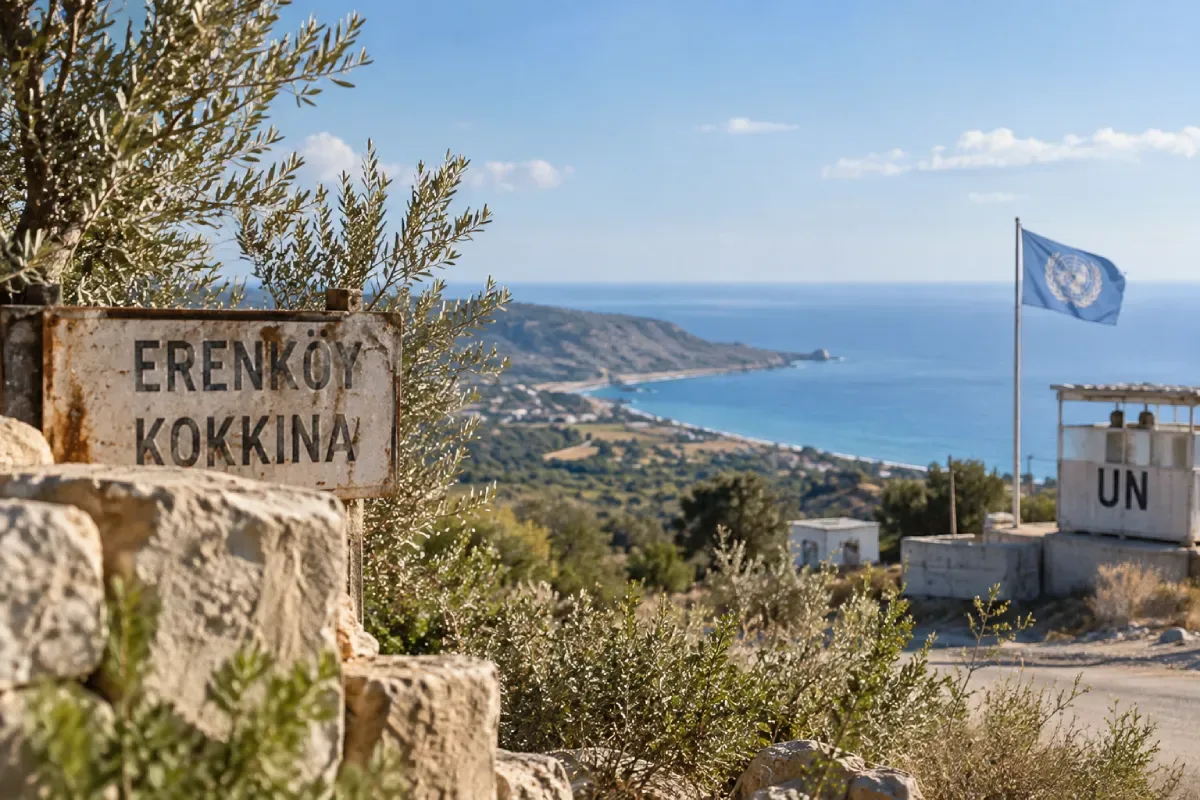
The Erenköy/Kokkina enclave on Cyprus' northwest coast has again become one of the hardest points in the search for new crossings between the island's two sides. After Wednesday's meeting between Turkish Cypriot leader Tufan Erhürman and Greek Cypriot leader Nikos Christodoulides, a Turkish Cypriot source told Greek Cypriot daily Politis that the Greek Cypriot side had brought the enclave into the discussion as agreement on other crossings was approaching.
That account matches part of the record, but not all of it. Erenköy was absent from the four-point map that emerged from the July 2025 New York round and that Erhürman later described publicly, yet the enclave itself was not a new demand. It had already appeared in Christodoulides' crossing-point package in January 2025 and was raised again during the New York meeting, although it did not survive into the working map produced by that round.
By early 2026, Erenköy was back inside a four-crossing formula after the Athienou-Aglantzia connection began to be treated as one through route rather than two separate crossing points. The package was still described as four crossings, but its composition had changed.
That shift became more important during the summer, when Erenköy was drawn more closely into the dispute over Akıncılar/Louroujina and the two sides began arguing over whether the package should remain intact, move in stages or be recalculated according to the access each community would gain.
Erenköy was already in the discussion before Geneva
The current four-crossing framework dates to the informal enlarged meeting in Geneva on March 17-18, 2025, where United Nations Secretary-General António Guterres announced agreement on opening four new crossing points as part of a wider confidence-building package.
The published UN statement did not identify the locations. Later reporting said each side was asked to propose two crossings.
Erenköy had already appeared before Geneva. In January 2025, Christodoulides presented a package involving Pyroi, Erenköy/Kokkina, Haspolat/Mia Milia and Akıncılar/Louroujina. Offsite reported at the time that then-Turkish Cypriot leader Ersin Tatar rejected Pyroi and Kokkina while backing an Akıncılar/Louroujina crossing.
The January record makes it difficult to describe Erenköy as a demand introduced near the end of the process, although it does not establish that the enclave remained inside every version of the crossing package that followed.
Accounts of Geneva are themselves not identical. Politis later reported that, under one version of the understanding reached there, the Greek Cypriot side would stop insisting on crossings the Turkish Cypriot side would not accept, including the Kokkina transit passage. The published UN record does not contain that level of detail, so the point remains part of a later account of the talks rather than the formal Geneva text.
The New York map left Erenköy out
The package became more specific at the enlarged meeting in New York in July 2025, when the Greek Cypriot side proposed a road linking Athienou with the Nicosia suburb of Aglantzia, with crossing points at the two ends of the route, while the Turkish Cypriot side proposed Haspolat/Mia Milia and Akıncılar/Louroujina.
Cyprus News Agency sources also said Christodoulides proposed a crossing through Kokkina during the plenary discussion in exchange for Haspolat/Mia Milia. That proposal, however, did not make the working map that emerged from the round.
The four points that did make it formed the map Erhürman says he found when he took office in October 2025, and Erenköy was not among them. This is the strongest part of the Turkish Cypriot argument now being repeated around the latest negotiations: the enclave had appeared in the political discussion, including in New York itself, but it was absent from the specific configuration that survived that meeting.
Tatar continued to raise Erenköy publicly regardless of its absence from the map. In September 2025, two months after New York, he accused the Greek Cypriot side of seeking passage through Erenköy or Kiracıköy in a way that could open the door to territorial claims in the buffer zone and described Erenköy as "our sacred place."
The wider record and the New York map tell different parts of the story. Erenköy had dropped out of one working configuration, but it had not disappeared from the political dispute surrounding the crossings.
The recount changed the four
A different four-crossing configuration was public by Jan. 28, 2026, after a tripartite meeting involving Erhürman, Christodoulides and UN personal envoy María Ángela Holguín Cuéllar.
Christodoulides named Erenköy/Kokkina, Akıncılar/Louroujina, Haspolat/Mia Milia and a through road between Athienou and Aglantzia. The package was still described as containing four crossings, but Athienou and Aglantzia were no longer occupying two separate places in that formulation.
On the New York map, Athienou and Aglantzia had appeared as two crossing points at either end of the proposed road. In Christodoulides' January formulation, the road itself was treated as a single connection, leaving room for Erenköy to return as the fourth element.
Both sides have since used the phrase "four-crossing package" for different combinations of routes, and that helps explain why later public statements can look contradictory even when they are built around different ways of counting the same road.
Christodoulides kept the same basic position in the months that followed. In Rome on Feb. 26, he said the Athienou-Aglantzia road "or through Kokkina" should open so that Greek Cypriots would also benefit from the package. Erhürman responded that Haspolat/Mia Milia and Akıncılar/Louroujina would benefit both communities and rejected the suggestion that the two proposals served only Turkish Cypriots.
On March 1, Greek Cypriot negotiator Menelaos Menelaou described another possible sequence, saying Haspolat/Mia Milia and the Athienou route could move first if the Turkish Cypriot side accepted the UN compromise on the road, while discussions continued over both Erenköy and an Akıncılar/Louroujina-Lymbia connection.
By that stage, Erenköy was no longer outside the live political package, even though it had not been part of the New York map.
July tied Akıncılar and Erenköy more closely
The package came under fresh strain during Guterres' visit in late July 2026, when the argument shifted from the composition of the four crossings to whether all four had to advance together.
According to Cyprus Mail, the Greek Cypriot side proposed at a July 29 tripartite meeting that the package be divided, allowing Haspolat/Mia Milia and the Athienou-Aglantzia connection to move first while Akıncılar/Louroujina was left for a later stage. The Turkish Cypriot side rejected that approach and insisted that the package remain whole.
Once Akıncılar/Louroujina returned to the immediate discussion, Erenköy again appeared opposite it.
AlphaNews later reported that Erhürman put forward an Akıncılar/Louroujina-Lymbia route before Guterres and that Christodoulides responded with Kokkina, which Erhürman rejected. Yusuf Kanlı, writing in August for the Başkent Ankara Strategy Institute (BASED), described the same linkage and argued that the Greek Cypriot side had tied movement on Akıncılar/Louroujina to a crossing through Erenköy.
The latest Politis account is strongest when read against that sequence. The Turkish Cypriot source is on firm ground in saying Erenköy was absent from the New York map, but describing it more broadly as a new demand introduced only when agreement was close leaves out months of public statements in which Christodoulides had already returned Kokkina to the four-crossing discussion.
The sequence is more precise if Erenköy is read as an older proposal that returned to the immediate bargain when Akıncılar/Louroujina also returned to it.
One road can be counted two ways
The Athienou-Aglantzia road sits at the center of the arithmetic because the proposed route requires an entry point and an exit point as it runs from Athienou toward Aglantzia, crossing the buffer zone and territory in the north before returning to the government-controlled areas.
Whether those endpoints are treated as two separate crossings or as parts of one through road changes the balance of the package.
If Athienou and Aglantzia are counted separately, they occupy two of four positions, while Haspolat/Mia Milia and Akıncılar/Louroujina fill the remaining two. If Athienou-Aglantzia is counted as a single connection, another place becomes available and Erenköy can enter without changing the political description of the package as containing four crossings.
The count changes what each side appears to receive. The same set of projects can consequently be described as three, four or even five crossings depending on whether roads, endpoints or separate access points are being counted.
That disagreement sits underneath much of the public argument over who changed the package and when.
Security objections cut across both routes
The road dispute is complicated further by military geography, and both sides have used security arguments when rejecting versions of the routes they consider unacceptable.
According to Cyprus News Agency sources, Guterres proposed an Athienou route of about 11.4 kilometers, divided roughly between the buffer zone and the north. Menelaou has said the Greek Cypriot side accepted that formula in July 2025.
Cyprus News Agency sources said the Turkish side instead wanted the route to run through the north, while the Turkish Cypriot side has subsequently objected to the UN compromise on the grounds that part of the proposed route crosses a military area.
Erhürman has presented the road dispute from another angle, saying the Turkish Cypriot side proposed a new route through the north as far as Aglantzia and that Christodoulides rejected it partly because Greek Cypriots would not feel safe driving for an extended distance through the north.
He has also questioned how policing, traffic accidents and emergency intervention would work along a road running for a substantial distance through the buffer zone, where ordinary jurisdiction is more complicated than on roads administered entirely by either side.
Erenköy carries a separate and heavier security history.
The enclave has occupied a distinctive place in Turkish Cypriot political memory since the fighting of 1964. When the Yeşilırmak/Limnitis crossing was agreed in 2009, the UN announced a special arrangement under which visits from the north to Erenköy/Kokkina would take place on designated days under escort by the UN Peacekeeping Force in Cyprus (UNFICYP).
The same agreement dealt with non-military supplies and energy requirements associated with the enclave, underlining that Erenköy was already being handled through a special regime long before the present crossing-point negotiations.
None of that settles whether a road should be opened there now, but it helps explain why the Turkish Cypriot side has never treated Erenköy as an ordinary transport project.
Christodoulides approaches the package through a different test and has repeatedly argued that new crossings must provide reciprocal benefit rather than serve only Turkish Cypriot movement. The same road is being judged through different tests of security, jurisdiction and reciprocal access.
Türkiye appears in the Athienou road dispute
Türkiye also appears directly in the Athienou discussion, although the specific road offer currently on record comes from Erhürman rather than Ankara.
Erhürman said on Aug. 5 that Foreign Minister Hakan Fidan had offered to have Türkiye build the northern route, telling the Greek Cypriot side that the road could be constructed by Türkiye. According to his account, an alternative southern route financed by the European Union was also discussed and rejected.
Erhürman said the Greek Cypriot side then raised the issue of pre-1974 Greek Cypriot properties affected by the northern route, after which the Turkish Cypriot side proposed covering expropriation costs through the Immovable Property Commission (IPC), known in Turkish as the Taşınmaz Mal Komisyonu (TMK). He said that proposal was also declined.
Bosphorus News has not located a public Turkish Foreign Ministry statement confirming Fidan's specific road offer. Fidan discussed Cyprus extensively in an Aug. 8 interview with Anadolu Agency, but the published accounts of that interview do not contain the Athienou proposal.
The road offer remains Erhürman's account unless Ankara places its own version on the public record.
Christodoulides has separately described Türkiye's role from the opposite side of the table, saying that he accepted an earlier UN formula for the road while Türkiye, and Fidan specifically, rejected it. He later said he accepted a revised formula under which a larger part of the road would run through the north.
That account likewise remains one side's description of the negotiation rather than a jointly confirmed record.
What the latest Politis account actually adds
The latest anonymous briefings do not uncover an unknown Erenköy dispute, because the disagreement itself has been public for months. Their value lies in showing how each side now describes the sequence that produced the current deadlock.
The Turkish Cypriot source's assertion that Erenköy was not on the New York map is consistent with Erhürman's description of that map. A broader suggestion that the enclave had not previously been part of crossing-point negotiations is much harder to sustain against the January 2025 package, the Kokkina proposal reported from the New York plenary and Tatar's own statements later that year.
The Greek Cypriot position that Erenköy belongs in the wider crossing discussion also has a documented history, although that record does not establish that Kokkina appeared on every UN working map or remained continuously inside each version of the package.
The wider bargaining record and the New York map therefore tell different parts of the story. Erenköy was present in the first, absent from the map that survived New York and back inside the package once the Athienou-Aglantzia connection was recounted as a single route.
Its link with Akıncılar became more explicit when the four-crossing package began to fracture during the summer.
The current deadlock now reaches beyond the location of another gate. The sides disagree over which version of the map should guide the talks, whether Athienou-Aglantzia counts as one crossing or two, whether the package can be divided and how reciprocal access should be measured when one community gains a route the other does not regard as equivalent.
Sept. 17 comes next
Erhürman and Christodoulides are due to meet again on Sept. 17, likely their final session on the island before the UN General Assembly high-level week in New York, while a UN document compiling convergences from earlier Cyprus negotiations is also expected soon.
The UN has not said publicly that the crossing-point configurations themselves will be settled through that document, and neither side has put on the record a formal formula making Erenköy conditional on Akıncılar/Louroujina.
The record shows how the two routes became harder to separate. Erenköy is an old proposal that was absent from one important working map, returned when the composition of that map changed and became more closely linked to Akıncılar when the package began to fracture during the summer.
The Sept. 17 meeting will inherit several versions of essentially the same bargain: the map that came out of New York, the later four-crossing recount and the July attempt to separate routes that could move immediately from those that would be left for another stage.
Sources: Republic of Cyprus Presidency, Turkish Cypriot Presidency, United Nations, UN News, International Crisis Group, Cyprus Mail, Cyprus News Agency, Politis, AlphaNews, Offsite, Anadolu Agency, Kıbrıs Gazetesi, Haber Kıbrıs, Başkent Ankara Strateji Enstitüsü, Türk Ajansı Kıbrıs, Bosphorus News review and reporting.