
By Murat Yıldız
In the spring of 2004 I was a graduate student at the National and Kapodistrian University of Athens, writing a master's thesis on the political history of the Turkish Cypriot community since the British occupation. One of our professors brought a copy of the Annan Plan into a seminar room at a point when very few people anywhere had read it, and passed it down the table. Before I opened the cover I asked him one question.
Are the British leaving?
No, he said.
I handed the file back.
I was wrong about the answer, and it took me twenty-two years to find out how. Britain had in fact offered to give up 117 square kilometres of its Sovereign Base Areas under that plan, roughly forty-six percent of the territory it holds on Cyprus, and the largest concession it has ever placed on a Cyprus table. What it offered was farmland. Sixty percent of the base areas is privately owned and cultivated. The runways at Akrotiri were not on offer, and neither was Ayios Nikolaos, the listening station inside the Eastern base.
The answer to my question was not no. It was that Britain would return the part it did not need. The offer has never lapsed. London has restated it periodically since, most recently in September 2016, and nobody has taken it up.
What was kept
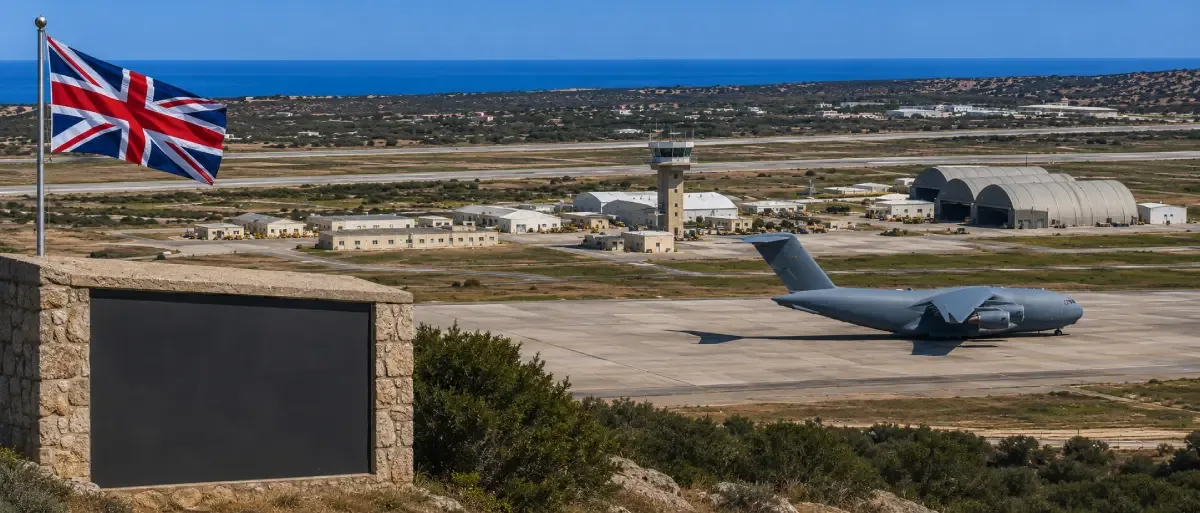
Under the 1960 Treaty of Establishment, Britain retained 254 square kilometres of Cyprus, about three percent of the island, split between Akrotiri in the south and Dhekelia in the east.
The distinction that matters is not the size. Akrotiri and Dhekelia are not bases on Cypriot soil. They are sovereign British territory, administered from London, with their own courts, their own police and their own legal order. Around 15,500 people live inside them, of whom roughly 9,700 are Cypriots, and sixty percent of the land is privately owned and farmed. British Forces Cyprus, the tri-service command that runs the areas, gives its strength as around 3,500 service personnel. American aircraft, including U-2 reconnaissance flights, operate from Akrotiri with British approval, though there is no permanent United States base.
Set that against what Britain gave up in the same period. Between 1968 and 1971 it withdrew from east of Suez. India was already gone, and Palestine, Egypt, Aden and the Gulf followed. From the entire imperial retreat it kept three percent of Cyprus, and it kept it as territory rather than as a lease.
The retention was not incidental to Cypriot independence. It was a condition of it. Richard Clogg of St Antony's College, Oxford, writing in Byzantine and Modern Greek Studies, put the point plainly: retaining sovereignty in perpetuity over part of a former colonial territory is unique in the history of British decolonisation.
How the position was held
The Foreign Office files show a policy that reversed direction without ever changing its object.
In September 1947, in a memorandum from Harvey to Sargent, the Foreign Office was weighing the transfer of Cyprus to Greece, reasoning that it would be the greatest possible contribution to Greek morale and to British influence and would strengthen London's hand against Soviet designs in the border countries. Nine years later the department had reversed its alignment. A memorandum from Cox to Fisher, dated 13 July 1956, sets out the approach to the Turkish position:
Our attitude to this question is that we wish to assist the Turks as much as possible with the publicity for their case, but must at the same time be careful not to appear to be shielding behind them and to be instigating the statement.
The sentence carries its own analysis. The aim is to advance the Turkish case, and to avoid being seen to advance it.
The instruments matched the memorandum. Britain recruited an auxiliary police force drawn from Turkish Cypriots, the Special Mobile Reserve, to act against a Greek Cypriot insurgency, following the standard colonial practice of arming a minority against a majority revolt. The consequence on the ground was that attacks on the colonial police were experienced by Turkish Cypriots as attacks on themselves. In 1955 London convened a tripartite conference and invited Türkiye alongside Greece, giving Ankara a formal standing in a question where it had held none since Lausanne. The guarantee system that governs the island today, and the Turkish military presence that follows from it, descend from that invitation.
Whether Britain intended communal conflict is contested among historians, and this argument does not require settling it. Some hold that London's overriding interest was a secure base, and that inflaming Greek-Turkish hostility would have worked against it. The narrower claim is sufficient. Britain took decisions whose communal consequences were foreseeable, changed sides between 1947 and 1956 as strategic need dictated, and came through every reconfiguration with its territory intact.
Britain has been on the Greek side and on the Turkish side. It has never been on the losing side of a Cyprus arrangement.
The week the question opened
On Sunday 1 March 2026, Prime Minister Keir Starmer said Britain had accepted an American request to use its bases for defensive strikes in the war against Iran.
At three minutes past midnight the following morning, a Shahed-type loitering munition struck RAF Akrotiri. Damage was minor. It was the first strike on the base since 1986. Two further drones heading for Akrotiri were intercepted during Monday, and on 4 March Greek F-16s intercepted two more in Lebanese airspace. Cypriot officials attributed the launch to Hezbollah from Lebanon, and stressed that the base rather than Cyprus had been the target.
The village of Akrotiri was evacuated. Families of British personnel were moved to alternative accommodation elsewhere on the island. More than a thousand Cypriots live in the immediate vicinity of the base, and they received no timely warning.
Nicosia's response was immediate and unusually direct. Government spokesman Konstantinos Letymbiotis said the government viewed with dissatisfaction the absence of any clear statement from the British prime minister that the bases would not be used for anything other than humanitarian purposes. Christodoulides said the Republic of Cyprus was not participating in and did not intend to be part of any military operation.
By 6 March, Reuters was reporting renewed calls for an end to the British military presence. On 25 March Christodoulides announced that discussions with London had begun. "We have a clear plan on how to proceed step by step on all issues related to the British bases in Cyprus," he said. According to reporting in the Telegraph, he had raised the security arrangements of the 1960 treaty directly with Starmer, while stopping short of asking Britain to give up the bases. In April, Nicosia proposed a joint technical committee to examine their future and operational framework.
For the first time in decades, the question was formally on a table.
The answer
A British Ministry of Defence spokesman closed it.
The status of the Sovereign Base Areas is not in question. The SBAs have never been part of the Republic of Cyprus, as UK sovereignty was retained over these areas when Cyprus became independent in 1960. We have no plans to change this.
The reasoning is not that the request is premature, or that the timing is wrong, or that the security arrangements might be revisited later. It is that the territory has never belonged to the state making the request, and therefore there is nothing to negotiate.
Starmer separately assured Christodoulides that Akrotiri would not be used for American strikes on Iran. That was a reassurance about use. On status, the position was that the subject does not exist.
Five months have passed. The technical committee has produced nothing that has been made public.
Why Nicosia cannot press it
The usual explanations are deference to a permanent member of the Security Council, or a Cypriot preference for keeping a Western patron close. Neither is necessary. There is a structural reason, and it binds both communities at once.
Both sides derive their legal position from the same 1960 architecture.
The Greek Cypriot case rests on the continuity of the Republic of Cyprus: the state established in 1960 persists, holds the seat and is the government of the whole island. That republic was created by the Treaty of Establishment, and the Treaty of Establishment is the instrument that transferred the base areas to British sovereignty. To reopen the bases is to reopen the settlement from which the claim of continuity descends.
The Turkish and Turkish Cypriot case rests on the Treaty of Guarantee, which provides the legal basis for the 1974 intervention and for the guarantor status Ankara continues to assert. That treaty belongs to the same package, signed at the same time by the same parties.
Neither side can pull the British thread without unravelling its own.
The record bears this out. AKEL, which has agitated about the bases for decades, held the presidency from 2008 to 2013 and did nothing concrete, a point made by the Cyprus Mail rather than by any Turkish source. In 2019 the International Court of Justice issued an advisory opinion on the Chagos Archipelago finding that the decolonisation of Mauritius had not been lawfully completed while Britain retained the islands. Nicosia did not pursue the parallel.
There was material available closer to home. The General Assembly adopted resolution 3212 on 1 November 1974, unanimously, by 117 votes to none. It urges the speedy withdrawal of all foreign armed forces and foreign military presence and personnel from the Republic of Cyprus, and the cessation of all foreign interference in its affairs. Security Council resolution 353, adopted unanimously on 20 July 1974, demands the immediate withdrawal of foreign military personnel present in the Republic of Cyprus. Neither text names Türkiye. Both say foreign.
Britain's answer is that the base areas are not in the Republic of Cyprus, and so fall outside those words entirely. That answer holds only if Britain's sovereignty claim holds, and there is one place where it was tested.
Britain has its own written standard as well. Appendix O to the 1960 treaty records the British government's declared intentions for the base areas: not to develop them for other than military purposes, not to set up and administer colonies, not to create customs posts or frontier barriers between the areas and the Republic, not to permit civilian commercial or industrial enterprises except as connected with military requirements, and not to expropriate private property except for military purposes on payment of fair compensation. It is a commitment Britain wrote for itself, and it is the measure Britain invited others to use.
The parallel was available, and it worked for someone else.
Britain's position on Chagos was that the archipelago had been under continuous British sovereignty since 1814 and had never been part of the Republic of Mauritius, and that the dispute was bilateral rather than a question of decolonisation. On 25 February 2019 the International Court of Justice rejected that position by thirteen votes to one, finding that the decolonisation of Mauritius had not been lawfully completed and that Britain was obliged to end its administration of the archipelago as rapidly as possible. On 22 May 2019 the General Assembly adopted resolution 73/295 by 116 votes to 6 with 56 abstentions, demanding unconditional withdrawal within six months. Britain rejected the opinion and let the deadline pass. In 2025 it agreed to transfer sovereignty to Mauritius.
The formula that protects the Cyprus bases is the formula that failed on Chagos, and Britain used it again in March, word for word, on a different island and a different republic.
There is one difference, and Britain wrote it down itself. In a government statement issued after the Secretary-General's 2020 report on the implementation of resolution 73/295, London restated that Mauritius had never held sovereignty over the archipelago, and then added that Britain had a long-standing commitment, first made in 1965, to cede sovereignty of the territory to Mauritius when it was no longer required for defence purposes. On Chagos, the retention was always conditional on need. On Cyprus, it never was. The Treaty of Establishment made it permanent, and in March the Ministry of Defence said there were no plans to change it.
The second difference is that Mauritius's legal position did not depend on a treaty it had signed with Britain. Cyprus's does.
The newcomers
While the oldest military presence on the island was being declared non-negotiable, three newer ones were being built, and none of them required opening the 1960 treaties either.
In the week following the drone strike, four separate national reinforcements arrived on one island. France sent anti-drone and anti-missile systems and moved the Charles de Gaulle carrier group into the Mediterranean. Greece sent frigates and F-16s to the Andreas Papandreou air base at Paphos. Britain deployed a destroyer and helicopters to Akrotiri. On 9 March, Türkiye announced the deployment of six F-16s and air defence systems to the north, describing it as phased planning to increase the security of the Turkish Republic of Northern Cyprus in light of regional developments. Germany, Italy, the Netherlands and Spain also contributed assets. Each acted on its own authority. None of it was coordinated through any Cyprus framework, because no Cyprus framework exists for it.
On 8 June, France and the Republic of Cyprus signed a Status of Forces Agreement in Nicosia, concluded by the French armed forces minister Catherine Vautrin and the Cypriot defence minister Vasilis Palmas on the margins of an informal European Union defence council held during the Cypriot presidency. It covers military coordination, defence industry, joint exercises and the administrative arrangements for each country's forces on the other's territory. It is not a mutual defence pact and establishes no permanent French base. Türkiye's Ministry of National Defence declared it contrary to the 1960 treaties and to international law.
The American presence is being built differently, through infrastructure rather than through treaty. United States European Command is funding a new heliport at the Evangelos Florakis naval base, capable of handling Chinook-class transport helicopters, and a new apron at Andreas Papandreou for heavy-lift military transport aircraft. A US assessment team visited Paphos in March to advise on projects intended, in the Cypriot government's own words, to enhance interoperability with the United States and other partners. There is no permanent American base and no announced American troop presence. There is an island whose two principal military installations are being upgraded to American specifications.
The lever that was removed
Both of the outside powers with real leverage over a Cyprus settlement gave that leverage away before it could be used.
The United States imposed an arms embargo on Cyprus in 1987, and the stated purpose was to prevent an arms race and encourage a peaceful settlement. Congress lifted it in 2019. The first joint military training followed in 2020, over Turkish objections. Infrastructure funding followed in 2026.
The European Union did the same thing in a shorter timeframe. The Copenhagen European Council decided in December 2002 that Cyprus would accede whether or not a settlement was reached. The Accession Treaty was signed on 16 April 2003. The referendums were held on 24 April 2004, when Turkish Cypriots voted 64.9 percent in favour of the Annan Plan and Greek Cypriots voted 75.8 percent against. Accession followed a week later, as it had been going to for eighteen months.
In both cases an instrument explicitly tied to a settlement was released in advance of the moment it might have mattered.
The objection
There are three foreign military presences on this island, and a fourth being constructed.
Britain holds 254 square kilometres as sovereign territory, with British Forces Cyprus giving its own strength as around 3,500. Türkiye maintains a force in the north that outside estimates place at between thirty and forty thousand, a figure Ankara does not publish. France has held a legal framework in the south since June. The United States is funding the infrastructure it would use.
The asymmetry in those figures is itself part of the picture. One presence is documented by the state that maintains it. One is not.
Writing in the Times of Israel in March, Yaakov Chaliotis, who describes his own identities as Greek, Cypriot, Jewish and British, put a version of this to London: the question is no longer whether Britain has the right to act from Cyprus, but whether it has the honesty to acknowledge what that presence costs. The same question is owed by everyone else on this island, and none of them has answered it either.
Each actor selects its objection. Nicosia calls the Turkish presence an occupation, regulates the French presence by agreement, and refers the British presence to a technical committee. Ankara calls the French agreement unlawful, grounds its own presence in a treaty, and says nothing at all about the British bases. London does not comment on any of the three, and has not needed to.
If the objection to foreign forces on Cyprus is a principle, it covers all of them. If it covers only one, then what is being objected to is not the presence but the flag.
That is the argument I would put to anyone on either side of the line who believes their position on this is a matter of principle. It is not a rhetorical question. It has an answer, and each of us knows what our own is.
I asked the wrong question in that seminar room in Athens. The question is not whether the British are leaving. It is why, in sixty-six years and through every framework anyone has proposed, nobody has been in a position to ask them to.
Murat Yıldız is the founder and editor-in-chief of Bosphorus News. His master's thesis, "The Political History and Culture of the Turkish Cypriot Community Since British Occupation", was submitted to the Department of Political Science and Public Administration at the National and Kapodistrian University of Athens in September 2004.
Sources
• PRO FO 371/67084, R 13462, Harvey to Sargent, 26 September 1947, memorandum
• PRO FO 953/1694, G11926/23, Cox to Fisher, 13 July 1956, memorandum
• Treaty of Establishment and Treaty of Guarantee, 1960, and Appendix O to the Treaty of Establishment
• UN General Assembly resolution 3212 (XXIX), 1 November 1974
• UN Security Council resolution 353, 20 July 1974
• International Court of Justice, advisory opinion on the Chagos Archipelago, 25 February 2019
• UN General Assembly resolution 73/295, 22 May 2019, adopted 116-6-56
• UK government statement on the Secretary-General's report on the implementation of resolution 73/295
• UK Ministry of Defence statement on the status of the Sovereign Base Areas, March 2026
• Richard Clogg, "The Sovereign Base Areas: colonialism redivivus?", Byzantine and Modern Greek Studies
• Cyprus Mail, Annan Plan reference and 8 March 2026 report on the bases
• Reuters, 2 March and 6 March 2026
• The Independent and the Telegraph, on the Christodoulides approach to Starmer
• Times of Israel, 23 and 25 March 2026
• Associated Press, April 2026, on United States European Command funding
• Daily Sabah, 9 March 2026, on the Turkish deployment to the north
• Turkish Ministry of National Defence statement on the France-Cyprus agreement
• Cyprus Today, June 2020, on the Anastasiades-Cameron accord
• Bosphorus News review and reporting