
By Kostas Yfantis
This article was originally published in Greek by Protagon.gr on July 13, 2026. It is published by Bosphorus News in English with the author's permission. Translation by Bosphorus News.
The NATO summit in Ankara was not a good moment for the Alliance. Now that several days have passed and the events are no longer occupying most of the international press, it is easier to offer an assessment.
The starting point is that, despite the smiles and positive comments, almost none of the major unresolved issues was addressed in any meaningful way. Some observers, focusing on the defence agreements reportedly concluded on the sidelines, regard the summit as a success.
Yet nothing substantial moved forward.
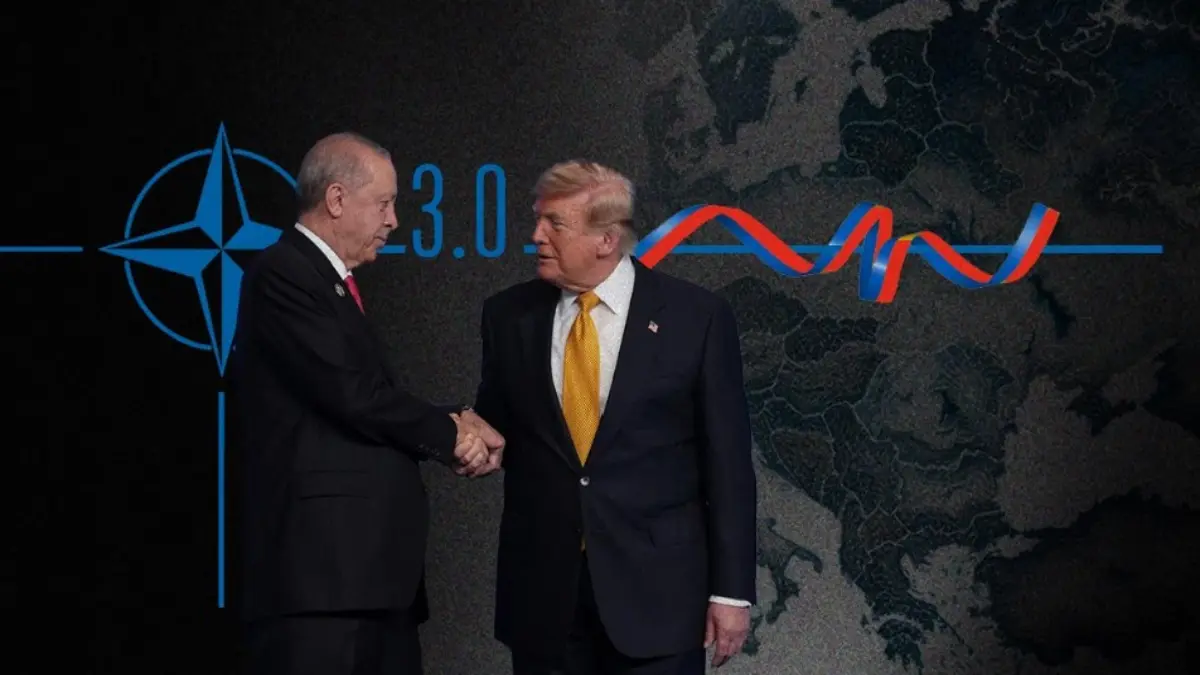
One fact, however, is beyond dispute. The summit developed into a show for two: US President Donald Trump and Turkish President Recep Tayyip Erdoğan. Perhaps that was how it had been designed from the beginning.
In the case of the US president, the summit confirmed in the clearest possible way that Donald Trump views his participation in such important meetings primarily through the lens of personal diplomacy rather than multilateral cooperation.
One could argue that he is not merely uninterested in multilateral cooperation, particularly when the partners in such a system are not "subordinates," but that he regards it as harmful to American interests, as he himself defines them.
This view should neither surprise nor puzzle anyone. It is the clear and official doctrine of US strategy, as set out in the National Security Strategy of November 2025.
Within this framework, Trump's objective has been, and remains, to make every summit he attends about himself and about the issues that concern him, whether old or new.
The Alliance, like every multilateral institution, including the United Nations and the European Union, has importance and value only to the extent that it aligns with his personal preferences.
President Trump, who bears primary responsibility for the condition of the Alliance at an exceptionally difficult moment for the world, could not resist the temptation to attack European allies, some of them in particularly harsh terms.
The rupture with Spain, the temporary, perhaps, collapse of his personal relationship with the Italian prime minister, and the revival of the "Greenland issue" were all added to the agenda without even the slightest diplomatic tact.
The US president's "anger" and "disappointment" at the unwillingness of European allies to assist the United States in its military operation against Iran were also expressed through deeply disparaging insinuations.
What is striking, or perhaps not, is the absence of political logic in the White House's understanding of the role and obligations of alliance members in an offensive war decided by Washington without any prior consultation.
Donald Trump shares important political and cultural instincts with President Erdoğan. Both want a Europe that is weak and open to manipulation.
They are both populist and authoritarian leaders who meet in a deeply anti-institutional voluntarism. For the US president, Türkiye and its leader are the only "ally" through whom he can hurt Europe.
Following Orbán's defeat in Hungary, Donald Trump needs someone who shares his authoritarian, illiberal worldview and who can support his fundamental choices across Eurasia.
For Ankara, this was an opportunity.
For some time, Türkiye has been attempting a turn towards the West and Europe, but without being forced to align fully with European priorities.
Its failure in previous years to advance its interests as an autonomous major power across the wider Middle East compelled Ankara to retreat, primarily by persistently courting Washington.
Turkish diplomacy understands, correctly, that rapprochement with Europe has limits and institutional conditions.
By contrast, President Trump's transactional culture makes an understanding with the United States easier, even though it is not an understanding built around a long-term strategic horizon.
At the tactical level, President Erdoğan invested in a bargain that may resolve some of Ankara's most urgent problems.
It is clear that the highly unusual familiarity between the two leaders served as President Erdoğan's passport for returning Türkiye to the centre of the transatlantic bargain.
That, in practice, is Türkiye's upgrade: Erdoğan's personal relationship with the US president.
For Türkiye, the central objective is the F-35.
The Turkish air force is a third-generation force at a time when its competitors either already possess, or will soon acquire, fifth-generation capabilities.
The prospect of Türkiye's own fighter aircraft is real, but it is not immediate, while its technological capabilities remain uncertain.
The Eurofighter is not a solution, not even in the medium term.
Türkiye's options are therefore specific. The direction in which events will develop is fairly obvious.
Türkiye will rid itself of the S-400 system and sharply increase its chances of re-entering the F-35 programme during the next decade.
President Erdoğan and Türkiye tried by every possible means to avoid the "withdrawal" of the S-400s, but were ultimately forced to retreat after years of arrogance.
President Trump evidently made clear to his counterpart that there was no alternative.
Qatar, or another Gulf country, appears to offer a plausible scenario for implementing such an arrangement, although matters are not so simple.
The sale of the system would have to be genuine rather than fictitious.
Even then, it is difficult to imagine a Russian system being deployed alongside US military installations.
Russia's consent is not a critical issue in the broader equation.
Moscow needs Türkiye's benevolent neutrality, particularly following the fall of the Assad regime in Syria and Russia's confinement to the "Western," meaning Ukrainian, front.
For Greece, the prospect of a Türkiye equipped with F-35s does not alter the substance of the confrontation.
Balancing the Turkish threat is, unfortunately, still the only course available.
But that is a subject for another article.
Kostas Yfantis is Professor of International Relations at Panteion University.
Originally published by Protagon.gr. © Kostas Yfantis. English translation published with permission.