
By Bosphorus News Geopolitics Desk
Azerbaijani President Ilham Aliyev has confirmed that former senior German politicians met current and former Russian officials in Baku without the knowledge of the Azerbaijani government, exposing an unofficial channel operating outside Berlin's declared policy toward Moscow.
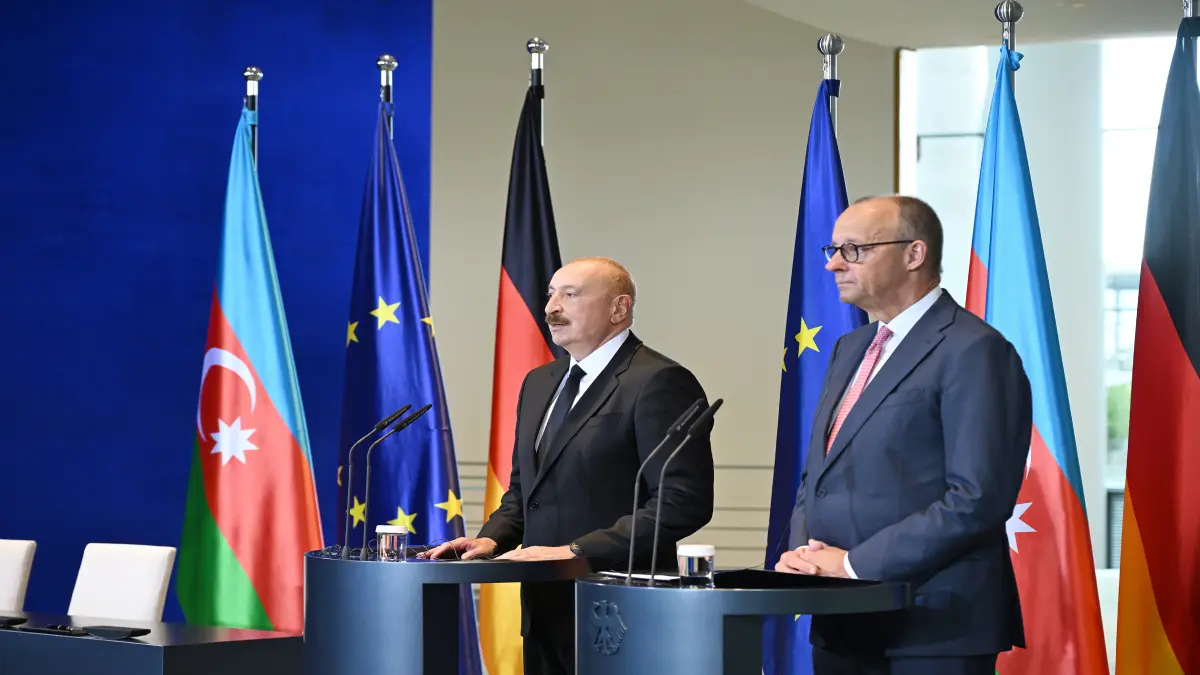
Standing beside German Chancellor Friedrich Merz at a joint press conference in Berlin on July 21, Aliyev said Azerbaijan investigated the reported meeting after German media identified another round of contacts in the Azerbaijani capital.
"We received no information about this from either Germany or Russia," Aliyev said. "In other words, our territory was simply used without our knowledge."
Aliyev said flight records showed that Ronald Pofalla, who served as chief of the German Chancellery under Angela Merkel, and former Social Democratic Party chairman Matthias Platzeck arrived in Baku from Berlin on July 12 and returned on July 14.
During the same period, Viktor Zubkov, a former Russian prime minister who chairs Gazprom's supervisory board, and Valery Fadeyev, chairman of Russia's Presidential Human Rights Council, also travelled to Baku, Aliyev said.
The flight data "give grounds to say that such a secret meeting was held in Baku," he added. Azerbaijan's State Border Service examined the travel records after reports about the gathering appeared in Die Zeit and the German public broadcaster ARD.
Aliyev said he could not confirm what was discussed. He nevertheless left open the possibility that the contact could serve a diplomatic purpose.
"If this meeting will bring an end to the Ukraine-Russia war, then of course we welcome it," he said.
Berlin Rejects an Official Role
Merz said during the press conference that he had no knowledge of the meeting.
The German government had already distanced itself from the channel before Aliyev's intervention. The German Foreign Office told ARD's Kontraste programme that the government was not planning "any continuation or further use" of the Petersburg Dialogue, the former German-Russian forum under whose name the Russian participants reportedly describe the meetings.
The Chancellery separately told the programme: "This is not an initiative of the Federal Chancellery. Beyond that, we cannot provide you with any information."
Those statements deny official sponsorship but do not establish whether parts of the German government had previously been informed about the contacts. Merz's answer in Berlin went further by saying he was unaware that the July meeting had taken place.
Pofalla and Platzeck no longer hold public office, but both retain political connections inside parties represented in the German coalition. Pofalla is a former senior Christian Democratic Union figure, while Platzeck previously led the Social Democratic Party and served as premier of Brandenburg.
The two men did not explain the content of the July talks when approached by ARD and Die Zeit reporters in Baku. Platzeck said only that the German group had paid its own expenses and was staying at a less expensive hotel than the Four Seasons, where the meeting was held.
Neither the German nor Russian participants responded to later written questions, according to ARD. Reuters was also unable to obtain comment from Pofalla or Platzeck.
Russian Delegation Included Kremlin-Linked Figures
The Russian delegation was led by Zubkov and included Fadeyev and Alexey Gromyko, director of the Institute of Europe at the Russian Academy of Sciences, according to the joint Die Zeit and ARD investigation.
Fadeyev is subject to European Union sanctions over his role in supporting Russian state propaganda and disinformation. Gromyko's institute previously prepared a confidential document recommending that existing channels be used to increase fear among Germans of a possible conflict between Russia and NATO, according to the investigation.
"Through existing channels, pressure must be increased to stir up German citizens' fear of a possible conflict between NATO and the Russian Federation," the document said, as quoted by ARD.
German security agencies regard the Baku meetings as a Russian influence operation aimed at affecting German policy, Die Zeit and ARD reported. The Russian side has reportedly argued in the discussions that the war can end only on Moscow's terms and has explored how German-Russian relations could be restored after the conflict.
Gazprom did not respond to Reuters' request for comment. A Russian polling organization whose board includes Fadeyev also did not respond. No public statement from the Kremlin or Russia's Foreign Ministry has confirmed the purpose, mandate or content of the July meeting.
The absence of a Russian explanation leaves the German media investigation as the main source for the participants' objectives. The evidence confirms the meeting and the identities of several participants, but does not establish that they carried an official negotiating mandate from Moscow or Berlin.
Participants Defend Contact, Critics Warn of Influence
The Baku channel has operated since at least 2024. Its participants have described previous meetings as private contacts intended to preserve communication during the war.
Ralf Stegner, a serving Social Democratic lawmaker who attended an earlier meeting, said at the time that he had travelled privately and was not acting on anyone's instructions.
"I can only say that I do not comment on private matters," Stegner told ARD. "I was not travelling on behalf of anyone, and I did not use funds from anyone."
He later argued that communication channels should remain open during difficult periods and that dialogue sometimes required contact with difficult counterparts.
German lawmaker Roderich Kiesewetter, a Christian Democratic Union foreign and security policy figure, has rejected that defence.
"This is shadow diplomacy that undermines the intended isolation of Russia and Germany's clear positioning on the side of Ukraine," Kiesewetter said. He argued that Russia controls the terms by insisting on the Petersburg Dialogue label.
Kiesewetter described the meetings as "a form of cognitive warfare" because they could create the impression among Germany's allies that Berlin was pursuing a separate policy toward Moscow.
Sarah Pagung, a Russia specialist who heads the Berlin office of the Körber Foundation, said maintaining discreet channels with Moscow was not inherently unreasonable. She questioned the choice of Russian interlocutors.
"To believe that one can meet such people and then have any form of influence on Russian policy is, in my view, completely misguided," Pagung said.
Azerbaijan Rejects the Role of Secret Host
Aliyev's statement separates Azerbaijan from the substance and organization of the meetings.
Baku did not claim that the gathering was illegal, nor did Aliyev reject dialogue aimed at ending the war. His objection was that foreign political figures used Azerbaijan as a meeting point without informing the host government.
That distinction matters because Baku has maintained ties with Moscow and Kyiv since Russia's full-scale invasion in February 2022. Azerbaijan has provided humanitarian assistance to Ukraine but has not joined Western sanctions against Russia.
Relations between Azerbaijan and Russia have also deteriorated since an Azerbaijani passenger aircraft was shot down in December 2024. Against that background, Aliyev's public disclosure denies Moscow and Berlin the ability to present Baku as a consenting diplomatic intermediary.
The available record establishes that the July meeting occurred, that Azerbaijan was not informed and that the German government denies authorizing the channel. It does not establish what commitments were discussed, whether either delegation carried messages from serving officials or whether the contacts influenced policy in Berlin or Moscow.
Sources: Azerbaijan Presidency, German Federal Chancellery, German Foreign Office, Reuters, ARD Kontraste, Die Zeit, Bosphorus News review and reporting.