
By Bosphorus News Defense Desk
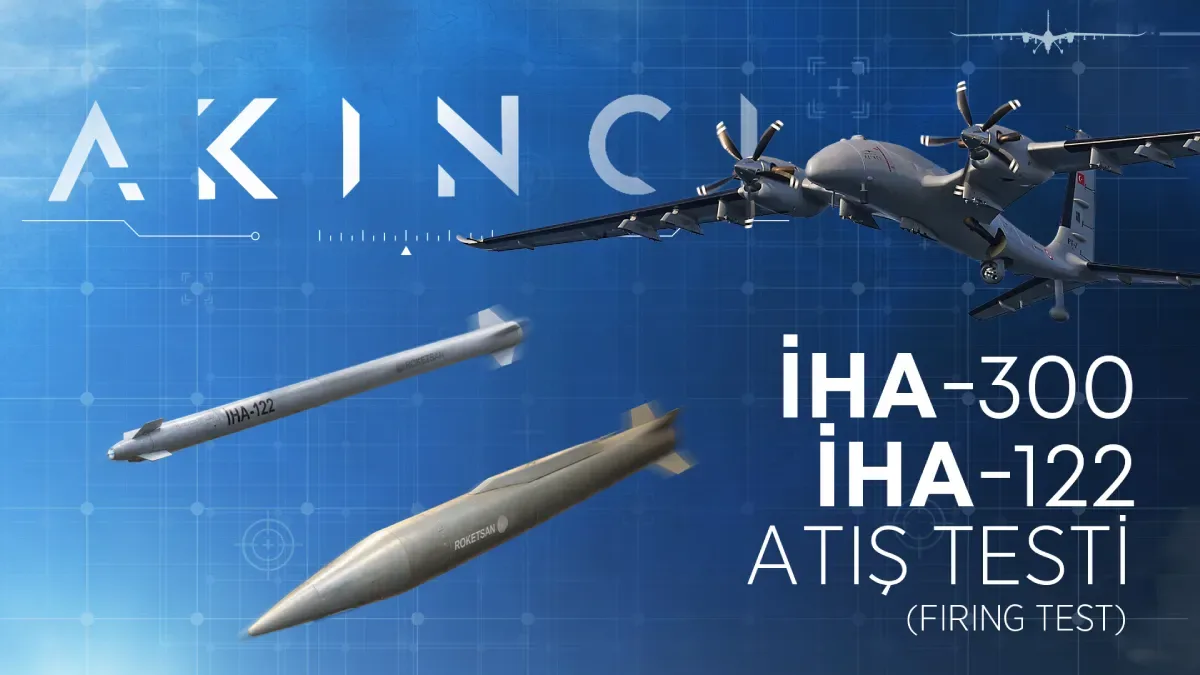
Türkiye's Bayraktar AKINCI unmanned combat aerial vehicle struck a maritime target from more than 250 kilometers away using Roketsan's UAV-300 supersonic ballistic missile in a firing test conducted over the Black Sea on September 11.
Baykar said the AKINCI took off from its Flight Training and Test Center in Çorlu, Tekirdağ, before flying to the test area off Sinop. The UAV-300 was launched against a target at sea and scored what the company described as a direct hit before the aircraft returned to Çorlu.
The test adds another long-range weapon to AKINCI's expanding ammunition set. Baykar had previously completed the integration of Roketsan's UAV-122 and UAV-230 supersonic missiles on the platform.
Unlike shorter-range precision-guided weapons already carried by AKINCI, the UAV-300 gives the unmanned aircraft a strike option at distances beyond 250 kilometers demonstrated in the latest test. Baykar describes the weapon as a supersonic ballistic missile developed by Roketsan.
The company has not released detailed information in its September 11 statement on the missile's speed profile, warhead, guidance package or maximum operational range. The test therefore confirms a demonstrated engagement beyond 250 kilometers rather than the full performance envelope of the weapon.
AKINCI Expands Long-Range Strike Set
AKINCI has been used as an integration platform for an increasingly broad range of Turkish-developed weapons, including the MAM family, TOLUN, TEBER, laser and satellite-guided bomb kits, the ÇAKIR cruise missile and the EREN high-speed loitering munition.
The UAV-300 joins a smaller group of weapons intended to push the platform well beyond the ranges associated with conventional UAV-launched precision munitions.
That expansion gives AKINCI more flexibility in missions where the aircraft can launch from outside the immediate area of a defended target, although the September 11 test by itself does not establish how the missile would perform against a moving or defended target under operational conditions.
The use of a maritime target off Sinop is also significant for the test profile. Baykar confirmed the target was positioned at sea, but did not say whether it was stationary or moving.
Baykar has continued ammunition integration work on AKINCI throughout 2026. Recent tests have included several variants of ASELSAN's TOLUN family, while earlier work brought Roketsan's UAV-122 and UAV-230 onto the platform. Türkiye's Defense Industry Agency has also reported a series of new AKINCI munition trials during the year.
The September 11 firing extends that progression into a heavier long-range ballistic weapon class, with the confirmed test distance now exceeding 250 kilometers.
Sources: Baykar, Türkiye Defense Industry Agency, Bosphorus News review and reporting.