

By Murat Yıldız | XTRA
In the last days of September 1996, Türkiye's minister of state for the economy sat down in Washington with the World Bank and asked for something modest.
Ufuk Söylemez wanted between 200 and 300 million dollars. Not budget support, not a rescue. A structural adjustment loan, to merge a handful of weakening banks along sectoral or regional lines and rebuild their capital before their balance sheets gave way.
"I put a proposal to the World Bank," he says. "In order to strengthen the banking system in Türkiye, I want to merge certain banks sectorally or regionally and strengthen their capital structures. If you can give me a long-term loan in the structural adjustment category, we want nothing else."
He had reason to think the request would land. He had come to the ministry from inside the system: seven years as an inspector at Ziraat Bankası, then general manager of Türk Dış Ticaret Bankası, general manager and chairman of Halkbank, a seat on the board of the Banks Association of Türkiye, and a spell running the Privatisation Administration. The supervisory reports crossing his desk in 1996 and 1997 showed six or seven banks moving in the wrong direction. Some of it was fraud. Some of it was simpler: banks funding themselves short and parking the money in government paper at high yields, a trade that worked until it did not.
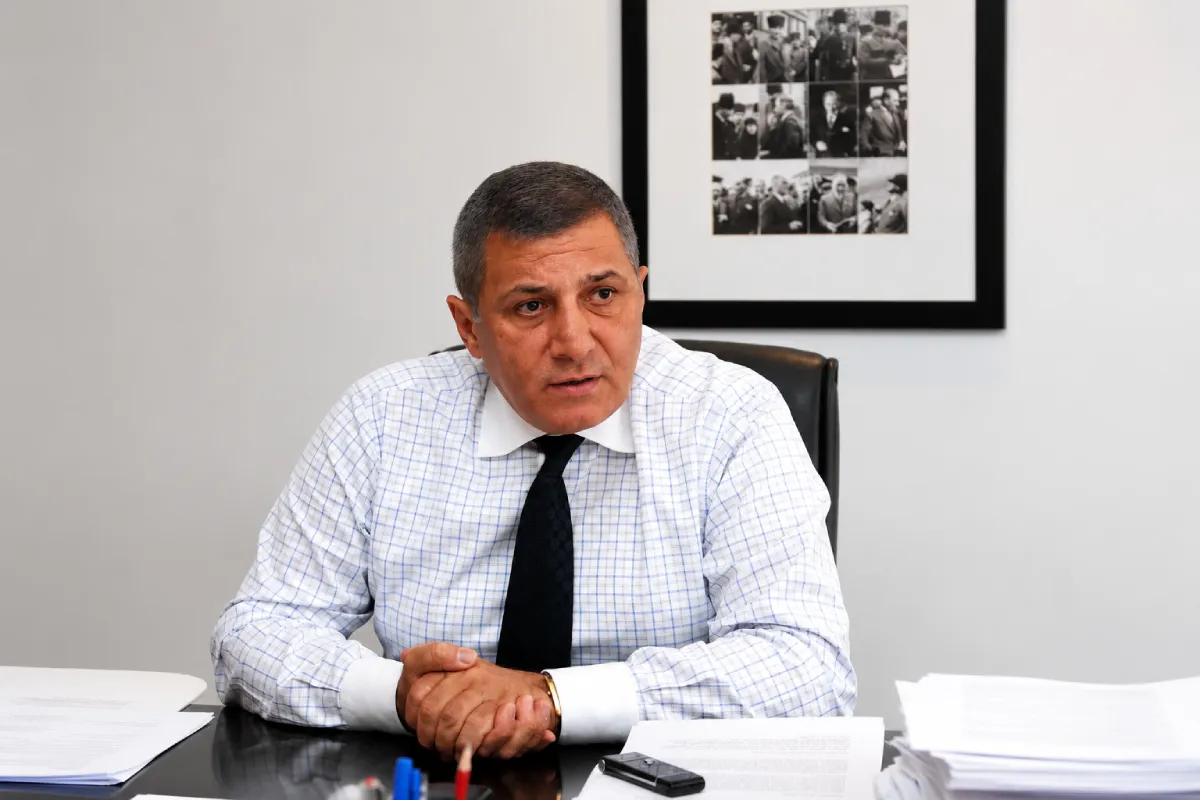
Ufuk Söylemez, Türkiye's minister of state for the economy in 1996 and 1997.
The World Bank's initial response was positive. Söylemez put the proposal to James Wolfensohn, the bank's president, and his team. The following day he met Kemal Derviş, then one of the bank's vice presidents and four years away from being called home to manage the crisis that had not yet happened. Derviş hosted the delegation for lunch at the close of the discussion.
"I thought this was done," he says.
A day later, Washington added a condition. Söylemez was asked whether he would put the proposal to the International Monetary Fund as well. It was Annual Meetings week, with the senior leadership of both institutions in the same city, and the appointment was arranged at once and at the top of the building: Managing Director Michel Camdessus and his first deputy, Stanley Fischer.
The refusal
Söylemez did not think Türkiye needed a Fund programme, and he did not think the arithmetic supported one.
"We have no business with the IMF," he told them. "We have no business with the IMF because we have no balance of payments problem. We only need to make structural corrections."
The numbers were on his side, at least on the terms he was arguing. Real output grew 7.2 percent in 1996 and 7.5 percent in 1997, according to the United States State Department's own country report. The current account deficit ran at roughly 2.4 to 2.5 percent of national income. There was no external financing emergency. There was a rotting patch in the banking system, and he wanted a scalpel for it.
The IMF proposed a programme anyway. Söylemez asked why. He recalls making the point that the economy had grown 7 percent under a coalition government, and asking what more a programme was supposed to deliver.
At that stage the decision stopped being his. He was a minister in Washington being asked to commit his government to a Fund programme, and he took the view that he could not settle it alone.
"It would not be right for me to decide by myself," he says.
He went to the Turkish embassy, sat down with Ambassador Nüzhet Kandemir, and sent an encrypted cable to Ankara. The prime minister was Necmettin Erbakan. His deputy was Tansu Çiller. The instruction came back: do not accept the IMF offer, and if the World Bank will proceed on its own, let it.
The World Bank did not proceed on its own. The loan never came.
What followed
Türk Ticaret Bankası was transferred to the Savings Deposit Insurance Fund on 30 May 1997, eight months after the Washington meetings. Söylemez's government fell one month later.
Bank Ekspres followed in October 1998. Interbank in January 1999. On 21 December 1999 five banks went to the fund on a single day: Egebank, Yurtbank, Yaşarbank, Esbank and Sümerbank. The November 2000 and February 2001 crises finished the sequence.
Söylemez's claim is direct. "If the World Bank had given us those loans then, and it easily could have, most of those four or five banks said to have failed would have been saved. There would have been no banking crisis."
The claim cannot be tested, and the arithmetic invites a question he does not answer. Interbank alone cost the state 1.7 billion dollars. Yurtbank cost 650 million. By the fund's own 2009 accounting, the twenty-six banks that failed cost Türkiye 30.2 billion dollars. A loan of 200 to 300 million dollars is small against those figures.
What a World Bank structural adjustment loan carries beyond money is conditionality and signal, and both arrive earlier than the money does. That is the case Söylemez is making: not that the sum was large, but that the moment was early.
"My whole perspective changed"
The episode altered how he read the institutions themselves.
"I saw that these organisations, besides being bodies that give technical support to member countries and do the right things, are also open to political influence," he says. "My whole perspective changed."
He is careful about how far he pushes this. He describes the World Bank, the IMF and the OECD as genuinely capable institutions with real technical depth. What surprised him was how much political weight, particularly American weight, he felt in the room alongside the technical conversation. He puts it more plainly against himself than against them: he says that he and his delegation were explaining what Türkiye needed with naive feeling, without knowing what was being planned for Türkiye.
What a minister actually holds
Ask him what levers the job gave him and the list is shorter than most people assume.
Interest rates were not his. Those belonged to the central bank, and coordination was the most a minister could hope for. What he did control was planning, and the machinery of supervision, and the work of keeping institutions pointed in the same direction. He compares the role to conducting an orchestra: economic policy, the legal framework and the government's programme have to be brought into the same tempo, and when each plays its own line the result is noise.
On central bank independence he is more heterodox than the textbook. He defends it, then qualifies it. A central bank that sets itself in total opposition to the programme of an elected government produces its own kind of instability, he argues, and the honest description of the relationship is a fine tuning rather than a wall. He points to the Federal Reserve holding its position against pressure from President Donald Trump, with the courts standing behind it, and contrasts that with governors in Türkiye who can be replaced the following morning.
He also offers an unfashionable defence of coalition government. Because no single partner could remove a senior official at will, officials could object, warn, and put an unwelcome finding in writing. The undersecretary's office still functioned. What he calls the memory of the state was still intact.
The precondition
Pressed on what makes any of it hold, he stops discussing economics.
"Being a state of law," he says. "If you are not a state of law, none of this exists. Our guarantee was the law."
He gives the mechanism in one example. If a minister dismissed the wrong official, the Council of State would put that official back. He says he cannot recall the last time that happened.
"If the law becomes politicised, if politics contaminates justice, if the law is not impartial and independent, the economy in that country does not go well either."
He reaches for the idea of animal spirits to explain why. Investors in an uncertain environment do not withdraw dramatically. They wait, the way an animal waits, and they keep waiting as long as the fog holds. A programme announced into that fog has a credibility problem no matter how well it is drafted.
His structural prescription follows from the same place. He describes a conversation in Ankara with Jin Xin, a vice-minister of the Chinese Communist Party's International Department, who set out what his country had done. Eight hundred million people had been living in hunger and destitution. Income per head in a country of 1.4 billion had stood at three or four hundred dollars. It now runs at around thirteen thousand, in the same band as Türkiye's fifteen thousand.
The method, as Jin described it, was to work on the shape of the distribution itself. Take a pyramid, narrow at the top and broad at the bottom, and press it into the shape of an olive, thin at both ends and thick through the middle.
Söylemez went back and plotted Türkiye's own income deciles. The middle was thinning.
He returns to one figure in particular. Some 6.8 million people in Türkiye aged 15 to 34 were neither in education nor in work in the first quarter of this year, on calculations drawn from official labour force data. That is more than a quarter of the age group, and it is not the same as the unemployment rate, which counts only those actively looking.
He had never told the Washington story publicly before. Asked why not, he was matter of fact about it.
"I had never told anyone these things. Outside private conversations I never told the press. Because there is no use in it. Nobody understands, and nobody asks."