

By Bosphorus News Economy Desk
Türkiye's economy entered 2026 with weaker momentum, as international forecasts point to a broader slowdown risk linked to the Iran war, higher energy prices and tight financial conditions.
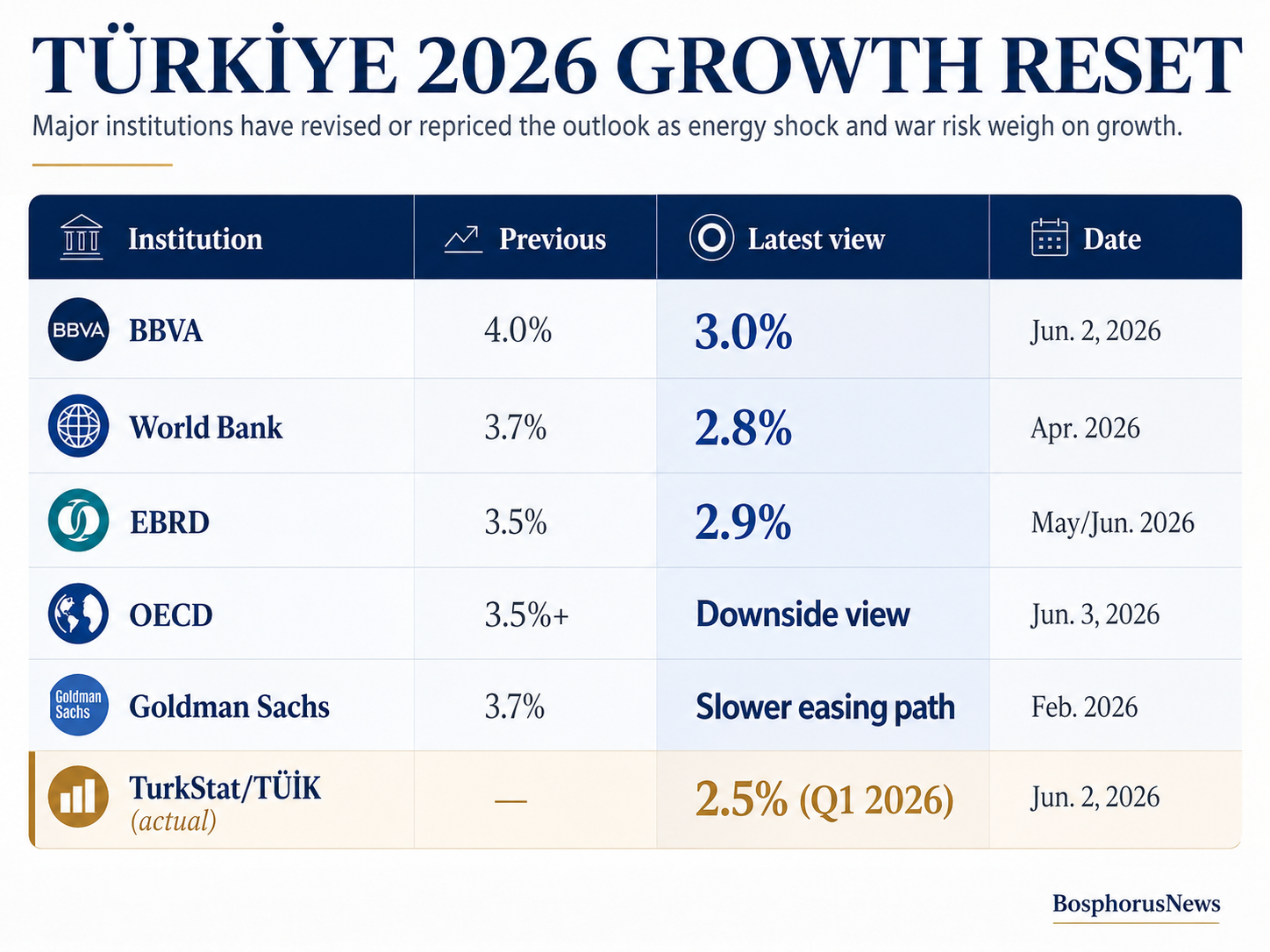
Official data from the Turkish Statistical Institute (TurkStat/TÜİK) showed gross domestic product (GDP) expanding 2.5 percent year-on-year in the first quarter of 2026, below the market expectation of 2.7 percent and down from 3.4 percent in the previous quarter. The headline number kept Türkiye's growth streak alive, but the details showed pressure building under the surface, with exports of goods and services falling 12.7 percent, industrial output contracting 0.8 percent and household consumption rising 4.8 percent.
The first-quarter figures left Türkiye with an uneven growth profile in which domestic demand continued to support activity while external demand and industrial production weakened at the same time. Local brokerage Alnus Yatırım said the sharp export decline likely reflected the impact of the Iran war alongside weakening industrial activity, and warned that those pressures could intensify in the second quarter.
Banco Bilbao Vizcaya Argentaria (BBVA) moved first with a direct Türkiye revision through its research unit, BBVA Research. The Spanish financial group cut its 2026 growth forecast to 3 percent from 4 percent, citing the Iran war, tight financial conditions and a worsening external balance.
"The prolonged conflict and tight financial conditions pose downside risks to the growth outlook, while the deteriorating external balance is reducing the room for supportive measures," BBVA Research said in a note following the first-quarter release.
ING pointed to the same pressure points, noting that net exports have become an increasingly negative contributor to growth while domestic demand remains the economy's primary driver. That split leaves policymakers facing a more difficult second half equation, with consumption still cushioning the economy even as exports, industry and financing conditions weaken.
The World Bank's latest Türkiye Macro Poverty Outlook puts 2026 growth at 2.8 percent, revised down from 3.7 percent. Its baseline assumes a temporary global energy disruption that raises average Brent oil prices by 36 percent, natural gas prices by 67 percent and fertilizer prices by 20 percent over the course of 2026.
The World Bank links the shock directly to Türkiye's inflation, interest-rate and current account path, arguing that higher energy prices, higher risk premia and higher interest rates all weigh on growth, while a longer period of elevated energy costs would deepen the impact on inflation, economic activity and the current account.
The European Bank for Reconstruction and Development (EBRD) lowered its regional growth projections in its June 2026 update, naming Türkiye among the economies with weaker than expected first-quarter performance alongside Egypt, Kazakhstan, Romania and Ukraine. The bank cited rising energy prices and supply chain disruptions linked to the Iran conflict as the main drivers of the revision.
The Organisation for Economic Co-operation and Development (OECD), in its June 2026 Economic Outlook published on 3 June, projected world growth slowing from 3.4 percent in 2025 to 2.8 percent in 2026 under a time-limited disruption scenario, before recovering to 3.1 percent in 2027. If the disruption becomes prolonged, the OECD said global growth could fall to 2.1 percent in 2026 and 1.8 percent in 2027, with the heaviest damage falling on energy-importing economies.
Türkiye sits directly inside that risk group as a net energy importer with a widening current-account deficit. Higher oil and gas prices feed into the import bill, inflation expectations and the timing of monetary easing, while weaker global demand hits exports at a moment when first-quarter data already showed a double-digit fall in goods and services exports.
The International Monetary Fund (IMF) had already placed Türkiye in a slower-growth setting in its April 2026 World Economic Outlook, projecting 2026 growth at 2.9 percent. The Iran war adds an external shock to that baseline, raising the cost of energy imports and narrowing the room for a smoother disinflation cycle at a moment when end-2026 inflation is still forecast at 25 percent by BBVA and 18 percent by the World Bank.
Private-sector assessments point to the same pressure points. S&P Global Ratings has focused on Türkiye's inflation and energy-price outlook, while Goldman Sachs Research has warned that the Iran conflict could keep energy markets exposed to renewed supply and risk shocks.
The policy room is narrow, since an earlier monetary easing cycle could support activity but weaken the disinflation programme, while restrictive financial conditions protect the inflation path at the cost of greater pressure on firms, investment and credit sensitive sectors. The OECD said maintaining tight monetary policy is key to lowering inflation expectations, which remain far above the central bank's target, and added that future rate increases "should not be ruled out."
The international revisions share a common external trigger, but the first-quarter data also point to a domestic weakness that predates the latest energy shock. The economy was already showing strain in its most externally exposed sectors before the Iran war changed energy assumptions.
In an exclusive comment to Bosphorus News, Professor of Economics Veysel Ulusoy, whose academic posts include Boston College and Harvard University, said Türkiye's headline growth figures understate the weakness building in the real economy, pointing to industrial stagnation, disputed GDP deflators and a growth rate well below the country's long term potential.
Ulusoy said Türkiye's potential growth rate is closer to 6 percent annually, meaning that expansion near 2 to 3 percent risks pushing unemployment higher, adding pressure on prices and slowing capital accumulation, particularly when industrial output is close to zero on both monthly and annual measures.
"The shock is hitting an economy where the production side was already weakening, exports were already falling and the quality of headline growth was already open to debate," Ulusoy said.
His assessment places the international forecasts in a sharper domestic frame. Growth near 2 to 3 percent in an economy with a potential rate of 6 percent marks underperformance rather than stabilisation, and the Iran war has made that gap harder to close.
Türkiye now has to manage the energy shock, the disinflation programme and the investment cycle at the same time, with little room for policy mistakes. The Iran war has sharpened an existing weakness rather than creating it from scratch, turning slower growth, fragile exports and a wider current account risk into the main macroeconomic test of 2026.
***Sources: Turkish Statistical Institute (TurkStat/TÜİK), Gross Domestic Product, Q1 2026; Banco Bilbao Vizcaya Argentaria Research, Türkiye Economic Outlook, June 2026; World Bank, Türkiye Macro Poverty Outlook, June 2026; European Bank for Reconstruction and Development, Regional Economic Prospects, June 2026; Organisation for Economic Co-operation and Development, Economic Outlook, June 2026; International Monetary Fund, World Economic Outlook, April 2026; S&P Global Ratings, Türkiye inflation and energy-price outlook; Goldman Sachs Research, Iran conflict and energy market risk assessment; Alnus Yatırım; ING; Bosphorus News reporting.