
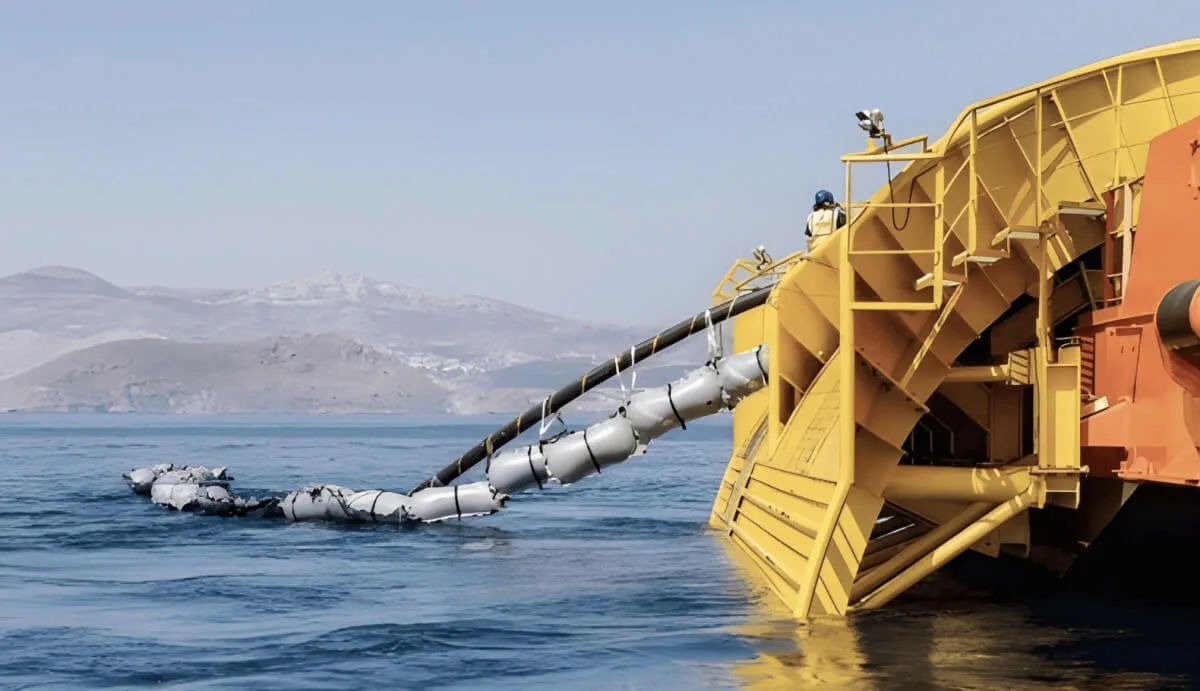
Republic of Cyprus President Nikos Christodoulides' statement that his government is ready to pay €25 million annually for the Great Sea Interconnector once a Navtex is issued for the continuation of survey and cable-laying work shifts the center of the debate over the project.
The question is no longer simply whether the Republic of Cyprus intends to pay. It is whether Greece is ready to take the GSI back to sea, where the electricity interconnection meets Greek-Turkish disputes and the geopolitical risks of the Eastern Mediterranean.
Christodoulides said linking the payment to the issuance of a Navtex had been agreed with Greek Prime Minister Kyriakos Mitsotakis. He also publicly backed Finance Minister Makis Keravnos over his reservations about the project's viability and rejected suggestions of friction between the Republic of Cyprus and Greece.
The Republic of Cyprus government's position is now clear. It does not question its agreed participation, it maintains its financial reservations, and it links disbursement to a specific step confirming that the project is returning to implementation.
This is where the political pressure moves to Athens.
Until now, attention could be directed toward the Republic of Cyprus through the question of why it had not paid the agreed amount for a project presented as strategically important to the Republic of Cyprus, Greece and the European Union.
Christodoulides has reversed that sequence. The Republic of Cyprus says it will pay once there is evidence that the project is moving forward at the point where it effectively stalled: at sea.
Navtex therefore assumes importance well beyond that of a technical maritime notice.
Its issuance would indicate an intention to resume activity in maritime areas where previous surveys triggered Turkish objections and exposed the geopolitical risk surrounding the project. At that point, the GSI ceases to be only an energy and financing project.
The real test begins when survey or cable-laying vessels return and implementation encounters the differing positions of Athens and Ankara over maritime jurisdiction.
Issuing a Navtex does not itself guarantee either the viability of the GSI or uninterrupted construction. It does, however, create a clear political benchmark.
If the notice is issued and work resumes, the Republic of Cyprus will be expected to honor its public commitment to pay the €25 million. If it is not issued, the question of why the project remains stalled moves toward Athens.
The financial dimension predates the current dispute. The Cyprus Energy Regulatory Authority approved a cost-recovery mechanism providing for a Cypriot contribution of €25 million annually and €125 million in total over the 2025-2029 period.
The Republic of Cyprus government, however, had already linked the actual release of funds to progress on the project.
Christodoulides' public support for Keravnos fits that position. The president is not setting aside the Finance Ministry's reservations to ease coordination with Athens. He is incorporating them into the government's position: the Republic of Cyprus is not rejecting its financial obligation, but it does not intend to fund a project without tangible progress.
"Progress" now has a specific meaning: the issuance of a Navtex and the return of work to sea.
For the Greek government, the dilemma extends well beyond a dispute over €25 million.
Resuming the surveys directly affects Greek-Turkish relations and questions of maritime jurisdiction. Previous Turkish reactions have shown that the return of vessels to the area could produce renewed tension. Greece is therefore being asked to assume the operational and geopolitical responsibility involved in restarting the project.
This is also the political substance of Christodoulides' position. The Republic of Cyprus is not withdrawing from the GSI, but it does not accept being portrayed as the main factor behind the delay. Its position is that it will fulfill its obligation once there is corresponding evidence that the project is moving from declarations to implementation.
The formula also allows Christodoulides to address several audiences. Toward Athens, he confirms that the bilateral agreement remains in force. At home, he can say public funds will not be released without substantive progress. Toward Brussels and investors, he maintains support for a project presented as strategically important.
The debate has acquired another layer following the restructuring of the investment scheme and the entry of Meridiam. Financing is an important prerequisite, but it does not resolve the GSI's fundamental problem: whether it can be built under the actual geopolitical conditions of the Eastern Mediterranean.
That is a risk no change in the shareholder structure can absorb.
The €25 million is therefore only the surface of the dispute.
Christodoulides' position creates a simple sequence: issuance of a Navtex, resumption of work, Cypriot payment. The Republic of Cyprus has turned a financial question into a political test of whether the project can actually be implemented.
Over the past two years, the GSI has faced technical, regulatory, financial and geopolitical difficulties. The question is now more specific than before.
Can the electricity interconnection genuinely return to sea?
The answer no longer lies in the Cypriot treasury. It lies in the next Navtex.
This analysis was originally published in full by IBNAEU. Read the original version here.