
By Bosphorus News Economy Desk
Türkiye's food security debate is moving beyond production capacity as data from the Organisation for Economic Co-operation and Development (OECD), the World Bank and the Food and Agriculture Organization of the United Nations (FAO) point to rising pressure from agricultural water use, land degradation and drought risk, while a 2025 report by the Independent Industrialists' and Businessmen's Association (MÜSİAD) ties the same risks to urbanisation and wrong farming practices.
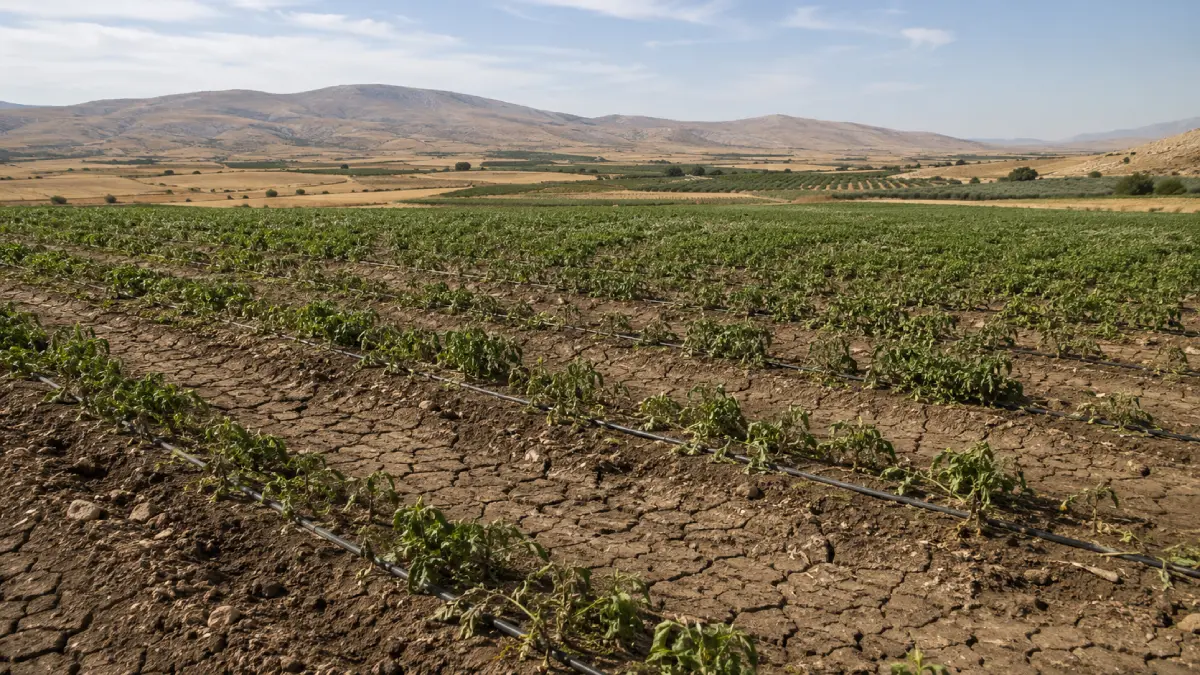
The water pressure is the clearest warning sign. The OECD's 2025 Türkiye agriculture profile says agriculture accounts for about 85% of the country's freshwater withdrawals, leaving food production exposed to any tightening in rainfall, irrigation efficiency or basin-level water management.
That pressure has already become a financing and policy issue. The World Bank has approved major Türkiye projects to improve irrigation efficiency, support crop production and strengthen flood and drought management, showing that water risk is now part of the country's wider food security and economic resilience agenda.
Land pressure adds a second layer. The Food and Agriculture Organization of the United Nations (FAO) links land degradation to lower productivity, weaker rural livelihoods and higher food security risks, making soil quality as important as the amount of cultivated land.
The climate link is harder to separate from the land problem. The Intergovernmental Panel on Climate Change (IPCC) treats climate change, desertification, land degradation and food security as connected risks, with drought and heat pressure affecting both yields and the stability of food supply.
MÜSİAD's 2025 agriculture report brings the same debate into Türkiye's domestic policy frame. The report links food security to urbanisation, shrinking rural labour, pressure on arable land and wrong farming practices, arguing that future food needs cannot be met through production increases alone.
Urbanisation cuts both ways in that reading. It increases demand for food, water, energy and logistics in cities, while the rural production base faces labour loss, ageing and weaker continuity across generations.
Wrong farming practices turn that pressure into a soil problem. Poor land use, erosion, excessive or inefficient input use and weak planning can reduce soil quality over time, leaving agriculture more exposed to drought, cost shocks and lower productivity.
The result is a food security debate that reaches beyond farms. Water management, soil protection, rural labour, storage, logistics and climate adaptation now sit inside the same policy field as production targets.
Türkiye does not face this pressure because it lacks an agricultural base. The problem is that water, soil quality, urban growth and farming practices are now pressing on the same system at the same time, making food supply and prices harder to keep stable.
The warning is already visible in the way the issue is being discussed. Food security in Türkiye is no longer only a question of harvest volumes; it is becoming a question of whether water management, soil protection and rural production can keep up with the pressure building around them.
***Sources: Organisation for Economic Co-operation and Development, World Bank, Food and Agriculture Organization of the United Nations, Intergovernmental Panel on Climate Change, MÜSİAD, Bosphorus News review.