
By Bosphorus News Geopolitics Desk
Turkish Foreign Minister Hakan Fidan used his first official visit to Singapore to place Türkiye's Southeast Asia policy on a more concrete track, bringing trade, defense industry, technology cooperation and ASEAN engagement into the same diplomatic conversation.
Fidan was in Singapore on 1-2 June for an official visit at the invitation of Singaporean Foreign Minister Vivian Balakrishnan. On 2 June, he was received by Prime Minister and Finance Minister Lawrence Wong, held talks with Balakrishnan and separately met Coordinating Minister for National Security and Home Affairs Minister K. Shanmugam.
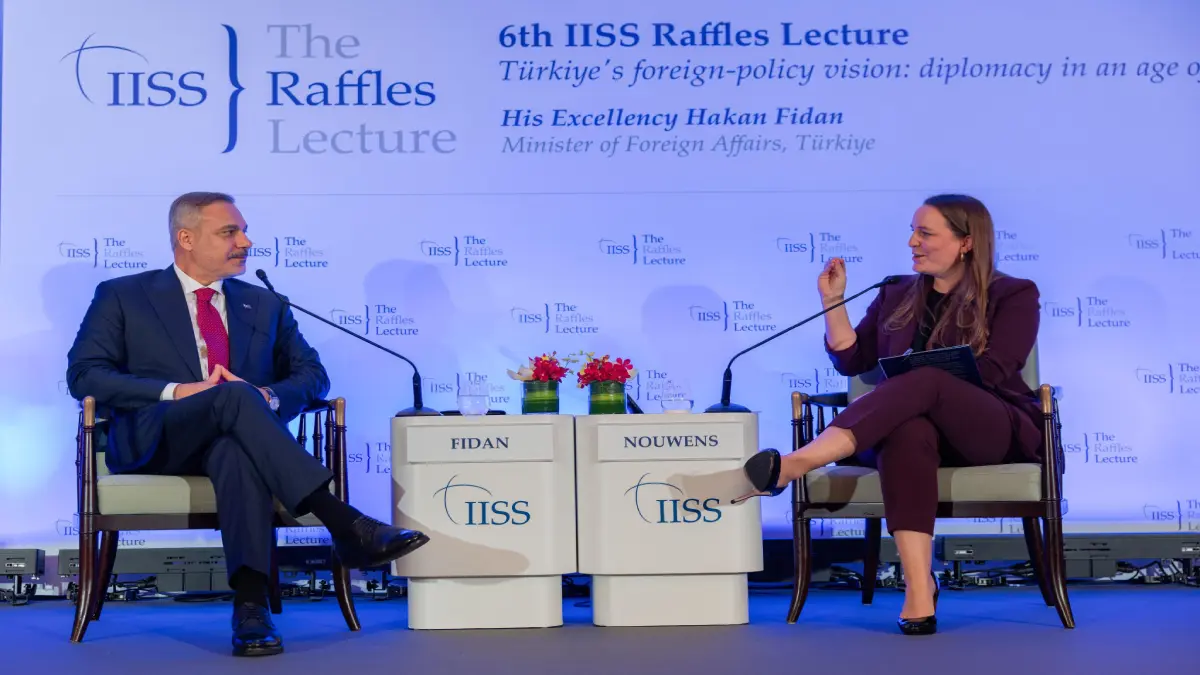
He also addressed the IISS Raffles Lecture, a foreign policy platform hosted by the International Institute for Strategic Studies, where he presented Türkiye's view of diplomacy at a time of widening geopolitical uncertainty.
Singapore's Ministry of Foreign Affairs said Wong welcomed Türkiye's intention to increase cooperation with Singapore and the wider ASEAN region. Wong and Fidan also exchanged views on international developments. In his meeting with Balakrishnan, the two ministers reviewed the growing bilateral relationship and discussed deeper cooperation in trade, investment, innovation, food security and renewable energy. Balakrishnan also expressed support for Türkiye deepening its engagement with ASEAN.
The visit rested on an established framework. Türkiye and Singapore elevated their relations to a strategic partnership in 2014. Their free trade agreement was signed in 2015 and entered into force in 2017, covering goods, services, investment, public procurement and wider economic cooperation. Singapore's trade ministry describes the deal as Türkiye's first comprehensive free trade agreement concluded in a single undertaking.
Bilateral trade reached 1.07 billion dollars in 2025, according to Turkish figures cited by Anadolu Agency. That volume is modest when compared with Türkiye's trade with larger Asian economies, but Singapore's value lies in the combination of finance, logistics, technology and maritime connectivity. It gives Ankara a compact but influential entry point into Southeast Asian supply chains, port networks and ASEAN-centred diplomacy.
The ASEAN track gives the visit its wider value. Türkiye has been seeking to upgrade its status with ASEAN from sectoral dialogue partnership to dialogue partnership, a step that would give Ankara deeper access to the organisation's ministerial and institutional architecture. Singapore's public support for closer Türkiye-ASEAN engagement gave that effort a useful diplomatic signal, even though no formal status upgrade was announced.
Defense industry was also part of the agenda. Turkish diplomatic sources said ahead of the visit that Fidan would discuss possible steps in military and defense cooperation, while his meetings also covered security, digital transformation and connectivity. No specific defense program, procurement deal or contract was announced.
The technology file broadened the visit beyond protocol. Turkish and Singaporean officials discussed cooperation in trade, investment, innovation, food security and renewable energy, while Turkish diplomatic sources pointed to possible areas such as artificial intelligence, semiconductors, financial technologies, electric vehicles and halal food.
Regional crises gave the talks a sharper foreign policy setting. Turkish sources said the agenda included Gaza, the Iran conflict, the Strait of Hormuz, Syria and developments in the South China Sea. Those files connected Fidan's Singapore stop to the wider diplomatic workload Ankara is carrying across the Middle East, NATO, the Black Sea and Eurasian connectivity routes.
The visit did not produce a headline agreement, but that is not the main measure of its significance. It tied together the files Türkiye wants to advance in Southeast Asia: an existing free trade framework, support for deeper ASEAN access, possible defense cooperation and technology-sector engagement. Singapore is not a symbolic stop in that map. It is one of the few places where Türkiye can connect diplomacy, finance, logistics, maritime routes and advanced technology in the same conversation.
***Sources: Singapore Ministry of Foreign Affairs press statement, 2 June 2026; Turkish Ministry of Foreign Affairs, 2 June 2026; International Institute for Strategic Studies; Anadolu Agency; Hürriyet Daily News.