
By Bosphorus News Economy Desk
Türkiye's farmland has become sharply more expensive in nominal terms. Data from property analytics platform Endeksa shows that unit prices for agricultural land, orchards and fields rose by just over 1,000 percent between January 2021 and May 2026, a tenfold increase in five years.
The increase looks dramatic until it is measured against the lira. Over the same period, the currency lost more than 80 percent of its value against the dollar. The dollar rose 506 percent against the lira in that window, and the euro rose 477 percent. Much of the increase disappeared in hard-currency terms even as farmland prices surged in lira.
The gap is visible province by province. Istanbul farmland now trades at 2,983 lira per square metre, the highest level in the country. One decare, the standard Turkish land unit of 1,000 square metres, costs just under three million lira at current rates, or roughly 65,000 dollars.
Şanlıurfa, the agricultural heartland of the southeast, comes in at 1,289 lira per square metre, with annual gains of 30.3 percent that outpace the national average. Konya, Türkiye's grain belt and the country's largest farming province by area, sits at roughly 240 lira per square metre, the cheapest among the major agricultural provinces surveyed.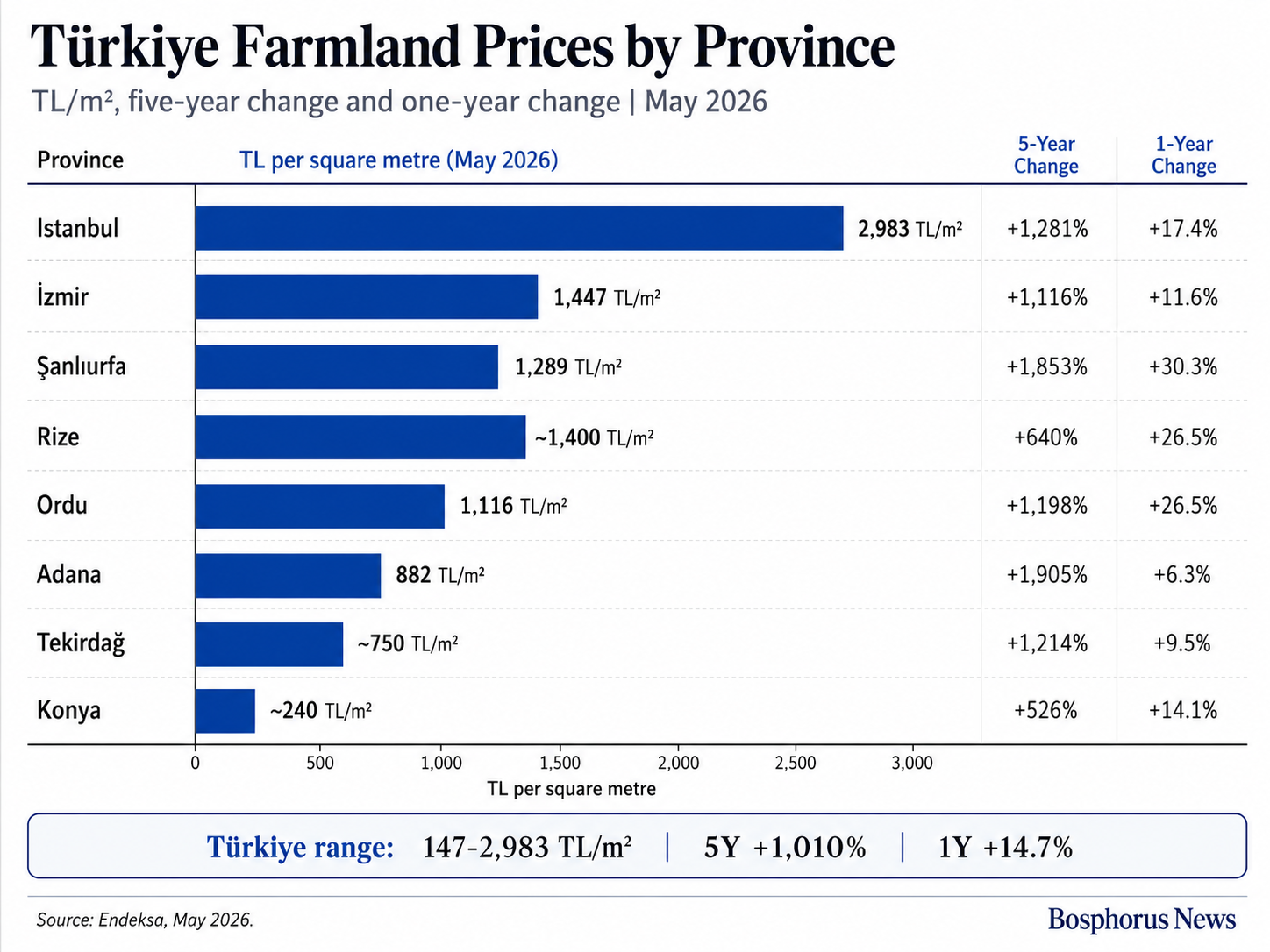
The GAP effect
Şanlıurfa's outsized five-year gain, nearly 1,900 percent and almost double the national figure, carries an irrigation premium. The province sits at the centre of the Southeastern Anatolia Project (GAP), the largest regional development programme in Türkiye's history.
GAP's irrigation system, built around dams and canal networks on the Euphrates and Tigris, had opened 675,250 hectares to irrigation by the end of 2024, while the original programme envisaged irrigation across 1.8 million hectares. The 2024-2028 GAP Action Plan set the operational irrigation target at 1.11 million hectares, keeping water infrastructure at the centre of the regional development push.
The prospect of irrigation changes the market value of land before every canal is completed. Land closer to planned or expanding irrigation networks is priced differently from land with no such expectation. In Şanlıurfa, that premium is already visible: farmland costs more per square metre than in Konya, although Konya remains the country's main grain province.
Shrinking ground
The price surge is unfolding against a long decline in cultivated land. Türkiye's total cultivated area stood at roughly 27 million hectares in the mid-1990s. By 2024, Turkish Statistical Institute (TÜİK) data showed it had fallen to about 24 million hectares.
TMMOB's Chamber of Agricultural Engineers, in a 2026 assessment that also cited Banking Regulation and Supervision Authority (BDDK) banking data, put the current cultivated area at 23.97 million hectares. The cumulative loss since 2002 alone amounts to approximately 2.6 million hectares, an area roughly comparable to North Macedonia.
The decline differs sharply by province. A Periskop analysis based on TÜİK data put Konya's agricultural land loss since 2004 at about 7.35 million decares, or roughly 735,000 hectares, even though the province remains Türkiye's largest farming province. The same analysis said Diyarbakır recorded the steepest percentage decline among metropolitan municipalities in the same period. Istanbul, where farmland now commands the highest prices in the country, has only 74,600 hectares of agricultural land remaining.
Much of the loss is difficult to reverse once farmland is converted into housing, roads, energy sites or industrial zones. Türkiye's Soil Protection and Land Use Law of 2005 prohibits the conversion of prime farmland in principle, but exemptions for public investment projects have opened a wide route for farmland to leave production.
The Türkiye Ziraat Odaları Birliği (TZOB), the Union of Turkish Chambers of Agriculture, said in June 2026 that the country had lost three million hectares of farmland over the past thirty years because of urbanisation, industrialisation, infrastructure projects and misuse.
Debt and dispossession
Land prices climbed while the financial position of farmers weakened. BDDK data shows that total agricultural credit outstanding reached 1.355 trillion lira by March 2026, up from roughly 2.5 billion lira in 2002, a 542-fold nominal increase.
Non-performing loans in the agricultural sector stood at 4.9 billion lira in February 2025 and reached 19.4 billion lira by February 2026. That is a 295 percent increase in twelve months, leaving the bad-loan stock almost four times higher than a year earlier.
The debt burden has already moved into enforcement files. Parliamentary statements by CHP Deputy Ömer Fethi Gürer, citing National Judiciary Informatics System (UYAP) enforcement data, said that in November 2025 alone, 63 tractors and 5,826 fields were listed for forced sale through enforcement courts. Similar monthly figures were reported through 2025, with volumes rising during the year.
Production costs added another layer of pressure. TÜİK's agricultural producer price index rose 43.5 percent year-on-year in May 2026, leaving many farmers exposed to high input costs even when the nominal value of land and output increased.
Agriculture's share of total employment fell from 34.9 percent in 2002 to 13.8 percent in the first quarter of 2026. The pressure on farming is visible in labour data as well as land records.
Asset boom, farming squeeze
The most expensive land is no longer where farming is strongest. Istanbul has the highest farmland prices in the country, but only a small agricultural base remains. Konya has the lowest price among the major provinces surveyed, yet it remains Türkiye's grain belt.
The nominal price surge reflects the lira's depreciation, speculative demand from investors treating land as an inflation hedge and, in specific cases such as Şanlıurfa, expectations of future productivity gains from public infrastructure. It does not, by itself, show a stronger agricultural economy.
Türkiye's farmland market now tells two stories at once: land is more valuable as an asset, while the production base behind it is thinner, more indebted and more exposed to conversion.
Sources: Endeksa, BDDK, TÜİK, TMMOB's Chamber of Agricultural Engineers, GAP Regional Development Administration, Periskop analysis based on TÜİK data, Türkiye Ziraat Odaları Birliği, parliamentary statements by CHP Deputy Ömer Fethi Gürer citing UYAP enforcement court data, Bosphorus News review and reporting.