

By Bosphorus News Economy Desk
Türkiye's net energy import bill rose by about $3 billion, or 26 percent, in March, April and May compared with the same months in 2025, as the Hormuz Strait crisis pushed global fossil fuel prices higher, energy think tank Ember said in a new analysis. The think tank said the bill could rise by a further $14 billion through the end of 2026 if fossil fuel prices remain at their May 1 levels.
The crisis dates to February 28, 2026, when war between Iran and the United States and Israel led to the closure of the Strait of Hormuz to shipping. The strait carries about 20 percent of global oil supply and liquefied natural gas trade. Between February 28 and May 1, Brent crude prices rose 50 percent, European gas prices rose 45 percent, and coal prices rose 3 percent.
Ember said the projected $14 billion increase for March through December would equal roughly 30 percent of Türkiye's annual energy import bill. Oil would account for about $8 billion of the additional cost and gas for about $6.4 billion, with coal adding a smaller amount, estimated at around $95 million.
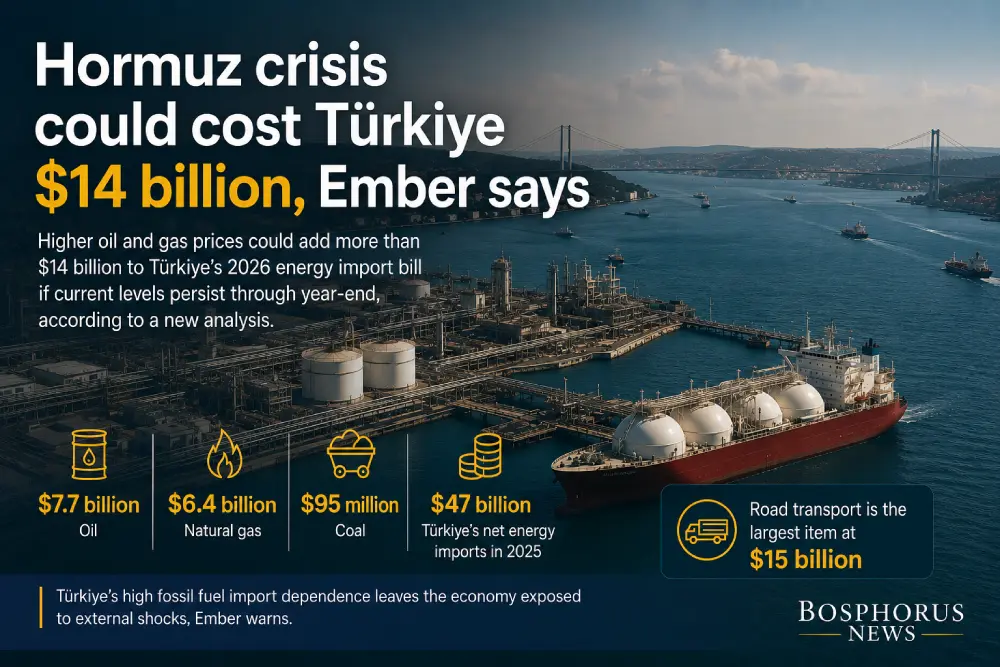
In 2025, Türkiye paid about $47 billion for net energy imports, with oil making up 47 percent of the bill, gas 43 percent and coal 10 percent. Road transport was the largest single category at about $15 billion, and the report said it would carry the heaviest share of the additional oil cost, at about $5.2 billion. On the gas side, the $6.4 billion increase would fall mainly on households, at $2.3 billion, followed by electricity generation at $1.6 billion and industry at $1.5 billion.
Part of the gas effect will arrive with a delay. Because Türkiye's gas supply contracts are indexed to oil prices, some of the cost increase from higher oil prices reaches the gas bill only after about nine months, Ember said.
Ember's figures show why Türkiye is exposed. According to the think tank's 2024 data, fossil fuels covered 67 percent of Türkiye's energy demand, with import dependence at 95 percent for gas, 83 percent for crude oil and 60 percent for coal. On crude oil, Russia supplied 46 percent of Türkiye's imports, followed by Iraq at 15 percent, Kazakhstan at 13 percent and Saudi Arabia at 7 percent. Iraq's share has become a live issue this week, as Baghdad has asked Ankara to extend the pipeline agreement covering crude exports through Ceyhan, as Bosphorus News reported.
The Economic Policy Research Foundation of Türkiye (TEPAV) has separately warned that the Hormuz crisis transmits risk beyond crude prices, into shipping costs, fertilizer markets, petrochemical inputs and wider industrial supply chains.
The crisis is not resolved. An OECD economic outlook published June 3 found that crude oil, refined products, natural gas, sulfur and fertilizer prices remained elevated in late May compared with their level before the war began. Iran has said it is allowing some vessels through the strait under coordination while keeping others out, and oilfield services company Baker Hughes has said the strait may not return to full capacity until the second half of 2026.
The report also argued the crisis strengthens the case for electrification. Speaking to Euronews Turkish, report author Bahadır Sercan Gümüş said accelerating clean energy transition in transport and buildings, the sectors that make up the largest share of the import bill, would permanently ease Türkiye's import burden. Ember estimated that one million electric vehicles could cut fossil fuel imports by about $900 million a year, while a 10 percent shift to heat pumps among households could reduce annual gas import costs by more than $1 billion.
Sources: Ember, Euronews Turkish, TEPAV, OECD, Bosphorus News review and reporting.