
By Bosphorus News Geopolitics Desk
Türkiye's business establishment is pressing the European Union to reopen the political horizon of Türkiye's accession process, arguing that the file can no longer be treated as a stalled diplomatic ritual while Europe debates competitiveness, supply chain security, energy resilience and defence capacity.
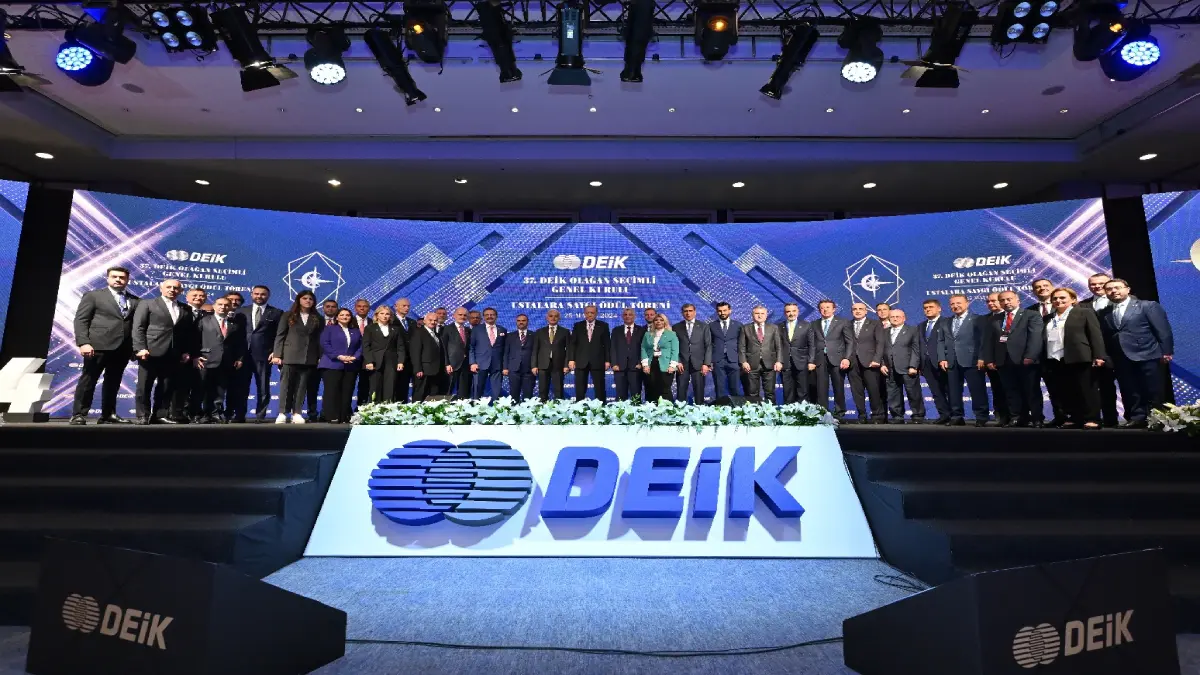
The Foreign Economic Relations Board of Türkiye, known by its Turkish acronym DEİK, launched the first phase of a coordinated public campaign in January 2026, when President Nail Olpak and DEİK Türkiye-Europe Business Councils Coordinating Chairperson Mehmet Ali Yalçındağ held a press conference in Istanbul. An open letter signed by both men and the chairs of Türkiye's bilateral business councils with 26 EU member states was published the following day as a full-page advertisement in the Financial Times. It was addressed to European Parliament President Roberta Metsola, European Council President António Costa and European Commission President Ursula von der Leyen, and called on Brussels to reconsider what it described as "the current unproductive methodology which stalls Türkiye's accession process."
The second phase began on May 8, timed around Europe Day. DEİK placed full-page open letters in leading national newspapers across Germany, France, the Netherlands, Spain, Italy, Poland and Belgium, this time directed at individual heads of government rather than EU institutions. The letter in Germany's Bild read: "A strong Europe is impossible without Türkiye." Letters to Rzeczpospolita in Poland and De Tijd in Belgium followed in the same week.
Candidate Country, Frozen File
The Council of the European Union granted Türkiye candidate status in December 1999. Accession negotiations opened in October 2005 and have been at a standstill since June 2018, when the Council froze further progress citing rule of law and fundamental rights concerns. The European Commission still formally describes Türkiye as a candidate country and identifies it as a key partner in trade, migration, security, energy, transport and regional affairs.
DEİK's campaign is built around that contradiction. Türkiye is treated as an indispensable external partner across multiple EU policy files, but the institutional framework that would bring it inside the EU's decision-making structure has been closed for eight years.
50 Billion to 250 Billion
The business case has become more concrete over successive months. At a German-Turkish Business Council board meeting on April 27, Olpak said Türkiye and Germany currently have a trade volume of approximately 50 billion euros including services. He argued that figure could reach 125 billion euros in five years and 250 billion euros in ten years if the relationship is developed through targeted sectoral steps. Yalçındağ said the business community's ultimate goal is Türkiye's full EU membership and tied that directly to Europe's own capacity gaps, arguing that Türkiye's integration would strengthen regional energy and supply chain security, defence capacity and digital competitiveness.
DEİK carried the same argument to the Antalya Diplomacy Forum on April 18, where it co-organised a panel on European competitiveness in an era of geopolitical uncertainty. Olpak said the Customs Union modernisation should not be read as a technical trade adjustment but as an investment invitation, and asked publicly whether Türkiye's EU membership would continue to be negotiated for another 60 years and the Customs Union for another 30.
The Customs Union, in force since 1996, has not been updated to cover services, public procurement, digital trade, green regulation or modern supply chain rules. The Carbon Border Adjustment Mechanism, the EU's carbon pricing tool for imports, is adding new costs for Turkish exporters as additional sectors are phased in. Olpak described the mechanism as a set of new walls for companies already embedded in European value chains.
Kos in Ankara, Wadephul in Berlin
The DEİK campaign has run alongside official contacts that have kept the accession file in diplomatic circulation. On February 6, Foreign Minister Hakan Fidan met EU Commissioner for Enlargement Marta Kos in Ankara. Both sides issued a joint statement reaffirming Türkiye's candidate status and acknowledging the strategic value of the relationship for regional stability and economic resilience. The statement said both sides recognised the importance of constructive dialogue toward Customs Union modernisation. Kos's programme in Ankara included meetings with Vice President Cevdet Yılmaz, Trade Minister Ömer Bolat and Finance Minister Mehmet Şimşek, and a roundtable with Turkish business representatives. The Commission published on the same day a study on trade routes linking Europe and Asia via the South Caucasus and Türkiye, with Kos noting that cargo volumes on those routes were rising while infrastructure investment remained urgent.
On May 18, Fidan co-chaired the third session of the Türkiye-Germany Strategic Dialogue Mechanism in Berlin with German Foreign Minister Johann Wadephul. Wadephul said Germany supports Türkiye's inclusion in EU defence and industrial policy frameworks and described Berlin as a reliable partner for Türkiye's EU membership path, while noting that accession depends on meeting EU criteria. The following day, Erdoğan spoke by phone with Von der Leyen. Türkiye's Directorate of Communications said Erdoğan raised Türkiye's participation in EU security strategy initiatives and the need to update the Customs Union. Von der Leyen described Türkiye as "a key partner in a region in turmoil" and said EU and Turkish interests converge on keeping trade routes open, energy flowing and supply chains stable.
Where the File Sits
The Council's 2018 and 2019 positions have not been formally revised. Thirty-three of the 35 accession chapters remain blocked or unopened. The European Commission has not publicly responded to either phase of the DEİK campaign.
That is the gap Türkiye's business community is now pressing from the outside. Europe has continued to rely on Türkiye as a trade partner, NATO ally, migration manager, energy transit country and connectivity corridor across multiple crises. The institutional question of where Türkiye belongs in Europe's architecture has not moved.
DEİK's argument is that the cost of keeping the file frozen has risen faster than the cost of reopening it. Whether that calculation reaches European capitals is a different question. The campaign has produced press conferences, newspaper advertisements and bilateral diplomatic language. It has not yet produced a Council decision.
***Sources: Anadolu Agency, TRT World, Hürriyet Daily News, Financial Times (advertisement, January 31, 2026), DEİK official press conference statements (January 30, 2026), European Commission official statements, Turkish Ministry of Foreign Affairs, Türkiye Directorate of Communications.