
By Bosphorus News Defense Desk
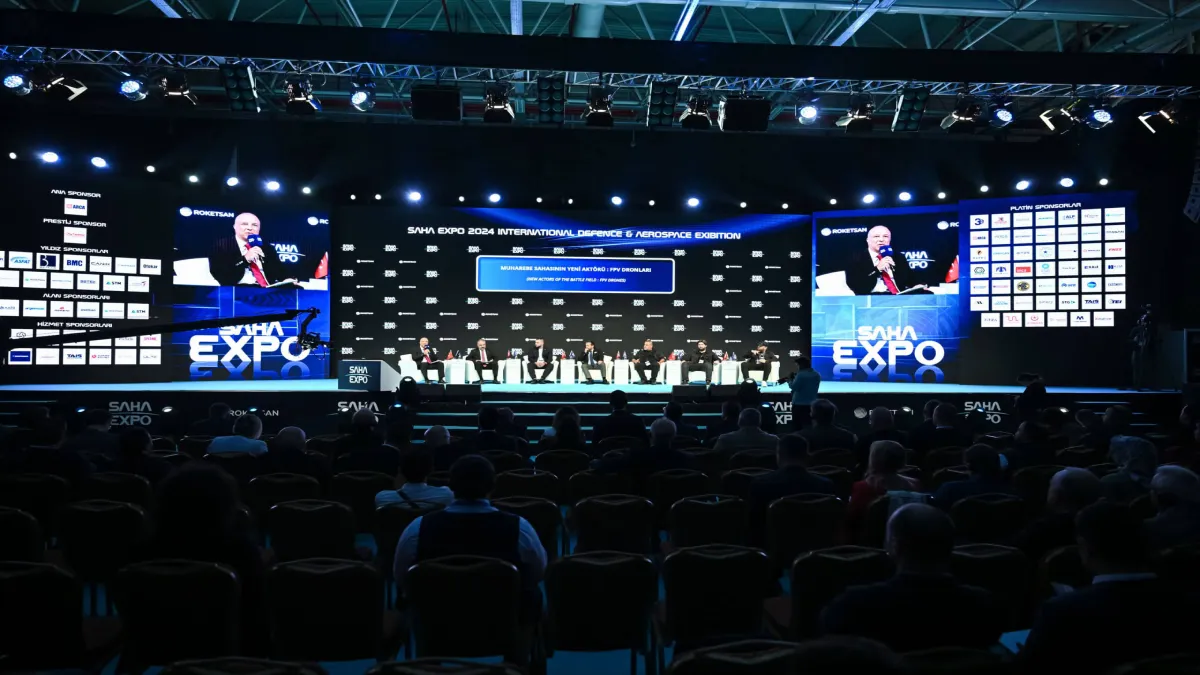
Türkiye closed SAHA 2026, the İstanbul defence and aerospace fair organized by SAHA İstanbul, the country's largest defence and aerospace industry cluster, with 182 agreements worth $8 billion, giving the expo a clear export and production-scale message as demand grows for unmanned strike systems, long-range munitions and autonomous naval platforms.
President Recep Tayyip Erdoğan said at the May 8 closing ceremony that $6 billion of the total business volume came from export-oriented agreements. He said 1,763 companies took part in the fair, including 1,500 domestic firms and 263 foreign companies, while 203 products were introduced for the first time.
"The Turkish defense industry has now become an ecosystem that is in demand, trusted, closely followed and preferred not only in its region but also worldwide," Erdoğan said.
The closing numbers confirmed the scale already visible at SAHA 2026, where Türkiye's defence firms moved through $8 billion in deals and ASELSAN's Steel Dome agenda had placed industrial capacity at the center of the fair.
Industry and Technology Minister Mehmet Fatih Kacır put the same shift in domestic production terms. He said Türkiye had raised the share of domestic products in the defence industry to around 80 percent and now produces two-thirds of armed drones sold worldwide. He also said Türkiye is among the 10 countries capable of building its own warship.
The most striking export signal came from Pasifik Teknoloji. The company signed an export framework with an unnamed friendly and allied country covering 101,035 unmanned systems. The package includes 100,000 MERKÜT FPV kamikaze UAVs, 10 ALPİN unmanned helicopters, 25 DUMRUL mini unmanned helicopters, 500 DELİ tactical kamikaze systems and 500 KORGAN autonomous ground support and observation units.
The scale of that package points to a different production model from prestige platforms built in smaller numbers. The demand is moving toward cheaper, attritable and mass-produced unmanned systems shaped by recent battlefield experience in Ukraine, the Caucasus and the Middle East.
ASELSAN widened the same picture into the maritime domain. The company unveiled KILIÇ and TUFAN, extending Türkiye's kamikaze and autonomous systems agenda into underwater and surface warfare. KILIÇ was presented as a one-way attack autonomous underwater vehicle family, while TUFAN adds an unmanned surface strike system with swarm-capable operational concepts.
ASELSAN CEO Ahmet Akyol said more cost-effective deterrent systems are moving to the center of future warfare. His remarks matched one of the strongest patterns at SAHA 2026: Türkiye's unmanned systems base is spreading from aerial platforms into coastal defence, port security, chokepoint operations and naval strike missions.
STM added the long-range air layer with KUZGUN, a kamikaze UAV with a range exceeding 1,000 kilometers. The system can take off with rocket assistance from mobile land platforms or fixed launchers, giving Türkiye another entry in the long-range loitering munition field.
The long-range layer also connects to the wider deterrence debate opened by Türkiye's Yıldırımhan missile prototype, which pushed SAHA 2026 beyond drones and into the question of how Türkiye's missile and strike systems are being read by allies and rivals.
Baykar used the fair to widen its international industrial network. The company signed a contract with Italy's Gruppo Esea for a fully robotic UAV production line, a move aimed at higher-volume, more cost-effective and more standardized production. Baykar also signed a framework agreement with France's Safran Electronics and Defense on aviation electronics and electronic solutions.
The company's agreement with the UAE's EDGE Group added another layer through the integration of the Emirati-made Al Tariq precision-guided munition into the Bayraktar AKINCI UCAV. Turkish platforms are increasingly becoming integration hubs for partner-country sensors, munitions and subsystems.
The same outward-facing industrial pattern has also appeared in Türkiye's defence cooperation track with Brazil, showing how Ankara is using defence ties to expand production, integration and export channels beyond its immediate region.
TCG Anadolu's opening to public visitors at Sarayburnu on May 9 gave the closing phase a public naval visibility element. Inside the fair, the more consequential naval story came from autonomous underwater attack vehicles, unmanned surface strike systems and loitering munitions built for a more crowded maritime battlespace.
Airborne drones made Türkiye's defence industry globally visible over the past decade. SAHA 2026 showed a wider portfolio taking shape around mass FPV exports, long-range loitering munitions, unmanned helicopters, autonomous ground units, one-way attack underwater vehicles and unmanned surface strike systems.
The fair closed with record figures, but the weight of the event sits in the combination of contracts and systems. Export deals, robotic production lines, foreign munition integration and autonomous naval weapons now point to an industry trying to convert battlefield demand into production scale, and production scale into strategic leverage.
***Sources: Presidency of the Republic of Türkiye, Anadolu Agency, Xinhua, KAP Public Disclosure Platform, ASELSAN, STM, Baykar, Janes, Defence Turkey, Bosphorus News reporting.