
By Bosphorus News Defense Desk
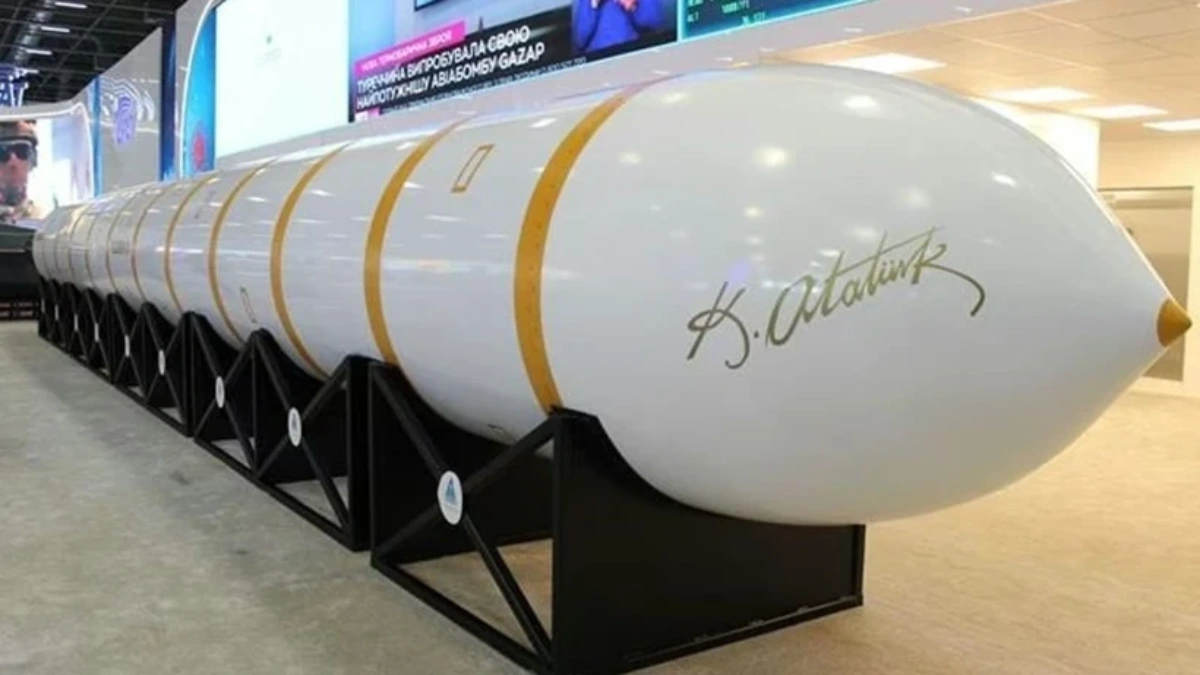
Türkiye has moved its long-range missile ambitions into a new strategic category after unveiling Yıldırımhan at SAHA 2026, presenting the system as the country's first liquid-fuelled, hypersonic, long-range missile with a reported 6,000 km range.
The missile was displayed at the Istanbul defence fair by the National Defense Ministry's Research and Development Center. Turkish officials described Yıldırımhan as the longest-range missile system Türkiye has publicly presented, with a three-ton warhead capacity, four liquid-fuelled rocket motors and a speed profile reported between Mach 9 and Mach 25.
The unveiling gives Ankara a new deterrence narrative at a time when missile defence, long-range strike systems and air defence integration have become central issues across NATO's southern flank. It also requires careful wording. Turkish officials have confirmed laboratory tests, but no public flight test, completed field trial or operational deployment has been announced.
National Defense Ministry spokesman Rear Admiral Zeki Aktürk said at the SAHA 2026 weekly press briefing that the liquid fuels used in Yıldırımhan, including asymmetric dimethylhydrazine and nitrogen tetroxide derivatives, are produced domestically by the ministry's R&D Center.
"The laboratory test processes for the Yıldırımhan missile system, which has a three-ton warhead carrying capacity, have been successfully completed, and work on field tests is continuing in line with the planned schedule," Aktürk said, according to Anadolu Agency.
Defense Minister Yaşar Güler also framed the system as a major technological threshold for Türkiye's missile program. Speaking at SAHA 2026, Güler said Yıldırımhan represented the country's first liquid rocket-fuelled missile system capable of hypersonic-speed flight and carrying the longest range publicly associated with a Turkish missile.
"If we have to use it, let no one doubt that we will not hesitate," Güler said, while adding that tests would begin in the coming period, according to TRT Haber.
That distinction sits at the centre of the story. Yıldırımhan has been displayed, and its laboratory phase has been presented as complete. Türkiye has not disclosed a launch, flight profile, impact test or operational deployment. The system therefore remains a strategic prototype and a public declaration of intent, rather than a confirmed intercontinental capability in service.
The Defense Ministry's R&D Center has also placed the project inside a longer technological track. Nilüfer Kuzulu, head of the center, said in a televised interview during SAHA 2026 that work on rocket motors was completed last year and that Türkiye had been working on hypersonic systems for around a decade. Her remarks make Yıldırımhan part of a sustained state R&D program, not a sudden exhibition surprise.
International coverage moved quickly. Al Jazeera reported the missile's 6,000 km range, Mach 25 maximum speed and 3,000 kg payload capacity, while Breaking Defense described the unveiling as a major addition to Türkiye's deterrence debate.
The NATO dimension remains sensitive, but no direct alliance dispute has emerged. NATO had issued no statement dedicated to Yıldırımhan by May 8. There was also no public response from the Greek Foreign Ministry, the Greek Defense Ministry or Israeli authorities. Greek and Israeli media covered the unveiling, but official reaction from Athens, Tel Aviv and NATO remained absent.
That absence does not remove the strategic weight of the announcement. Türkiye remains inside NATO's collective defence architecture while also developing national long-range strike capabilities far beyond the range of its previously public missile inventory. Yıldırımhan therefore enters a space where missile defence, deterrence autonomy and alliance politics overlap.
The Missile Technology Control Regime angle also requires precision. Türkiye has been a member of the regime since 1997. The regime focuses on exports, transfers and proliferation risks involving missile systems and related technologies, especially systems capable of delivering payloads of at least 500 kg over ranges of at least 300 km. Yıldırımhan's advertised range and payload place it far above that threshold, but domestic development alone does not automatically create an MTCR violation.
The more immediate issue is political and strategic. A tested Yıldırımhan would give Türkiye a long-range deterrent narrative extending well beyond the Eastern Mediterranean, the Black Sea and the Middle East. An untested Yıldırımhan still matters because Ankara has chosen to place that ambition in public view, with official language that links the system to deterrence rather than to a routine defence industry display.
Yıldırımhan's real weight will now be determined by the first field or flight test Türkiye chooses to disclose. Until that point, the system is less an operational intercontinental capability than the clearest public sign yet of the threshold Ankara wants to cross in long-range deterrence.