
By Bosphorus News Geopolitics Desk
Europe's argument over where Türkiye belongs in the continent's security order sharpened again on April 22, just as NATO Secretary General Mark Rutte arrived in Ankara and publicly praised the country's defence industry. The overlap mattered. In Brussels, Türkiye has been folded into an increasingly uneasy political debate about influence, access and institutional boundaries. In Ankara, Rutte pointed instead to production, innovation and military industrial value.
That contrast became clearer after recent controversy surrounding European Commission President Ursula von der Leyen's decision to place Türkiye alongside Russia and China in remarks on Europe's geopolitical environment, as detailed in Bosphorus News reporting on the von der Leyen backlash.
Ankara treated the formulation as more than a rhetorical slip. AK Party spokesperson Ömer Çelik called it "a very grave intellectual and political contradiction," arguing that such language exposed a deeper inconsistency in Europe's strategic thinking.
Against that backdrop, Rutte's stop at ASELSAN carried more significance than a routine alliance visit. Speaking at the company's technology base, he said NATO could "learn a lot" from what Türkiye had achieved and described the country's recent trajectory as a "defence industrial revolution." He tied that message to a broader alliance push for higher output, stronger resilience and a production network stretching "from Alaska to Ankara."
The emphasis was not accidental. NATO is under pressure to expand manufacturing capacity, reduce supply bottlenecks and strengthen the industrial base behind its deterrence posture. By using Türkiye as an example in that discussion, Rutte effectively acknowledged that the alliance sees Turkish defence production as part of the answer to a larger capability problem.
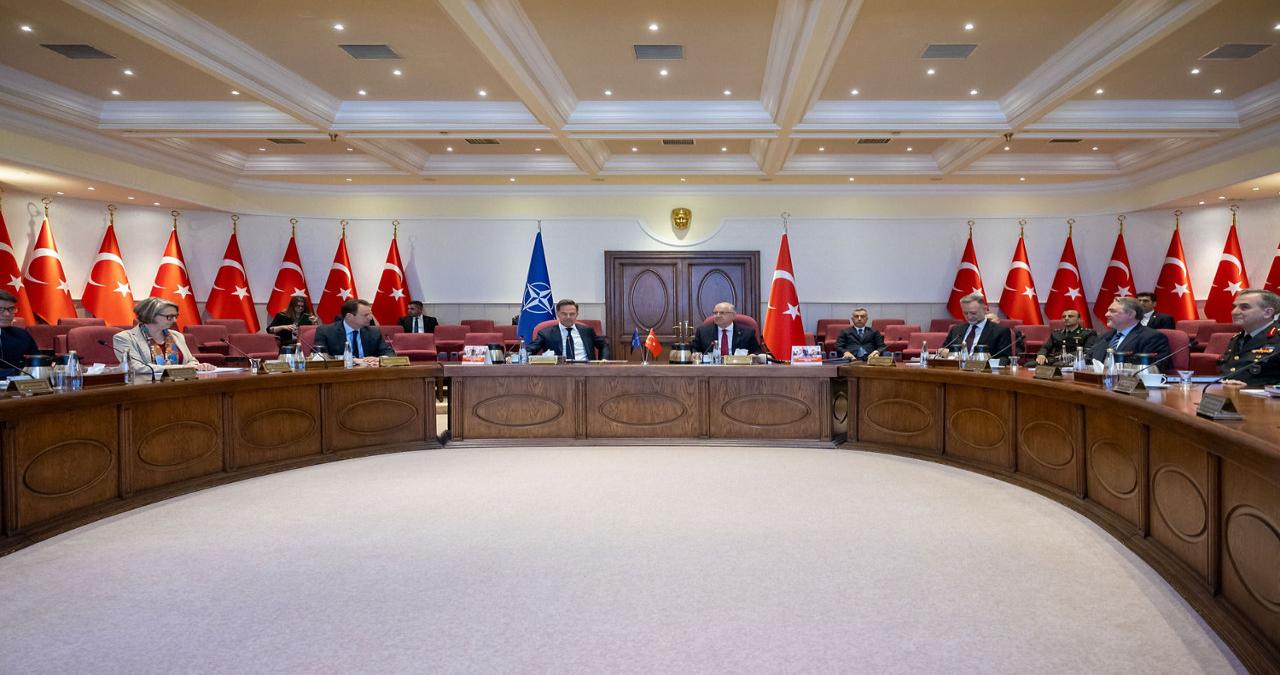
Erdoğan, in his meeting with Rutte the same day, answered from the political side of the same debate. According to the official Turkish readout, he said excluding European allies that are not members of the European Union from the bloc's defence initiatives would not serve the purpose those initiatives claim to advance. He also underlined the need for stronger solidarity within NATO ahead of the leaders summit in Ankara.
The sequence gave Ankara an opening to sharpen a long standing argument. NATO's senior leadership was in the Turkish capital praising domestic defence output at the very moment Europe's institutional debate was moving in a narrower direction. That made Rutte's remarks more consequential. They no longer sounded like ceremonial praise delivered to a host country. They sounded like recognition that Europe and NATO are not speaking in the same strategic register.
This tension has been visible for some time. One track is operational. It revolves around production speed, industrial depth and usable capacity. The other is political and financial. It is shaped by decisions over participation, access and who is allowed inside Europe's emerging defence architecture. As explored in Bosphorus News analysis of the NATO-EU defence split.
The divergence is not only conceptual. It has taken institutional form through the European Union's €150 billion SAFE funding mechanism, which continues to exclude Türkiye from the core of Europe's defence-industrial planning, as outlined in our coverage of the SAFE framework.
That is why April 22 mattered. The day did not produce a formal rupture, a summit decision or a new institutional deal. What it did produce was a clearer picture of the contradiction itself. NATO is increasingly explicit about the value of Turkish defence capacity. Europe is still far less settled on how much room it is prepared to give Türkiye inside the structures built around that capacity. In Ankara, those two realities appeared side by side.