
By Bosphorus News Defense Desk
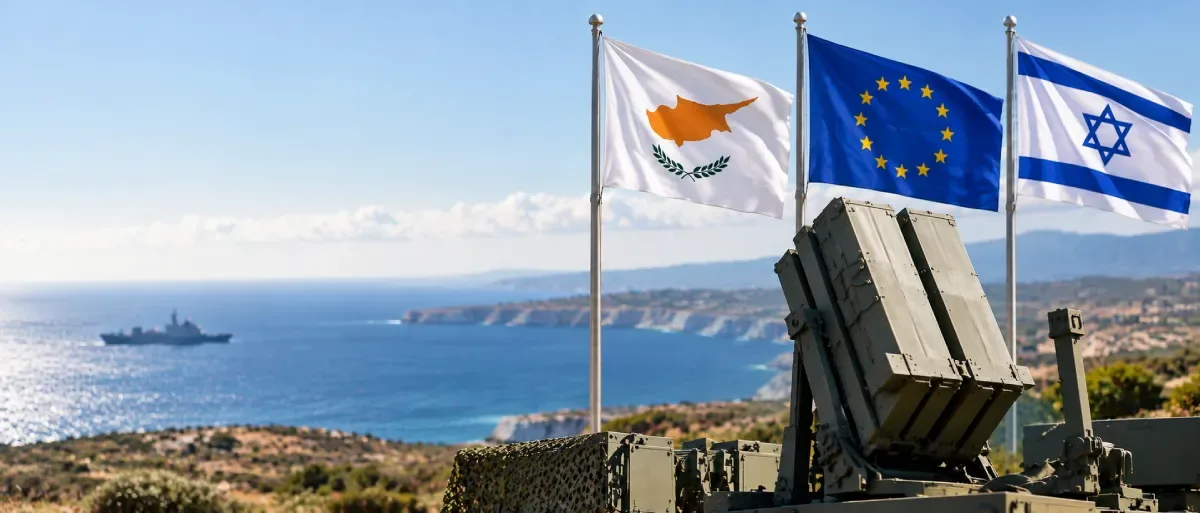
Israeli defense companies are considering establishing operations in Cyprus to compete for contracts financed through the European Union's Security Action for Europe (SAFE) loan program, Cyprus Mail reported Thursday. The subject surfaced during Israeli President Isaac Herzog's one-day working visit to Nicosia, where he met Republic of Cyprus President Nikos Christodoulides.
The reported interest opens a different path from the one available to companies and products based directly in Türkiye. Türkiye would need a separate agreement with the EU before they could become eligible under SAFE, and because Türkiye is an EU candidate country that agreement would require unanimous approval in the Council. An Israeli company incorporated in Cyprus would be examined instead under the rules governing contractors established inside the EU.
A Cypriot address, however, would settle very little on its own. SAFE also looks at where the company is managed, who controls it, where production and components originate and, for some categories of equipment, whether the contractor actually controls the design.
What Was Discussed in Nicosia
Cyprus Mail reported that Herzog and Christodoulides discussed defense cooperation, possible further Republic of Cyprus purchases from Israel and the interest of Israeli companies in SAFE-funded procurement.
Israel is already a major defense supplier to the Republic of Cyprus, which has acquired the Israeli-made Barak MX air defense system and radar equipment and has examined further purchases.
The discussion comes as Cyprus starts implementing its SAFE investment plan. The European Commission gave the plan a positive assessment in January, and the Council on Feb. 11 made available a maximum loan of about €1.18 billion. An initial payment of €177.2 million, equivalent to 15% of the allocation, followed in June.
Herzog's talks in Nicosia also covered the Aphrodite gas field, the Great Sea Interconnector and wider bilateral relations. Neither presidency had published an account of the reported SAFE discussion by the time of writing.
No Israeli company has been named publicly, and no application, procurement decision or SAFE-backed contract involving an Israeli subsidiary in Cyprus has been announced. Cyprus Mail is reporting interest in the program, not a procurement structure already agreed or in use.
A Cyprus Subsidiary Would Still Face Article 16
SAFE was established under Council Regulation (EU) 2025/1106 and provides up to €150 billion in loans to member states for defense investment through common procurement. Article 16 contains the main industrial eligibility rules.
Contractors and relevant subcontractors must be established in the EU, a European Economic Area-European Free Trade Association (EEA-EFTA) state or Ukraine, and their executive management must also be located in one of those territories. Separate restrictions apply to the infrastructure, facilities, assets and resources used in procurement, with limited exceptions where suitable alternatives are not available.
Registering a subsidiary in Cyprus while leaving its executive management elsewhere would not be enough.
Ownership and control are examined separately. A contractor controlled by a country or entity outside the eligible group can still qualify in certain circumstances, either after foreign-investment screening and any required mitigation measures or through guarantees verified by the member state where the company is established.
Those guarantees are intended to prevent a foreign parent from blocking performance of a contract or gaining access to classified information and other material protected on EU or member-state security grounds.
An Israeli-controlled company in Cyprus is consequently possible under SAFE, but its eligibility would depend on the structure behind the subsidiary rather than the location printed on its corporate registration.
The 35% Rule Follows the Hardware
SAFE also examines the product itself.
Components originating outside the EU, EEA-EFTA states and Ukraine may account for no more than 35% of the estimated component cost of the end product. Sourcing can also be restricted where dependence on a third country conflicts with the security and defense interests of the EU or its member states.
Without an Article 17 agreement covering Israel, Israeli-origin components would count toward the 35% ceiling.
That could become a difficult test for systems sold through a Cypriot subsidiary while most of their major hardware continued to come from Israel. Moving the contracting company to Cyprus would not alter the origin of the equipment inside the system.
SAFE places another requirement on its second category of capabilities, including air and missile defense, maritime surface and underwater capabilities, drones, space capabilities and electronic warfare. Contractors must be able to define, adapt and develop the design without restrictions imposed by a third country or third-country entity, including having the authority to replace restricted components.
With some Israeli-designed systems, the decisive issue may be who controls the design rather than who owns the Cypriot subsidiary.
The Single-State Window Has Closed
SAFE is built around common procurement by more than one participating country. It temporarily allowed procurement by a single member state where the contract was signed no later than May 30, 2026, but that window has now closed.
A Cypriot subsidiary of an Israeli company would not simply acquire access to a €1.18 billion national fund that the Republic of Cyprus could spend on bilateral purchases. New SAFE-financed contracts must fit the common-procurement structure and satisfy the industrial conditions attached to it.
A company established in Cyprus could compete if it met those requirements. An ordinary Republic of Cyprus purchase from an Israeli supplier would not become SAFE-financed merely because the supplier had created a Cypriot subsidiary.
Türkiye Faces a Political Gate
Türkiye's direct participation is dealt with mainly under Article 17, which allows certain third countries, including EU candidate countries, to enter the program through agreements concluded with the Union.
Such an agreement can extend SAFE eligibility to contractors, subcontractors and products based in the participating country and establish how the regulation's rules on management, control, infrastructure, component origin and design will apply.
When SAFE was adopted, the Republic of Cyprus said its support rested on the use of Article 212 of the Treaty on the Functioning of the European Union (TFEU) for agreements with candidate countries.
The unanimity rule comes from Article 218(8) TFEU, which requires the Council to act unanimously on Article 212 agreements concluded with countries that are candidates for EU membership.
Contractors and products based directly in Türkiye would therefore need an EU-Türkiye agreement approved by every member state before gaining access through that channel. The Republic of Cyprus, like every other member state, could block the agreement.
Cypriot officials made their political position clear during the SAFE negotiations. Marilena Raouna, then deputy minister for European affairs, said countries that did not respect the security, sovereignty and interests of the EU and its members should not benefit from the instrument.
Greece has taken a similar line. Senior Greek diplomatic sources said in July that Türkiye could not enter SAFE while the Grand National Assembly of Türkiye's 1995 Aegean resolution remained in force, a resolution Athens describes as a casus belli.
No EU-Türkiye agreement extending direct SAFE eligibility to Turkish contractors and products has been concluded.
European Partnerships Leave Other Options Open
The absence of an Article 17 agreement does not remove Turkish defense companies from every SAFE-linked industrial arrangement.
Turkish firms already work with European companies through partnerships and joint ventures, including Baykar's cooperation with Italy's Leonardo. An entity established inside the EU and bidding for a SAFE-backed contract would be assessed under Article 16, in much the same way as an Israeli-controlled subsidiary established in Cyprus.
The assessment would cover the location of the company and its management, ultimate control, production, component origin and, for category-two systems, the contractor's authority over the design.
SAFE also provides a narrower exception for certain non-EU subcontractors accounting for between 15% and 35% of a contract's value, subject to the conditions laid down in Article 16(4).
Turkish industry can consequently appear in SAFE procurement through more than one corporate structure, but direct eligibility from Türkiye remains a political question requiring an agreement with the EU. An EU-established entity is judged through a different set of industrial tests.
No Application Yet
The Israeli interest reported during Herzog's visit remains preliminary, and the regulation does not provide an automatic Cyprus shortcut.
An Israeli-controlled company established on the island would be judged on its ownership and management, the origin of its components and, where relevant, its authority over the design of the system being offered. That company-level assessment would not require the unanimous Council vote attached to Türkiye's direct route, but it would still have to satisfy Article 16.
Bosphorus News found no public announcement of an Israeli company filing a SAFE application through a Cypriot subsidiary.
Sources: Council of the European Union, Official Journal of the European Union, European Commission, Treaty on the Functioning of the European Union, Republic of Cyprus Presidency, Office of the President of Israel, Cyprus Mail, Defence Redefined, Orthodox Times, Strategy International, Bosphorus News review and reporting.