
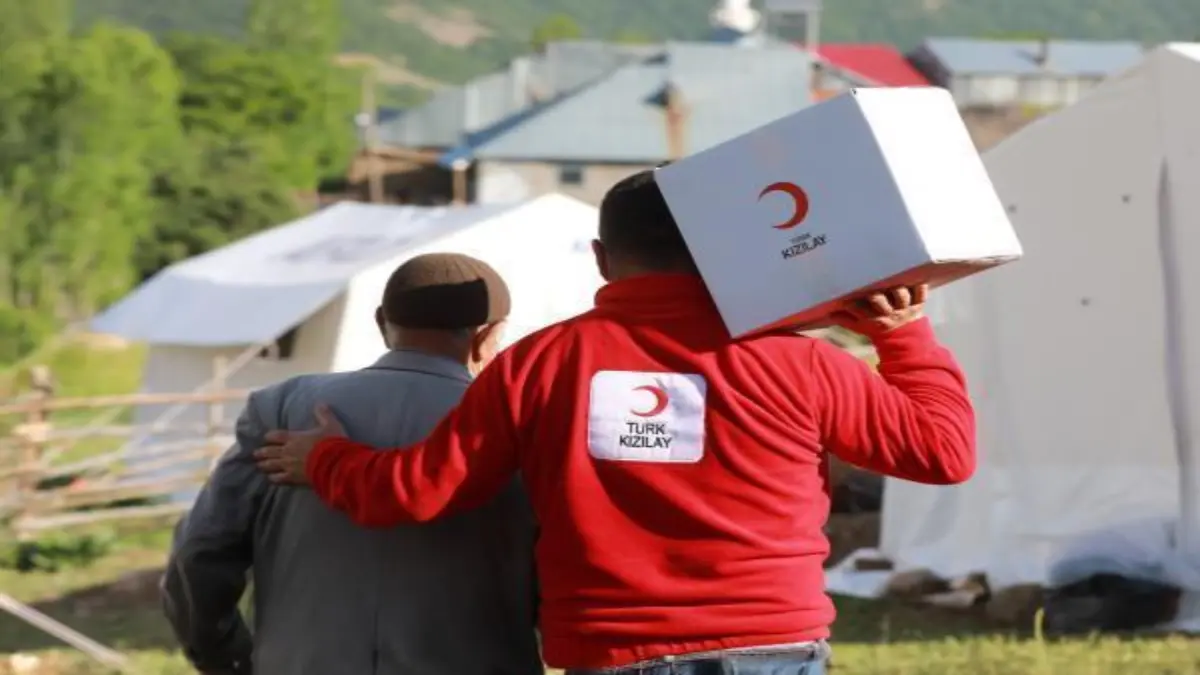
By Bosphorus News Türkiye Desk
The International Federation of Red Cross and Red Crescent Societies has published a final evaluation of the Türkiye earthquake response, praising the Turkish Red Crescent-led operation as a clear success while identifying gaps in data management, feedback systems and local branch involvement.
Dated October 2025 and posted publicly on 4 June 2026, the evaluation covers activities funded through the Türkiye Earthquake Response Emergency Appeal from 7 February 2023 to 28 February 2025, with a focus on six provinces where Turkish Red Crescent coordination offices operated. It prioritizes cash-based interventions, including multi-purpose cash, cash for protection and cash for livelihoods, with an emphasis on scalability, replicability and innovation.
The appeal followed the February 2023 earthquakes that killed more than 53,000 people, injured 107,000 and displaced 3 million. The evaluation says 15.7 million people were affected, including 1.8 million Syrian refugees, while agricultural losses were estimated at 6.4 billion dollars. The International Federation of Red Cross and Red Crescent Societies launched a 750 million Swiss franc emergency appeal on behalf of the Turkish Red Crescent, raising 500 million Swiss francs for shelter, health, food security, livelihoods, protection, water, sanitation and hygiene, and psychosocial support.
According to the evaluation, the Turkish Red Crescent mobilized its nationwide network to deliver assistance to 1.34 million people, while the International Federation coordinated the wider federation response, led shelter sector coordination and provided technical and surge support. More than 20 assessments informed the shift from emergency relief to recovery, with community service centers becoming central to resilience and capacity-building work.
The strongest operational figures show the scale of the response. More than 416 million hot meals were delivered, shelter support reached over 1.2 million people and around 1.7 million people received multi-purpose cash, cash for protection and cash for livelihoods support. The conclusion says beneficiary satisfaction reached 91 percent and describes the overall performance as highly effective, despite areas requiring improvement.
Cash assistance sits at the center of the findings. Cash and Voucher Assistance, or CVA, is described as the cornerstone of the Türkiye response, supported by the existing Kızılaykart and Emergency Social Safety Net infrastructure. That system allowed rapid and secure scale-up, with assistance moving from electronic vouchers to ESEN prepaid cards and later to ID-linked transfers, which are described as rapid, traceable and scalable.
The evaluation also presents the Turkish Red Crescent and International Federation partnership as a model of a nationally led response. The Turkish Red Crescent held the central operational role, while the federation provided technical support without taking over decision-making power. The document links that model to trust, shared leadership, strong operational systems and flexibility in adapting the appeal to Turkish Red Crescent recommendations.
The findings are not only positive. Centralized management limited the involvement of local branches and volunteers, even though volunteers played roles in some activities, including meal distribution. That reduced opportunities for deeper branch engagement and limited skill transfer at the local level. Staff well-being is also flagged as an area requiring improvement, with stronger protocols needed for personnel working under extreme conditions, including staff and volunteers who were themselves affected by the earthquake.
Data and accountability gaps appear repeatedly. Outdated lists, data silos, coordination delays and transparency gaps created strains in targeting and registration. Refugees and migrants faced political barriers to inclusion, while informal workers and refugees were excluded from livelihoods support. Communication gaps around container camp phase-outs also created uncertainty and anxiety in affected communities.
Information Management and Community Engagement and Accountability became major strengths during the response, with Power BI dashboards, SMS-based monitoring, call center systems, rumor tracking and community committees improving coordination and feedback. Yet outreach lacked clarity and accessibility in some areas, feedback and safeguarding mechanisms were underused, many people did not know safe channels to report concerns and the absence of a centralized public information platform reduced transparency.
The recommendations point to the next institutional test. They call for adaptive and decentralized leadership, stronger cross-sector coordination, better staff well-being protocols, wider use of ID-based cash transfer mechanisms, clearer community consultation before cash distributions, stronger safeguarding awareness, institutionalized community participation structures, pre-crisis data-sharing protocols with government and United Nations agencies, and harmonized internal data systems inside the Turkish Red Crescent.
The central finding is that Türkiye's earthquake response produced a strong national-society-led model that can inform future large-scale humanitarian operations. Its warning is just as important: scale alone is not enough. The next response will depend on whether the Turkish Red Crescent can turn the lessons of the 2023 earthquakes into deeper local branch capacity, cleaner data systems, clearer public information and stronger channels for affected people to shape how assistance reaches them.
***Read the evaluation: https://reliefweb.int/report/turkiye/final-evaluation-report-turkiye-earthquake-response-emergency-appeal-october-2025
Sources: International Federation of Red Cross and Red Crescent Societies final evaluation, ReliefWeb.