
By Bosphorus News Defense Desk
The Greek Government Council for Foreign Affairs and Defense, known as KYSEA, approved the acquisition of two Bergamini-class FREMM frigates from the Italian Navy on May 18, 2026. The council, chaired by Prime Minister Kyriakos Mitsotakis, simultaneously cleared an option for two additional vessels under a 2+2 structure, giving Athens room to expand without committing to four hulls immediately.
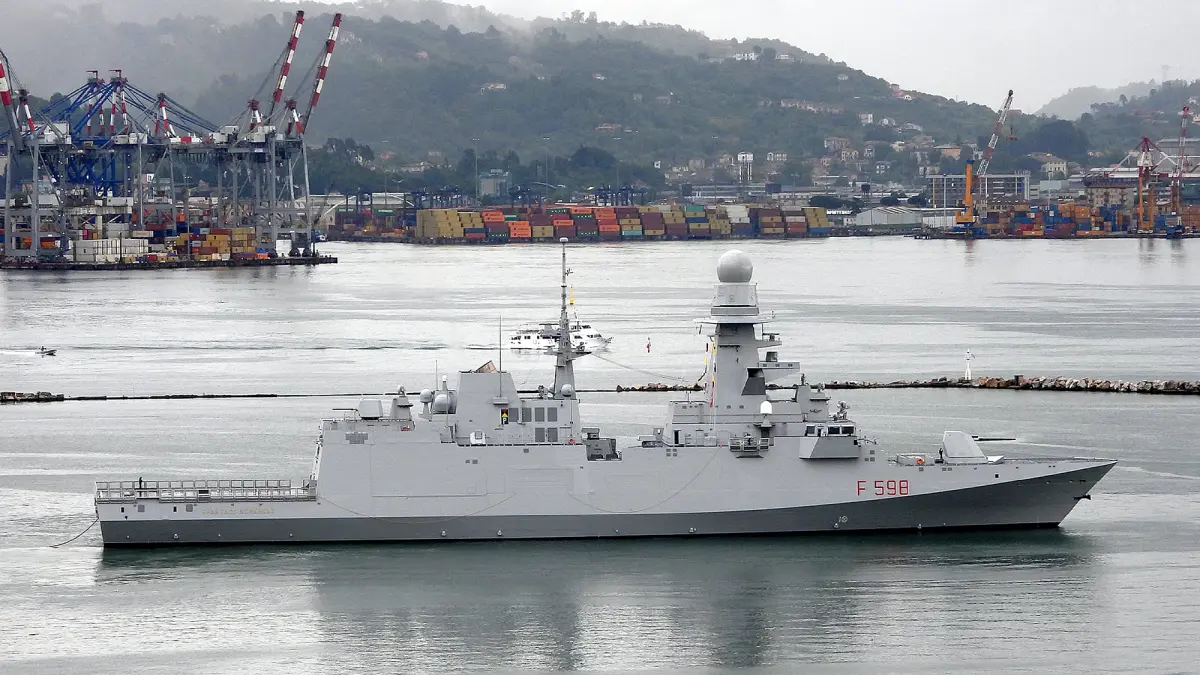
The two ships identified for transfer are ITS Carlo Bergamini (F 590) and ITS Virginio Fasan (F 591), both commissioned in 2013 under the Franco-Italian FREMM programme. FREMM stands for Fregata Europea Multi-Missione, a multi-mission warship designed for anti-submarine warfare, area air defense, and surface combat. Both remain in active Italian Navy service and will transfer once replacement FREMM EVO vessels enter Italian service, expected between 2029 and 2030. Delivery to the Hellenic Navy is scheduled between 2028 and 2029.
The first two frigates are priced at approximately 700 million euros, including primary weapons systems. An additional 110 million euros covers CAPTAS-4 towed sonar systems, a passive underwater detection array used for locating submarines at depth. The second pair has not been budgeted, but comparable pricing is expected if Greece exercises the option.
Two Ships, Two Roles
The Carlo Bergamini is the general-purpose variant of the class. It carries Sylver A50 launch systems for Aster 15 and Aster 30 surface-to-air missiles, eight Otomat Mk-2/A anti-ship missiles, a 127mm OTO Melara main gun, and Leonardo EMPAR multifunction radar.
The Virginio Fasan is the anti-submarine warfare variant. It is fitted with CAPTAS-4 variable-depth sonar, MILAS anti-submarine missiles, and MU90 lightweight torpedoes. The ASW configuration addresses one of the Hellenic Navy's most pressing operational needs: sustained submarine detection across the Aegean and Eastern Mediterranean.
Both ships displace between 6,500 and 6,900 tons, reach speeds above 27 knots, and operate helicopters equipped with dipping sonar, sonobuoys, and torpedoes. That helicopter capacity significantly extends underwater search coverage beyond the hull-mounted systems alone.
Greek Defense Minister Nikos Dendias has said he wants both frigates fitted with the next-generation ELSA missile, the same system planned for the French-built FDI Belharra frigates already joining the Hellenic Navy. Fincantieri confirmed the integration is technically feasible.
How the Deal Was Built
The process began formally at the SEAFUTURE 2025 naval exhibition in La Spezia on September 29, 2025. The national armaments directors of Italy and Greece signed a preliminary transfer agreement in the presence of Defense Ministers Dendias and Crosetto, and Italian Navy Chief of Staff Admiral Enrico Credendino. Fincantieri announced the agreement the same day.
Dendias described the vessels at the time as roughly decade-old ships in very good condition with high capabilities. Greek naval inspection teams subsequently evaluated three Bergamini-class frigates, examining propulsion systems, sonar architecture, maintenance condition, and remaining service life.
On March 9, 2026, Dendias told Kathimerini: "We hope that negotiations with Italy will be concluded and that we will have signed a deal for the acquisition of 2+2 frigates by April." The parliamentary armaments committee received a briefing on May 5. KYSEA approval followed on May 18.
The final contract will take one of two forms: a government-to-government agreement, or a direct commercial contract between Fincantieri and the Greek Ministry of Defence. The format has not been finalised.
Buying Time and Hull Numbers
Greece is not acquiring Italian frigates because they are the ideal long-term solution. It is acquiring them because waiting only for new construction would leave the Hellenic Navy short of hulls, endurance, and anti-submarine capacity through the late 2020s.
The Bergamini-class ships are 15 years newer than the oldest Elli-class frigates currently in Greek service. The Elli class, eight ships commissioned between 1978 and 1982, is being progressively retired. New-build equivalents would not enter service before the early 2030s. The Italian frigates close that window.
At the same KYSEA session, the council approved a MEKO 200HN modernization programme valued at approximately 290 million euros, covering the frigates Hydra, Spetsai, Psara, and Salamis. Work begins in 2027 and is scheduled for completion by 2030 at Skaramangas Shipyards in Athens. The council also endorsed the National Strategy for Unmanned Vehicles covering 2026 to 2030.
Fleet Structure
The target fleet combines four French FDI HN Belharra frigates, four Italian FREMM Bergamini frigates, and four upgraded MEKO 200HN frigates into a standardized 12-frigate force. The configuration is optimized for anti-submarine warfare, layered air defense, and sustained Eastern Mediterranean operations.
Dendias outlined the full naval modernization framework in 2025, budgeted at approximately 28 billion euros through 2036. It covers naval recapitalization, autonomous systems, anti-drone capability, and communications security.
The Türkiye factor is explicit in Greek defense planning. Ankara operates 24 frigates and is expanding its fleet under the Blue Homeland maritime doctrine, which asserts Türkiye's maritime rights in the Aegean and Eastern Mediterranean. In May 2026, a Turkish naval vessel intervened against a ship operated by Ocean Link, which was laying a fiber optic cable off the island of Astypalaia. The Greek frigate Adrias intervened and stopped the pressure. Ocean Link was operating under permits issued by Greek authorities.
Greece's submarine programme runs in parallel. Athens is equipping its four Papanikolis-class submarines with MdCN cruise missiles and new sonar systems, targeting an underwater advantage as Türkiye introduces six new Reis-class submarines and develops the indigenous MILDEN submarine programme.
If the full 2+2 FREMM plan is completed alongside the Belharra deliveries and MEKO upgrades, the Hellenic Navy will enter the early 2030s with a broader, younger, and more capable surface fleet than it has operated in decades.