
By Bosphorus Geopolitics Desk
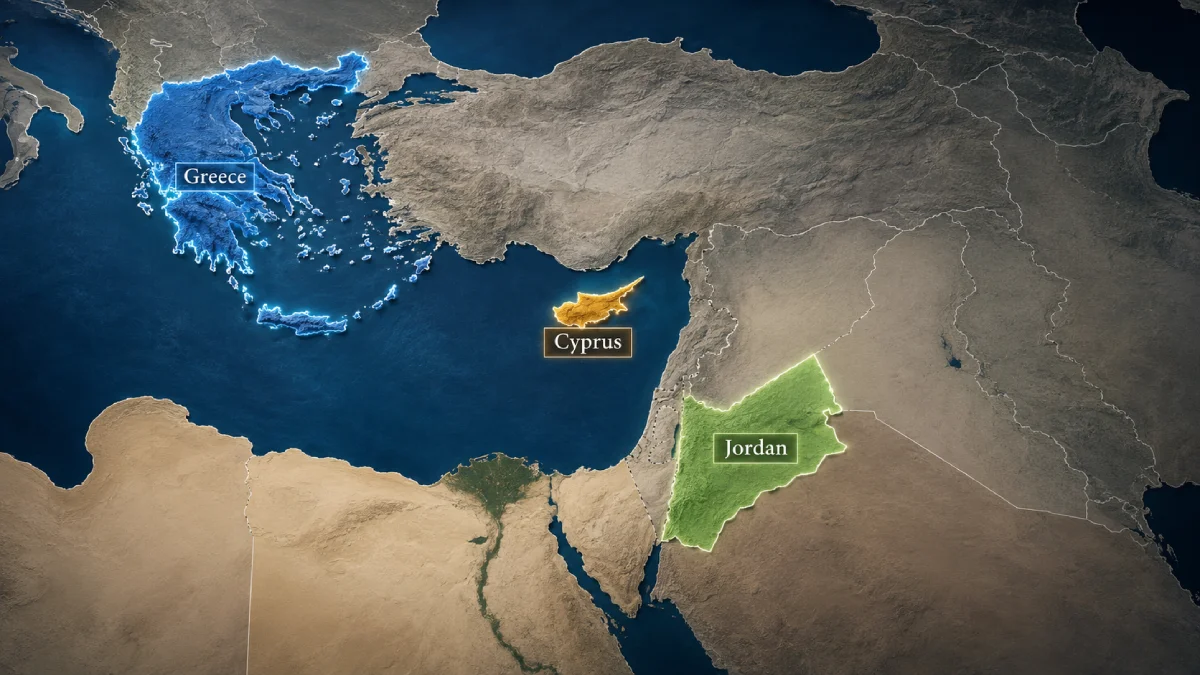
Greece, Cyprus and Jordan used their fifth trilateral summit in Amman to reaffirm the UN-backed federation framework for Cyprus while placing the Eastern Mediterranean inside a wider security and connectivity agenda stretching from trade routes and logistics to the Strait of Hormuz.
The declaration was issued after King Abdullah II, Republic of Cyprus President Nikos Christodoulides and Greek Prime Minister Kyriakos Mitsotakis met in the Jordanian capital on May 6. The text was published by the Greek Prime Minister's office and Jordan's Petra news agency as the formal joint communiqué of the trilateral summit.
The Cyprus section repeated language drawn from the United Nations framework, expressing support for a "just, comprehensive and viable settlement" in accordance with international law and relevant UN Security Council resolutions. The declaration said those resolutions provide for a bicommunal, bizonal federation and added that unilateral measures inconsistent with UN resolutions or international law must cease.
The text also reaffirmed support for the United Nations Peacekeeping Force in Cyprus, known as UNFICYP, saying the mission plays an important role in safeguarding peace and stability on the island. It added that a comprehensive settlement of the Cyprus issue would benefit the people of Cyprus and contribute to regional peace and stability.
The declaration was issued two days before Christodoulides met Turkish Cypriot President Tufan Erhürman in the UN buffer zone in Nicosia, where the two sides agreed on four practical steps but left the deeper disputes over format, status and political equality unresolved. The timing matters because the Amman text placed the federation formula inside a regional format that did not include the Turkish Cypriot side.
Erhürman has pushed a step-by-step approach and argued that practical issues in Nicosia should be addressed before the process is moved into another wider diplomatic format. Bosphorus News noted after the Nicosia meeting that Cyprus talks still return to the status dispute beneath every new UN move.
The federation language reflects the long-standing Greek and Greek Cypriot position inside a regional diplomatic structure that includes Jordan but not Turkish Cypriot representation. It does not alter the UN parameters, but it shows how the Cyprus settlement framework continues to be carried into regional platforms beyond the island itself.
The same declaration placed the Eastern Mediterranean in a broader economic and security frame. Greece, Cyprus and Jordan said they would increase cooperation in trade, energy, investment and culture, while strengthening supply chain resilience, trade route security, transport and logistics infrastructure.
The text described the Eastern Mediterranean as a "vital hub" linking Europe and the Arab region. That phrase gives the trilateral format a wider role than routine political consultation, because it links the region to economic interconnectivity, energy routes and the movement of goods between Europe and the Middle East. Bosphorus News previously examined how the Greece-Cyprus-Jordan framework is being used to position the Eastern Mediterranean as a Europe-Arab connectivity platform, a role reinforced by the Amman declaration.
The Hormuz clause gave the declaration an additional security dimension. The three countries called for sustaining the ceasefire between the United States and Iran and working toward a lasting solution that would respect international law, state sovereignty, non-interference in internal affairs and freedom of navigation in the Strait of Hormuz.
The Strait of Hormuz reference matters for Greece because of the role of Greek-owned shipping in global energy transport. It also matters for Cyprus because the island is increasingly being presented by Nicosia and its partners as a maritime, logistics and crisis-response node in the Eastern Mediterranean.
The declaration also welcomed Cyprus' assumption of the Presidency of the Council of the European Union on January 1, 2026, and backed the priorities of the Cypriot presidency, including stability and security in the Eastern Mediterranean, migration and asylum, cooperation with neighbouring regions and the green and digital transitions inside the European Union.
The text further welcomed the Pact for the Mediterranean as a framework for cooperation between the European Union and its Southern Neighbourhood. It also cited the Cyprus Regional Aerial Firefighting Station, launched in Paphos on April 23, as part of regional civil protection and disaster response cooperation.
The Amman declaration did not mention Türkiye. But it touched several files Ankara follows closely: Cyprus settlement language, maritime security, energy routes and the growing regional role of Greece and Cyprus in EU-linked Eastern Mediterranean formats.
That context widened in the same week, when Türkiye was reported to be preparing a maritime jurisdiction bill covering the Aegean and Eastern Mediterranean. Bosphorus News reported that the claimed draft legislation would move Türkiye's maritime position from diplomatic argument into domestic law, just as Greece, Cyprus and the European Union are trying to consolidate their own maps, energy plans and legal narratives.
The Amman text brings those layers into the same field of view. Cyprus appears through the familiar language of federation, UN resolutions and UNFICYP, while the wider Eastern Mediterranean is framed through energy, shipping, trade routes, logistics and crisis management. That combination gives the declaration its weight: Greece, Cyprus and Jordan used a regional format to restate the Cyprus framework while placing the island inside a broader security and connectivity agenda that now reaches from Nicosia to the Strait of Hormuz.