
By Bosphorus News Geopolitics Desk
The Opening Move
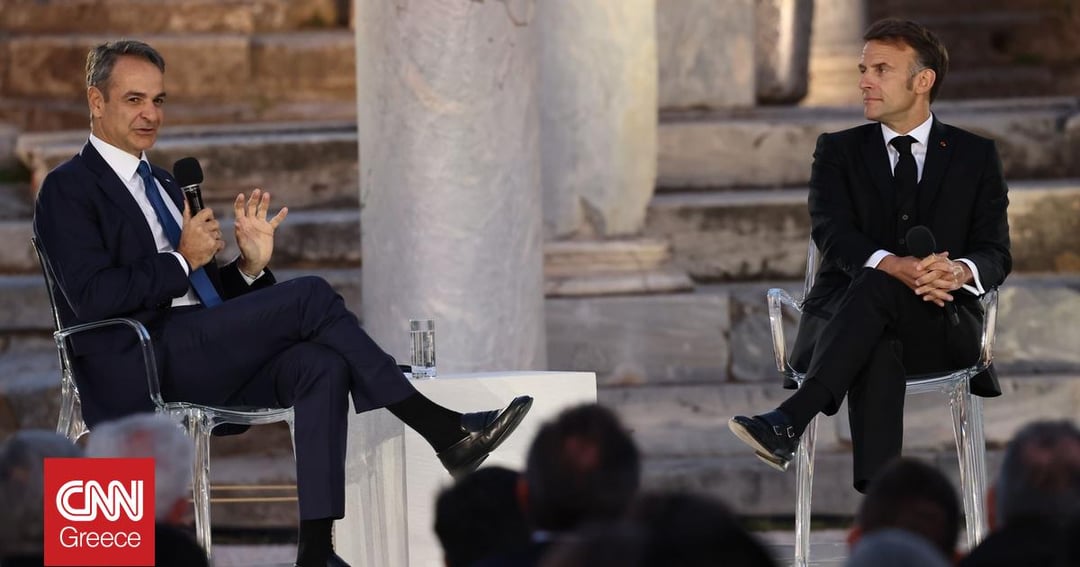
French President Emmanuel Macron arrived in Athens on April 24 for a two-day visit and left with nine signed agreements, a renewed defence pact and a statement that drew a sharp response from Ankara. Within days, Paris was walking it back. Asked what France would do if Greek sovereignty in the Aegean were challenged, Macron did not hesitate. "Don't even ask the question," he said. "Whatever happens, we will be there, by your side." He added: "If your sovereignty is threatened, do what you must do for yourself. And we will be there."
Macron did not name Türkiye, but the setting left little room for a neutral reading in Ankara. The France-Greece Enhanced Comprehensive Strategic Partnership, renewed in Athens on April 25, includes a mutual assistance clause covering threats to sovereignty. Both leaders described it as non-symbolic. Nine agreements span defence, energy, nuclear technology, missile system upgrades, digital ocean infrastructure and education.
The day after Athens, Macron visited Cyprus. Speaking on April 26, President Nikos Christodoulides confirmed what had been under negotiation for weeks. "Indeed, an agreement will be signed at ministerial level in June," he said, "which will provide for the presence of French forces in Cyprus for humanitarian purposes." The agreement is a Status of Forces Agreement (SOFA), a legal framework governing the conditions under which foreign military personnel may operate on another country's territory. It will formalise the basis for the presence of French military personnel and access to military facilities on the island. As Bosphorus News tracked in detail, the France-Greece axis has been expanding steadily since 2021, and the Cyprus dimension gives it a geographic anchor that extends well beyond bilateral cooperation.
Türkiye and TRNC Push Back
Türkiye's National Defense Ministry issued the week's sharpest statement on April 30. The ministry named France and Greece directly, saying scenario-based remarks by both NATO allies risk increasing tensions and damaging regional stability. The full position, as reported by Bosphorus News, was unambiguous: "In any situation involving security and stability, those who position themselves against Türkiye will not prevail, while those who act alongside Türkiye will." On Cyprus, the ministry recalled Türkiye's status as a guarantor power under international agreements and said the security rationale for a French deployment remained unclear. "Such steps could disturb the island's sensitive balance and raise tensions," it warned.
Turkish Republic of Northern Cyprus (TRNC) Prime Minister Ünal Üstel had already set the tone three days earlier. "The announcement that French troops will be deployed to southern Cyprus is an extremely dangerous, provocative and unacceptable step," he said in a formal statement on April 27. "What is expected of Macron and the EU is that they abandon their colonial mentality in approaching the Cyprus issue and adopt a fair stance."
TRNC National Assembly Speaker Ziya Öztürkler sharpened the language on April 28. "Let Macron know: it is not French soldiers but the presence of the Motherland Türkiye that determines the balance on this island," he said. "Do not try to set up new games under the shadow of your colonial past."
Paris Walks Back Macron's Türkiye Reading
The French Foreign Ministry responded on May 1. Spokesman Pascal Confavreux, speaking at a weekly press briefing, said Macron's Athens remarks had been misread. "The remarks were made in response to a general question about the possibility of an attack on a European country," he said. "This approach applies to all allies and partners. Türkiye was not specifically targeted."
Confavreux said France supports the ongoing dialogue between Greece and Türkiye and is committed to developing bilateral relations with Ankara. He pointed to a phone call between the two countries' presidents in April and diplomatic visits in February. Asked about Greek media coverage framing the Athens visit as a France-versus-Türkiye alliance, he declined to engage. "It is not our role to comment on press commentators," he said.
The correction was narrow, not strategic: the SOFA remains on schedule for June, French naval assets remain active in the Eastern Mediterranean, and the nine agreements signed in Athens remain in force.
What the Military Map Shows
Confavreux's press briefing did not alter what France has been building. As Bosphorus News analysis of the France-Greece partnership noted, the Athens-Paris axis now stretches from naval deployments to procurement, intelligence coordination and a pending SOFA on a divided island where Türkiye is a guarantor power.
NATO still relies on Türkiye's armed forces, its control of the Turkish Straits and its position on the alliance's southern flank. A SOFA in Nicosia does not change that. But as Bosphorus News reported on the widening EU-NATO defence gap, EU financing and procurement mechanisms are being constructed in formats that leave Ankara largely outside. Türkiye carries the operational commitments of a central NATO ally while European defence industry architecture is built around it, not with it.
Paris adjusted its framing on May 1. The military arrangements it is building did not move an inch. Ankara had stated its position plainly: "Those who position themselves against Türkiye will not prevail, while those who act alongside Türkiye will."
***Sources: TRNC Prime Ministry official statement, April 27, 2026. Türkiye National Defense Ministry briefing, April 30, 2026. Türkiye Gazetesi, May 1, 2026. Kibris Genc TV, April 28, 2026. Al-Monitor, April 30, 2026. Parapolitika.gr, April 28, 2026. Athens Times, April 24-25, 2026. Türkiye Today, April 25, 2026. Cyprus Mail, April 26-28, 2026. CBN Cyprus, April 26, 2026. Bosphorus News reporting.